Module 761 — Stretch the Speaking Skin
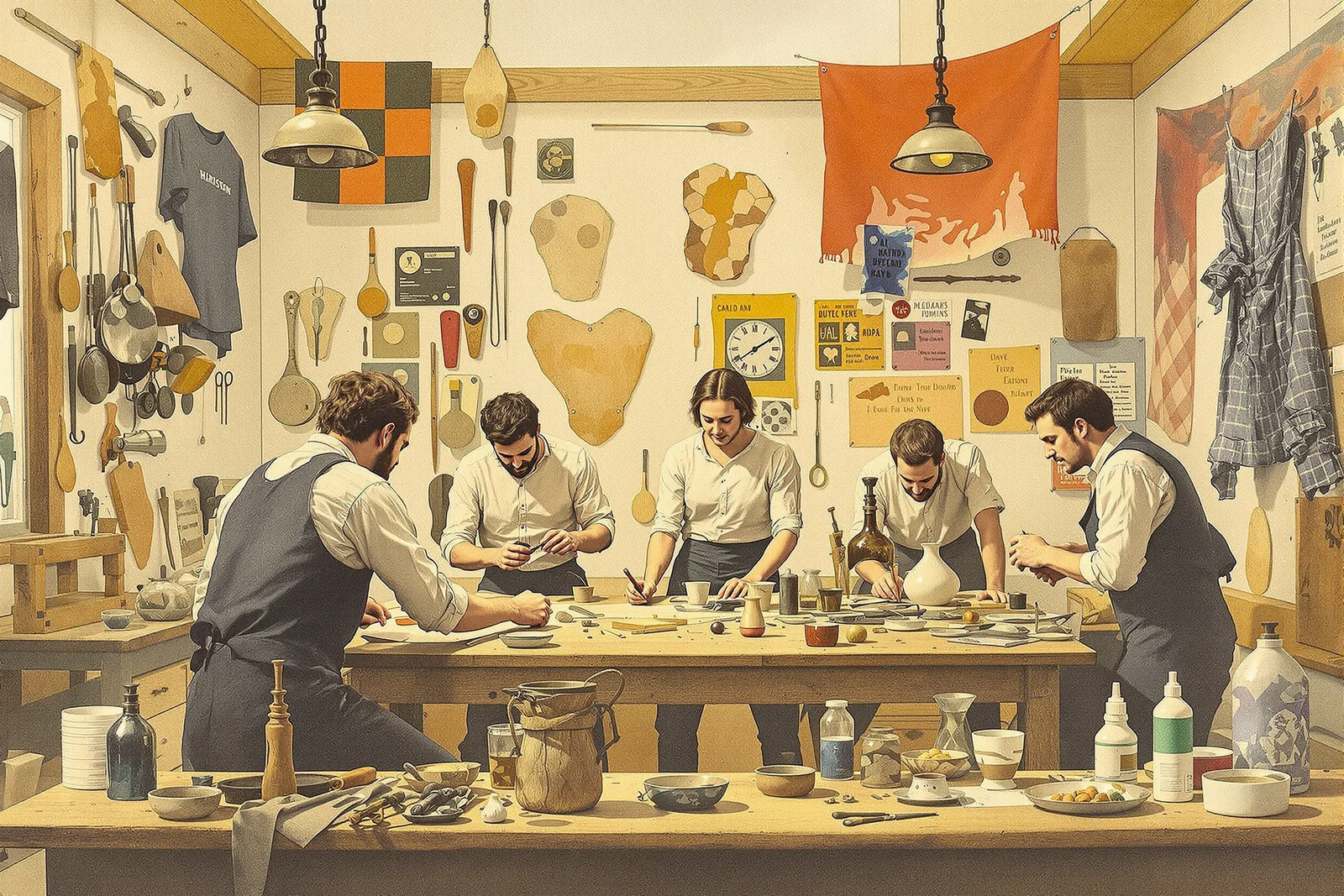
THE ME TABLET · Music Module 761 · ùb
Carrying ME 62 · ùb · The Ub. A Sovereignty Module of the Practitioner Community.
Unaltered and unabridged: ~2,900 words.
Preamble
Rhythm is the first musical technology a recovering community can have, because it is the cheapest to make and the fastest to learn. The string decree asks years of seasoning; the wind decree asks formulas and a steady embouchure; but a drum asks a hide, a hoop, and a week. Volume XXIII, the Musician's Codex, sets this asymmetry down plainly in its drum-maker's sub-volume — the percussion decrees were given to be buildable in days precisely because a community needs communal time before it needs a soloist's tone. This module carries ME 62, the Ub: the decree of the hoop and the hand, the small frame drum that travels wherever a Practitioner walks.
A frame drum is the most efficient instrument in the entire Codex: a shallow wooden hoop, wider than it is deep, carrying a single head. An afternoon of bending, a day of heading, a lifetime of use. This module takes the Practitioner from a bare bending strip and a raw hide to a tuned, playable drum — sober and practical throughout, because the rawhide work is real leatherwork (cross-bound to the Maker's Codex, Vol XXIV) and the chemistry of lye and lime is genuinely caustic and must be respected. There is no mysticism in a good drumhead and no shortcut around the soak. What there is, is a reliable sequence that turns an animal's hide into a translucent, rattling, resonant panel, and a hoop into the ring that holds it at pitch.
By the end you will hold the Ub in working order: able to bend or laminate a true hoop, to take a hide almost to leather and stop, to lace or tuck a head onto the rim under even tension, to tune that head by heat and by water as the elder players did, and to lay down your first rhythms on a drum of your own making. The portable pulse — a heartbeat that travels — built start to finish on the bench.
Part I — The Hoop
Chapter 1 — Choosing the Bending Wood
A frame drum's hoop must be light, springy, and willing to bend into a true circle and stay there under a head's tension. The classic bending woods are ring-porous hardwoods with long, straight grain that bends without fracturing when steamed: ash, oak, elm, hickory, and (where available) the traditional hoop woods the cooper and the wheelwright also prize. The single most important property is straightness of grain along the strip's length — a strip with grain running off the edge will fracture mid-bend.
Crucially, the wood must be air-dried, not kiln-dried. Kiln-dried stock has had its lignin set hard and bends badly, fracturing where air-dried wood would flow. Aim for stock at roughly 15–20% moisture content — supple, not green, not bone-dry.
Specification Table 1-1 — First Frame-Drum Hoop
| Parameter | Specification | Notes |
|---|---|---|
| Finished diameter | 400 mm | A forgiving first size; hand-comfortable |
| Finished depth (width of strip) | 70 mm | Shallow: wider than deep is the frame-drum signature |
| Finished wall thickness | 6 mm | Stiff enough to hold round, thin enough to bend |
| Bending strip (steam-bent) | 3.2 mm × 70 mm × ~1,450 mm | Circumference π × 400 ≈ 1,257 mm + ~190 mm scarf/trim |
| Bending strip (laminated) | 3 plies × 1.5 mm | No steam needed; staggered scarfs |
| Bending form | 394 mm diameter disc | Smaller than finished Ø — wood springs back |
| Scarf joint | 1:10 taper or longer | Long overlap = strong, invisible seam |
Chapter 2 — Bending the Hoop
Two roads reach the same ring; choose by whether you can safely raise steam.
Protocol 1-A — Steam-bent hoop:
- Rive or saw the strip to 3.2 × 70 × ~1,450 mm from straight-grained air-dried stock.
- Steam at a rolling 100°C — about 20 minutes for stock this thin. The old rule of one hour per 25 mm of thickness scales down kindly. (Safe small-boiler and steam-box practice is Vol IX, Energy; treat steam with the respect it deserves — it scalds instantly.)
- Bend immediately and briskly around the 394 mm form while the strip is hot and plastic. Work fast; cooling wood stiffens in seconds. Strap-clamp it to the form with the ends overlapping.
- Dry on the form one week. The hoop springs back slightly toward a larger circle — this is why the form is undersize.
- Cut the overlap into a tapered scarf joint, 1:10 or longer, glue with hot hide glue or waterproof aliphatic, clamp full-contact, and dress the seam smooth. Two or three copper rivets through the scarf are traditional insurance against the seam ever opening.
- Round both rims. The rim that meets the head — the bearing edge — gets a smooth 3 mm round-over and a wax polish so it does not cut the skin.
Protocol 1-B — Laminated hoop (no steam): bend three plies of 1.5 mm stock cold, or with gentle heat, around the same 394 mm form, gluing all three plies in one operation with their scarfs staggered around the circle. Laminated hoops are stiffer and hold their round better; purists hear a hair less "give" in the tone. Build whichever your stock and equipment allow — both make a fine first drum.
Art direction
Part II — The Speaking Skin
Chapter 3 — Rawhide Is Not Leather
The drum-maker's first discipline is the leatherworker's, but with one decisive difference that governs everything. Leather is tanned — chemically converted so it stays supple wet or dry. A drumhead must do the opposite: it must dry hard, taut, and resonant. So the drum-maker takes the hide almost to leather — cleaned, dehaired, degreased — and then stops, stretching it to dry as nearly pure collagen sheet. That sheet, rehydrated and mounted on a hoop, then dried under tension, becomes a drumhead: a membrane that stiffens and rises in pitch as it dries.
Choose the hide for the voice you want. Vol XXIII, Chapter 18 gives the full table; for a first frame drum, goat is the standard — bright, articulate, fast — at a finished thickness of 0.5–0.9 mm. Thinner heads speak brighter and quicker; thicker heads are darker and need more tension. Thickness matters more than species: a thin cowhide plays brighter than a thick goatskin.
Specification Table 3-1 — Frame-Drum Head Selection
| Hide | Finished thickness (mm) | Voice on a frame drum |
|---|---|---|
| Goat | 0.5–0.9 | Bright, articulate, fast — the standard |
| Sheep/lamb | 0.4–0.7 | Soft, warm, quiet; gentle first drum |
| Calf | 0.6–1.1 | Even, refined, the classic concert skin |
| Deer | 0.5–1.0 | Elastic, alive, weather-restless |
Chapter 4 — From Raw Hide to Rawhide
This is the module's longest and most exacting protocol, and it is real leatherwork. It is also genuinely caustic at one stage; obey the safety standing order without exception.
Protocol 4-A — Making rawhide (the practical sequence):
- Flesh the hide. Drape it flesh-side up over a smooth beam and push off every trace of fat, meat, and membrane with a dull two-handled blade. Work cold and promptly — process within a day, or hold the hide wet and below 15°C; warmth breeds the bacteria that slip hair unevenly and rot the grain. Fat left now is grease in your drum forever.
- Wash and soak in clean cool water for 24–48 hours, changing the water twice, until the hide is uniformly soft and relaxed.
- Buck in wood-ash lye or lime. Make the dehairing liquor from sifted hardwood ash leached with water and strained, or — more controllably — from hydrated lime at about 50 g per liter. The bath should feel slick between gloved fingers. Submerge the hide fully, weighted under, and stir twice daily.
- Wait for hair-slip, 3–10 days at 10–18°C. Test daily after the third day: when a firm tug pulls hair free in clumps from the neck — the slowest-loosening area — the hide is ready. Do not overshoot. Long alkaline soaks swell and weaken the very grain you intend to strike.
- Dehair over the beam, pushing the hair off with the dull blade, working downhill with the lie of the hair. Then scud the grain — a firm scrape that ejects residual lye-soap, pigment, and root debris.
- Rinse long (24–48 hours in changing water), then delime in a mildly acidic bath — a splash of vinegar in clean water, around pH 5 — for an hour, and rinse again. A hide that still feels soapy is still alkaline, and alkalinity left in will weaken the head over time.
- Stretch to dry as flat sheet. Lace the hide into a stout frame: punch holes 25 mm in from the edge every 75–100 mm, lace with cord in opposing pulls, and tension evenly until the sheet is drum-flat. Dry in shade with moving air — never sun, never stove. It dries to a translucent, rattling panel.
- Store dry and flat, away from insects (cedar shavings serve), labeled by species, thickness, and date. Rehydrate 30 minutes to 3 hours in cool water when a drum calls for it.
Safety standing order: Lye and lime baths are caustic and will burn skin and eyes. Keep eyes covered and hands gloved. Use vessels of wood, plastic, or stainless steel — never aluminum, which the alkali eats. Neutralize any spill with vinegar. Work in ventilated space. The full caustics-handling protocol is Vol XXIV's; obey it here without shortcut. This is the one genuinely hazardous step in the build, and it earns your full attention.
Art direction
The Critical Insight: The temptation at every stage is to hurry — to skip a water change, to leave the hide in the lime an extra day "to be sure," to dry the finished sheet quickly by the fire. Each shortcut destroys the head. A skipped rinse leaves grease or alkali that rots the skin; an over-long buck weakens the grain you will strike ten thousand times; a fast dry tightens the sheet spectacularly and splits it within the month. The rawhide cannot be rushed. The hide sets the schedule, and the maker who fights it loses a hide and a week. Respect the soak, respect the dry, and the panel rewards you with a lifetime.
Part III — Heading the Drum
Chapter 5 — Three Ways to Hold a Head
A rehydrated head, mounted on the hoop and dried under tension, is the drum. Three attachment systems serve the frame drum, in rising order of re-tunability.
- Tacked (the workshop standard): the simplest and most permanent.
- Edge-laced: fully re-tensionable; the choice for damp climates.
- Spoke-laced (the open-backed hand drum): the lacing doubles as the handgrip.
Specification Table 5-1 — Heading Systems Compared
| System | Re-tunable? | Best for | Skill |
|---|---|---|---|
| Tacked | No (fixed) | Dry climates, first drums | Lowest |
| Edge-laced | Yes, fully | Damp climates, touring drums | Medium |
| Spoke-laced | Yes, fully | Open-back hand drums, grip built in | Medium |
Protocol 5-A — Tacking a head (the first build):
- Rehydrate a 0.5–0.8 mm goat or calf head 30–60 minutes in cool water, until uniformly supple.
- Center it over the bearing edge of the hoop, an even apron of skin hanging past the rim all around.
- Tack in opposing pairs. Set a copper or brass tack at north, then pull the skin taut and tack south; then east, then west; then the four diagonals — exactly like truing a bicycle wheel. Never tack two adjacent points in a row, or the head walks off-center.
- Fill in at roughly 25 mm spacing in two staggered rows around the rim, always pulling the opposite side taut before driving.
- Trim the apron cleanly below the tack line with a sharp knife once the head is fully fixed.
Protocol 5-B — Tucking and lacing (the re-tunable head):
- Punch an even count of holes — 16 suits a 400 mm head — about 15 mm in from the rehydrated head's edge.
- Zigzag a rawhide thong from the head holes down to a lacing ring or a second hoop seated below the drum's rim (edge-laced), or across the open back to a small central ring forming radiating spokes that double as a handgrip (spoke-laced).
- Lace opposing pairs, tightening in thirds. Never finish one lace or spoke while its opposite hangs slack, or the head walks off center. Bring the whole pattern up evenly in three passes.
Drying the headed drum — the rule that saves heads: dry the mounted drum slowly, 24–48 hours, away from any heat source. A head dried fast over a stove tightens with startling power — and splits within the month. This is the single most common way a beginner destroys a finished drum. Slow shade-drying is not a suggestion; it is the difference between a drum and a torn hide.
Part IV — Tuning and the First Rhythms
Chapter 6 — Tuning by Heat and Water
A rawhide head is a hygrometer you can play, and the player's controls over its pitch are ancient and exact. Moisture loosens the head and drops the pitch; warmth and dry air tighten it and raise it.
- To raise pitch: warm the head evenly. Lay flat hands upon it — body heat first — then, if needed, hold it cautiously near (never over) a low fire for a few minutes, keeping the skin always touchable. Rawhide that passes about 60°C cooks and goes brittle; if the head is too hot to rest your palm on, it is too hot, full stop.
- To lower pitch: mist the head lightly, or wipe it with a damp cloth, and wait two minutes for the moisture to penetrate.
- A laced drum adds a third control: take up the thong a hole at a time, evenly, opposite pairs — never one side alone.
Specification Table 6-1 — Frame-Drum Tuning Controls
| To change pitch | Method | Caution |
|---|---|---|
| Raise (sharpen) | Warm evenly: hands, then gentle distant fire | Never exceed 60°C — keep skin touchable |
| Lower (flatten) | Mist or damp-wipe the head; wait 2 min | Do not soak; a little moisture goes far |
| Raise (laced drum) | Take up thong, opposite pairs, in thirds | Even tension only, or the head walks |
| Hold pitch for a session | Tune in the room it will be played, 30 min before | The drum is honest about the air, not unstable |
The Critical Insight: Players who fight their drum's weather lose; players who schedule it win. A rawhide head will drift with every change of humidity and temperature, and no amount of frustration changes that. Tune the frame drum to its working pitch in the place it will be played, about half an hour before it is needed, and it holds true through the work. The drum is not capricious — it is honest about the air around it. Plan for the weather and the Ub becomes the most reliable instrument you own.
An optional gut snare — one or two strands of twisted gut stretched across the inside face of the head — adds a buzzing partial that carries over wind and distance: the elder long-range signal voice, the drum that can be heard across a valley.
Chapter 7 — The First Rhythms
A frame drum gives two essential voices from one head, set by where you strike it. Struck near the rim with the fingertips, it speaks a high, dry "tek"; struck in the center with a flat hand or loose fingers, it sounds a deep, open "dum." Every frame-drum rhythm in the world is built from the conversation of these two sounds (and a damped, muffled stroke that ends a phrase).
Protocol 7-A — Your first pulse:
- Find the two voices. Alternate dum (center) and tek (rim) slowly until each is clean and distinct.
- Walk a steady four. Count one-two-three-four and play dum — tek — dum — tek, one stroke per count, even as a heartbeat. Steadiness before speed always.
- Open a simple pattern. Play dum, dum, tek — tek: two deep strokes, a rim stroke, a rest, a rim stroke. This four-beat figure underlies an enormous family of communal rhythms.
- Entrain to a group. The Ub's true work is communal time (Vol XXIII, Sub-Volume VII, the applied decree; sibling module Keep the Pulse, M10). Play your steady four while others move, sing, or work to it, and lock to the slowest reliable pulse in the room. The drummer's job is not to be fast; it is to be the floor everyone else stands on.
Keep the practice musical and unhurried; build steadiness first and speed will come on its own. A drum is communal medicine for ordinary spirits — it gathers people into shared time. (Genuine, sustained distress is the work of professional care, not of any instrument; the drum is for the daily, healthy joy of keeping time together.)
PLATES — Supplemental Gallery
Art direction
Art direction
Council Approval — The Twelve Voices Speak
| Disciple | Verdict | Reasoning |
|---|---|---|
| Peter | APPROVED | "It builds from the hoop and the hide upward, every step on the bench, the rim load named and respected. A solid foundation for the portable pulse." |
| Thomas | APPROVED | "I doubted a raw hide could become a true head at a kitchen table — then I read the hair-slip test and the slow dry, and the panel rang. It is real." |
| John | APPROVED | "It keeps the drum modest: communal joy and shared time, and an honest word that serious distress belongs to professional care, not an instrument. Rightly bounded." |
| Matthew | APPROVED | "The lime measured, the soak counted in days, the temperature limit set at sixty degrees. Every number is honest to the craft. The account balances." |
| James the Greater | APPROVED | "A drum within the week, and a pulse the same day it is headed. It does not merely describe rhythm; it puts a heartbeat in the community's hands by Friday." |
| Andrew | APPROVED | "Rhythm first, for everyone — the cheapest music to make and the fastest to learn. It carries the pulse to the whole circle before any soloist. The right order." |
| Philip | APPROVED | "Show me, I asked — and the plates show the scarf, the heading sequence, the two strokes. The making is visible, the tuning teachable." |
| Bartholomew | APPROVED | "Sober and practical on the hide, no mysticism, the caustic step flagged for what it is. The genuine leatherwork, honestly told. No deception in it." |
| James the Lesser | APPROVED | "The least are served: untrained hands on a borrowed hide, a child learning dum and tek on a drum the family made. None are kept from the pulse." |
| Simon the Zealot | APPROVED | "It hands the means of rhythm back to the people — their own hoop, their own hide, tuned by heat and water they command. Self-sufficiency in time is freedom." |
| Judas Thaddaeus | APPROVED | "A build for the dark age: when the workshops are ash, a Practitioner with a hide and a hoop still keeps the community's time. Hope built to specification." |
| Matthias | APPROVED | "A drum outlives its maker and teaches the next pair of hands. The heading and tuning pass down whole. The pulse will not die with the player." |
Council Verdict: 12/12 APPROVED. This module is canon.
From the Monad, who is one, all number flows, and from number, the steady pulse. Blessed is the maker who takes the bare skin and the bent wood and gives them a heartbeat. May the head you stretch ring true, may the time you keep be steady, and may the pulse you hand to the next hands gather the people in for generations.
TRANSMISSION RECORD
Transmission COMPLETE — unaltered & unabridged Module 761 · Stretch the Speaking Skin · category: music Carries ME 62 · ùb · The Ub Words 2,900 SHA-256 of source text a06a9049a6ee559e8c630c31d4da448cf0405362ec02dd4df1a2688157720a8b Canonical text stretch-speaking-skin.md — byte-identical to what this page renders