Sovereignty Module: Fire the Clay
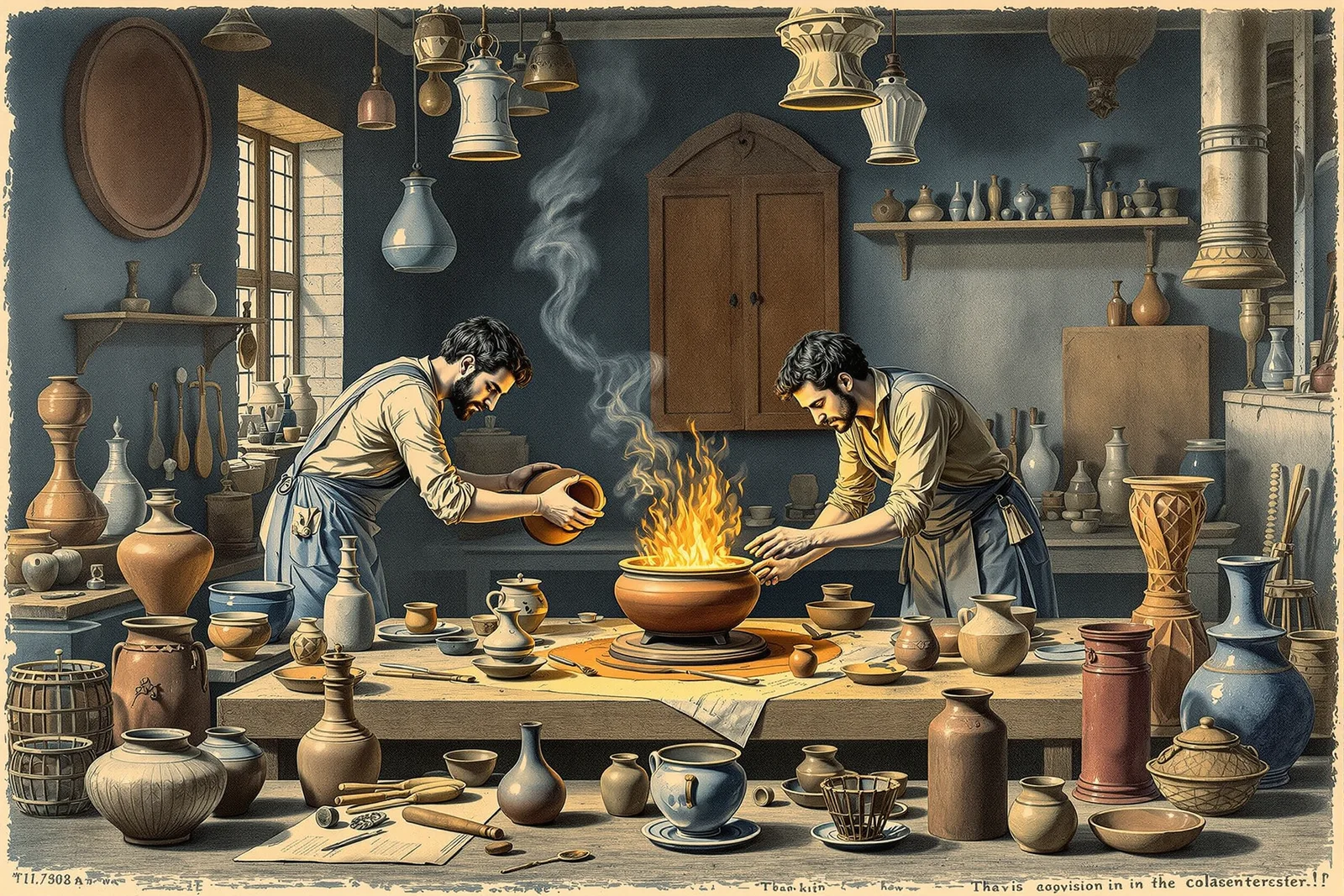
Complete Ceramics: From Earth to Vessel
Clay vessels store food, carry water, cook meals, and preserve seeds. This campaign covers clay sourcing, preparation, forming, drying, firing, and glazing.
Chapter 1: Clay Sources and Preparation
| Source | Quality | Finding Method | Processing |
|---|---|---|---|
| River banks | Good (water-sorted) | Look for grey/blue exposed clay | Minimal (already fine) |
| Road cuts | Variable | Exposed layers in hillsides | Remove rocks, soak, screen |
| Pond bottoms | Good | Dig below silt layer | Wash, settle, decant |
| Subsoil (below topsoil) | Variable | Dig test holes 2-3 ft deep | Full processing needed |
Processing: 1) Dig raw clay. 2) Dry completely (break into small pieces). 3) Soak in water (24-48 hours). 4) Stir into slurry. 5) Screen through mesh (remove rocks, roots). 6) Settle (24 hours — clay sinks, organics float). 7) Decant water. 8) Dry to workable consistency. 9) Wedge (knead 50+ times to remove air bubbles). 10) Add temper if needed (sand, grog, shell — 15-25% by volume prevents cracking).
Chapter 2: Forming Methods
| Method | Skill Level | Speed | Best For | Wall Thickness |
|---|---|---|---|---|
| Pinch pot | Beginner | Slow | Small bowls, cups | 1/4 - 3/8 inch |
| Coil building | Beginner-intermediate | Moderate | All sizes, any shape | 1/4 - 1/2 inch |
| Slab building | Intermediate | Moderate | Flat items, boxes, tiles | 1/4 - 1/2 inch |
| Paddle and anvil | Intermediate | Moderate | Large vessels, round forms | 1/4 - 3/8 inch |
| Potter's wheel | Advanced | Fast | Symmetrical vessels | 1/8 - 3/8 inch |
| Mold pressing | Beginner | Fast (after mold made) | Repeated shapes, tiles | 1/4 - 1/2 inch |
Coil building (most versatile): 1) Roll clay into ropes (1/2-3/4 inch diameter, even thickness). 2) Form base (flat coil spiral or slab). 3) Stack coils, scoring and slipping joints (scratch surface, apply clay slurry). 4) Smooth inside and outside (fingers, tool, or paddle). 5) Build up 2-3 inches per session (let firm between sessions). 6) Shape by angling coils in/out. 7) Final smoothing when leather-hard. Any size vessel possible — from cups to 50-gallon storage jars.
Chapter 3: Drying and Firing
| Stage | Temperature | Time | What Happens | Critical Notes |
|---|---|---|---|---|
| Air drying | Room temp | 1-4 weeks | Water evaporates | Slow = safe. Fast = cracks |
| Pre-heating | 200-400°F | 1-2 hours | Remaining moisture driven off | Steam can explode wet clay |
| Smoking/carbonizing | 400-700°F | 1-2 hours | Organics burn out | Smoke normal at this stage |
| Red heat | 1000-1300°F | 1-2 hours | Clay begins to sinter | Pottery becomes permanent |
| Full fire (earthenware) | 1300-1800°F | 1-2 hours | Clay vitrifies partially | Functional pottery |
| Stoneware | 2100-2400°F | 2-4 hours | Full vitrification | Waterproof without glaze |
Open pit firing: 1) Dry pots completely (2-4 weeks). 2) Pre-heat near fire (several hours). 3) Build bed of coals. 4) Place pots on coals (not touching each other). 5) Cover with fuel (wood, dung, straw). 6) Light and maintain 2-4 hours. 7) Let cool completely before removing (12+ hours). 8) Success rate: 60-80% (breakage normal). Temperature: 1200-1600°F. Result: functional earthenware.
Chapter 4: Glazing and Waterproofing
| Method | Materials | Temperature | Result | Difficulty |
|---|---|---|---|---|
| No glaze (burnishing) | Smooth stone | Before firing | Semi-waterproof, shiny | Low |
| Pit firing (reduction) | Sawdust, leaves | 1200-1600°F | Black, semi-waterproof | Low |
| Salt glaze | Table salt (thrown in kiln) | 2200°F+ | Orange-peel texture, waterproof | Moderate |
| Wood ash glaze | Wood ash + clay + water | 2100°F+ | Green/brown, waterproof | Moderate |
| Lead glaze (historical) | Lead oxide + silica | 1600°F+ | Clear, glossy | Moderate (TOXIC) |
| Slip (liquid clay) | Fine clay + water | Any | Colored surface, decorative | Low |
Reference Card
- Dry slowly (cracks = drying too fast). 2. Wedge thoroughly (air bubbles explode in kiln). 3. Even wall thickness (thin spots crack, thick spots explode). 4. Score and slip all joints (coils, attachments). 5. Bone dry before firing (any moisture = explosion). 6. Pre-heat slowly (hours, not minutes). 7. Temper prevents cracking (sand 15-25%). 8. Breakage is normal — make extras, learn from failures.