Sovereignty Module: Mark the Line
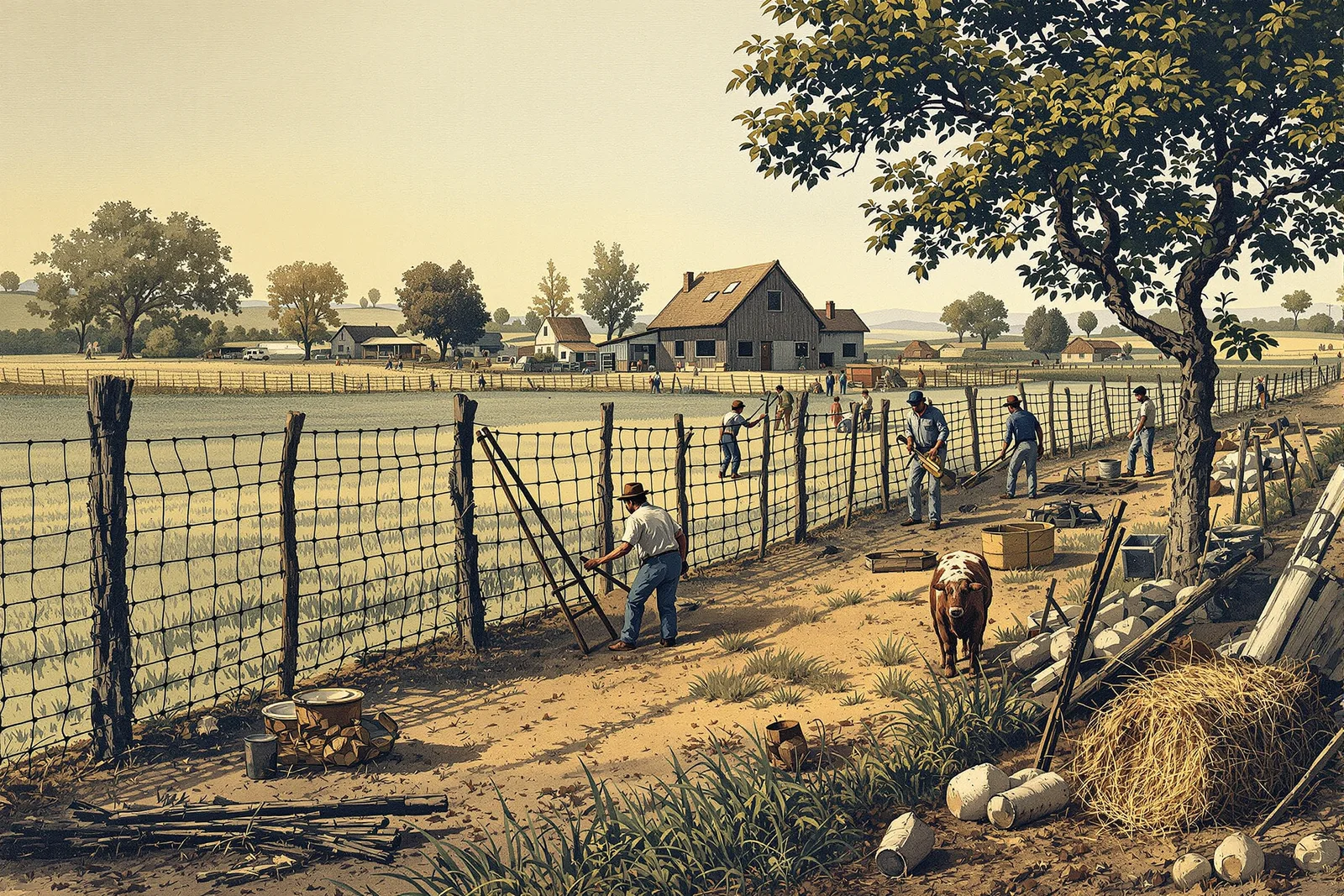
Complete Fence Building, Property Boundaries, and Livestock Containment Guide
Fences define civilization: they separate wild from tame, yours from theirs, garden from grazing. This campaign covers every fence type from simple brush barriers to permanent post-and-rail systems.
Chapter 1: Fence Types Compared
| Type | Height | Lifespan | Difficulty | Materials | Best For |
|---|---|---|---|---|---|
| Brush fence (dead hedge) | 3-5 ft | 3-7 years | Very low | Brush, branches, stakes | Gardens, temporary |
| Wattle fence | 3-5 ft | 5-10 years | Low-moderate | Flexible saplings (willow, hazel) | Gardens, livestock |
| Split rail (zigzag/worm) | 4-5 ft | 20-50 years | Moderate | Straight-grained logs (cedar, oak) | Livestock, boundaries |
| Post and rail | 4-5 ft | 15-30 years | Moderate | Posts + rails (any durable wood) | Livestock, horses |
| Picket fence | 3-4 ft | 10-20 years | Moderate | Sawn boards, posts | Gardens, yards |
| Stone wall (dry stack) | 3-5 ft | 100+ years | High | Field stone | Permanent boundaries |
| Living fence (hedge) | 4-8 ft | Indefinite | Low (patience) | Osage orange, hawthorn, multiflora | Permanent, self-maintaining |
| Barbed wire | 4-5 ft | 20-40 years | Low | Wire, posts | Large pastures (modern) |
Chapter 2: Post Setting
| Method | Depth | Best For | Lifespan | Details |
|---|---|---|---|---|
| Direct burial (tamped earth) | 1/3 of total length | Most situations | 5-15 years | Dig hole, set post, tamp earth in layers |
| Gravel fill | 1/3 of total length | Wet areas (drainage) | 10-20 years | 4-6 inches gravel at bottom, around post |
| Charring post base | Same | All situations | 15-25 years | Char bottom 6 inches in fire (seals against rot) |
| Rock packing | 1/3 of total length | Rocky soil | 15-30 years | Pack large rocks tightly around post |
| Deadman anchor | 2-3 ft | Corner/gate posts | 20+ years | Buried horizontal log tied to post base |
Post depth rule: bury 1/3 of total post length. A 6-foot fence needs 9-foot posts (3 feet buried). Corner posts and gate posts: set deeper and brace.
Chapter 3: Split Rail Fence (Virginia Worm Fence)
| Step | Action | Details |
|---|---|---|
| 1 | Select straight-grained logs: cedar, locust, oak, chestnut | 8-12 feet long, 6-10 inch diameter |
| 2 | Split with wedges and maul: halves, then quarters | Grain must be straight (splits clean) |
| 3 | Lay first course: zigzag pattern at 120° angles | Each rail overlaps the next by 6-12 inches |
| 4 | Stack subsequent courses: same zigzag, stacked at joints | 8-10 rails high = 4-5 foot fence |
| 5 | Stake at joints (optional): crossed stakes hold stack stable | Driven into ground, cross above top rail |
Advantages: No post holes needed. No nails or hardware. Easily relocated. Uses crooked timber. Self-bracing. Disadvantage: uses 2-3x more wood than post-and-rail. Takes more land (zigzag footprint).
Chapter 4: Wattle Fence Construction
| Step | Action | Details |
|---|---|---|
| 1 | Drive stakes: 2-3 inch diameter, 18 inches apart, 18 inches deep | Straight line or gentle curve |
| 2 | Weave horizontal weavers: flexible saplings (willow, hazel) | Alternate in front/behind each stake |
| 3 | Pack down each row tightly before adding next | Push down firmly — gaps weaken fence |
| 4 | Alternate starting side with each row | Creates balanced weave |
| 5 | Continue to desired height (3-5 feet typical) | Top with thicker rod for strength |
Best weaving materials: Willow (most flexible, fast-growing, coppices well), hazel, dogwood, privet. Harvest in winter (dormant, no leaves, most flexible). Wattle panels can be pre-made and installed between posts.
Chapter 5: Living Fence (Hedge)
| Species | Growth Rate | Thorns | Density | Climate | Stock-Proof? |
|---|---|---|---|---|---|
| Osage orange | Fast | Severe | Very dense | Temperate (US) | Yes (impenetrable) |
| Hawthorn | Moderate | Sharp | Dense | Temperate (Europe/US) | Yes |
| Holly | Slow | Sharp leaves | Very dense | Temperate (mild) | Yes |
| Privet | Fast | None | Dense | Temperate | No (decorative only) |
| Blackthorn/sloe | Moderate | Severe | Very dense | Temperate (Europe) | Yes |
| Multiflora rose | Very fast | Sharp | Very dense | Temperate | Yes (invasive — caution) |
| Bamboo | Very fast | None | Impenetrable | Tropical/subtropical | Yes (running types) |
Osage orange hedge: Plant seeds 6 inches apart in row. After 2 years, lay (bend) young trees at 45° angle, weave together. Within 3-4 years: impenetrable barrier that no livestock can cross. Self-maintaining. Lasts centuries. Called "horse-high, bull-strong, and hog-tight."
Chapter 6: Gate Construction
| Gate Type | Width | Best For | Hardware | Complexity |
|---|---|---|---|---|
| Simple bar gate | 3-4 ft | Foot traffic | Lift-out bars in slots | Very low |
| Hung gate (hinged) | 4-12 ft | All traffic | Hinges + latch | Moderate |
| Kissing gate | 3 ft | People only (not livestock) | Hinges | Moderate |
| Slip panel | 8-12 ft | Wide openings, temporary | Slides between posts | Low |
| Cattle guard | 8-12 ft | Vehicle passage, no gate needed | Steel pipes over pit | High |
Gate rule: gate posts must be the strongest in the fence. Set deeper (1/2 length buried), larger diameter, braced with diagonal. A sagging gate means weak posts.
Reference Card
- Post depth: bury 1/3 of total length. 6-foot fence = 9-foot posts (3 feet underground).
- Char post bases in fire (6 inches): seals wood against rot. Doubles lifespan.
- Split rail (worm fence): no post holes, no nails. Zigzag pattern. 8-10 rails high. Self-bracing.
- Wattle fence: drive stakes 18 inches apart, weave flexible saplings in/out. Willow is best.
- Living fence (Osage orange): plant thick, lay at 45° after 2 years. Impenetrable in 3-4 years.
- Corner posts: set deeper, brace with diagonal. Corners take all the strain.
- Gate posts: strongest in fence. Set deepest. Brace. A sagging gate = weak posts.
- Stone wall: 2 feet wide at base, batter inward. Through-stones every 3 feet. Lasts centuries.