Sovereignty Module: Fill the Shelf
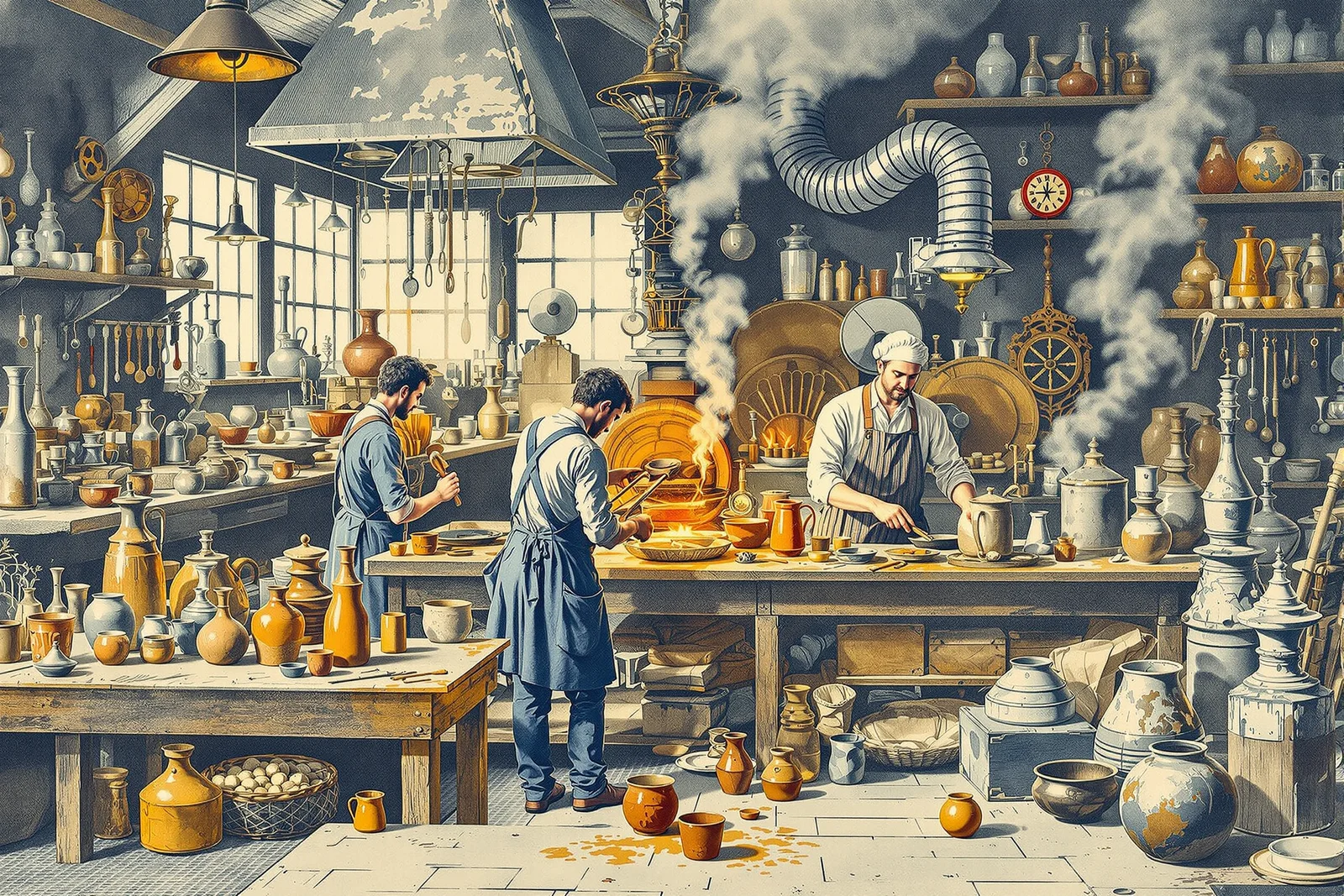
Fill the Shelf
Complete Functional Ware Production: From Single Pieces to Matched Sets
Complete Functional Ware Production: From Single Pieces to Matched Sets
Production pottery transforms the individual potter into a producer of matched, functional ware. This campaign covers repetition throwing, set making, production efficiency, and quality control.
Chapter 1: Production Mindset
| Hobby Potter | Production Potter |
|---|---|
| Makes one piece at a time | Makes sets and multiples |
| Each piece unique | Consistent size and shape |
| Works when inspired | Works on schedule |
| Fires when kiln is full | Fires on regular cycle |
| Prices by feeling | Prices by cost analysis |
| Sells occasionally | Sells regularly |
Chapter 2: Repetition Throwing
Repetition throwing: 1) Weigh clay balls to identical weight. 2) Center all balls before throwing any. 3) Throw all pieces in sequence. 4) Use calipers to check diameter. 5) Use gauge stick to check height. 6) Aim for consistency within 1/8 inch. 7) Speed comes from repetition (not rushing). 8) 50 identical mugs teaches more than 50 different pieces.
| Form | Clay Weight | Target Height | Target Diameter | Production Rate |
|---|---|---|---|---|
| Mug | 14-16 oz | 4-4.5 inches | 3-3.5 inches | 15-25 per hour |
| Bowl | 20-24 oz | 3-3.5 inches | 6-7 inches | 12-20 per hour |
| Plate | 24-28 oz | 1-1.5 inches | 9-10 inches | 10-15 per hour |
| Cup | 10-12 oz | 3-3.5 inches | 3 inches | 20-30 per hour |
| Pitcher | 32-40 oz | 8-9 inches | 5-6 inches | 6-10 per hour |
Chapter 3: Set Making
| Set Type | Pieces | Matching Requirements |
|---|---|---|
| Dinner set | 4-8 place settings | Plates, bowls, mugs, all matching |
| Tea set | Teapot, cups, saucers, creamer, sugar | All matching glaze and form |
| Serving set | Platter, serving bowls, utensil holder | Coordinated sizes and glaze |
| Baking set | Casseroles, pie plates, mixing bowls | Oven-safe, matching |
| Mug set | 4-6 mugs | Identical size, weight, glaze |
Chapter 4: Quality Control
| Check Point | What to Check | Reject If |
|---|---|---|
| After throwing | Size, shape, wall thickness | More than 1/4 inch off target |
| After trimming | Foot ring, balance, weight | Uneven, too heavy |
| After bisque | Cracks, warps, defects | Any crack, visible warp |
| After glazing | Coverage, drips, bare spots | Bare spots, heavy drips |
| After glaze fire | Color, surface, fit | Crawling, pinholing, crazing |
| Final inspection | Overall quality, function | Any defect affecting use |
Chapter 5: Pricing
| Cost Factor | Calculation |
|---|---|
| Clay cost | Weight of clay per piece x price per pound |
| Glaze cost | Estimated glaze per piece x price per batch |
| Firing cost | Kiln electricity or fuel per firing / pieces per load |
| Studio overhead | Monthly costs / pieces produced per month |
| Labor | Hours per piece x desired hourly rate |
| Total cost | Sum of all above |
| Wholesale price | Total cost x 2 |
| Retail price | Total cost x 2.5-3 |
Reference Card
- Consistency is the mark of a production potter (anyone can make one beautiful mug; making 50 beautiful mugs that match in size, shape, and glaze is the skill that separates the production potter from the hobbyist). 2. Weigh your clay (the single most important step in production throwing is starting with identical clay weights; this ensures consistent size and capacity across all pieces in a set). 3. Use measuring tools (calipers for diameter, gauge sticks for height, scales for weight; the eye alone cannot achieve the consistency that production ware demands). 4. Speed comes from repetition, not rushing (throwing fast while maintaining quality comes only from throwing the same form hundreds of times; rushing produces sloppy work). 5. Quality control must be ruthless (a single defective piece in a set ruins the entire set; inspect at every stage and reject any piece that does not meet standards). 6. Price based on cost, not emotion (many potters underprice their work; calculate all costs including labor, then apply appropriate markup; your skill and time have value). 7. Production pottery feeds families (throughout history, potters have earned their living by producing functional ware; production pottery is an honorable trade that provides useful objects to the community). 8. Every piece carries the potter's mark (a production potter's stamp or signature on the bottom of each piece is a promise of quality; it connects the maker to the user across time and distance).
TransmissionCOMPLETE — unaltered & unabridged
Words805 — every one of them
SHA-256 of source text955418ba56419b449af9fb84e5852927b90caee74711f80de4bf4af311f4ed37
Canonical textdownload campaign-fill-shelf.md — byte-identical to what this page renders