Sovereignty Module: Keep the Harvest
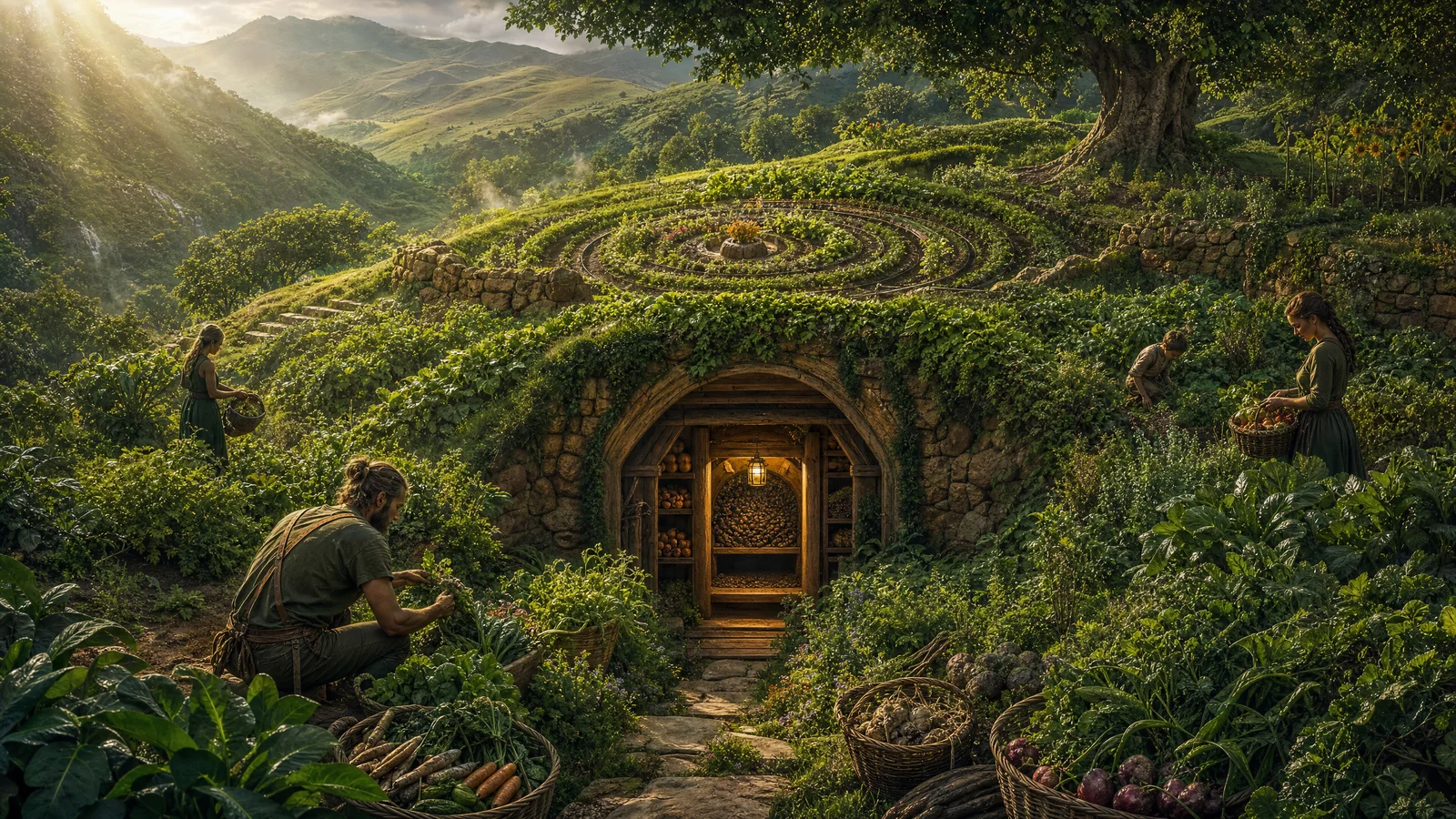
Keep the Harvest
Complete Food Storage, Root Cellar Construction, and Long-Term Preservation Guide
Complete Food Storage, Root Cellar Construction, and Long-Term Preservation Guide
Growing food is only half the battle. Storing it through winter, drought, and lean times is what separates survival from thriving. This campaign covers cold storage, root cellars, grain storage, and preservation infrastructure.
Chapter 1: Storage Methods by Food Type
| Food Type | Ideal Temp | Ideal Humidity | Storage Life | Method |
|---|---|---|---|---|
| Root vegetables (carrots, beets, turnips) | 32-40F (0-4C) | 90-95% | 4-6 months | Root cellar, sand burial |
| Potatoes | 38-45F (3-7C) | 85-90% | 6-8 months | Root cellar (dark, no light) |
| Onions/garlic | 32-40F (0-4C) | 60-70% (dry) | 6-12 months | Braided, hung in dry cool space |
| Apples | 32-35F (0-2C) | 85-90% | 3-6 months | Root cellar, wrapped individually |
| Winter squash | 50-55F (10-13C) | 50-70% | 3-6 months | Cool dry room (not cellar) |
| Cabbage | 32-40F (0-4C) | 90-95% | 3-5 months | Root cellar, hung by root |
| Dried beans/grains | 40-60F (4-15C) | Below 15% moisture | 1-5+ years | Sealed containers, cool dry |
| Dried meat (jerky) | Cool, dry | Below 15% moisture | 6-12 months | Sealed, dark, cool |
| Canned goods | 40-70F (4-21C) | Dry | 1-5 years | Shelf, dark, stable temp |
| Fermented (sauerkraut, kimchi) | 32-40F (0-4C) | N/A (in brine) | 6-12 months | Crock in cellar |
| Smoked meat | 35-45F (2-7C) | 60-70% | 2-6 months | Hung in cool, ventilated space |
| Honey | Any (never spoils) | Sealed | Indefinite | Sealed container |
| Salt | Any | Dry | Indefinite | Dry container |
Chapter 2: Root Cellar Design
| Feature | Specification | Purpose |
|---|---|---|
| Location | North-facing hillside (ideal) or underground | Naturally cool, stable temp |
| Depth | Minimum 4 feet below grade | Below frost line, stable 45-55F |
| Size | Minimum 8x8 feet (family of 4) | Stores 6-12 months of produce |
| Walls | Stone, concrete, or earth (with drainage) | Thermal mass, moisture control |
| Floor | Gravel or packed earth (not concrete) | Allows moisture to rise (humidity) |
| Ceiling/roof | Earth-covered (minimum 2 feet of soil) | Insulation, stable temperature |
| Ventilation | Two vents: intake low, exhaust high | Temperature and humidity control |
| Door | Insulated, tight-fitting | Prevents warm air entry |
| Shelving | Wood (not metal, which conducts cold) | Organize produce, air circulation |
| Drainage | French drain around exterior, slope floor to drain | Prevents flooding |
Chapter 3: Building a Hillside Root Cellar
| Step | Action | Details |
|---|---|---|
| 1 | Select north-facing slope (or dig into any hill) | North = less sun heating |
| 2 | Excavate into hillside (8x10x7 feet minimum) | Retain soil for covering |
| 3 | Build retaining walls (stone, block, or poured concrete) | Must withstand earth pressure |
| 4 | Install drainage (gravel bed + drain pipe at base) | Critical: water ruins stored food |
| 5 | Build roof structure (reinforced for earth load) | Timber, concrete, or arch |
| 6 | Waterproof exterior (tar, membrane, or clay) | Prevents water infiltration |
| 7 | Backfill with earth (minimum 2 feet over roof) | Insulation |
| 8 | Install ventilation (4-inch intake low, 4-inch exhaust high) | Dampers for control |
| 9 | Build insulated door (double door/airlock ideal) | Prevents temperature swings |
| 10 | Install shelving and bins | Wood, spaced for air flow |
Chapter 4: Grain Storage
| Method | Capacity | Pest Protection | Duration | Complexity |
|---|---|---|---|---|
| Sealed clay pots/jars | 5-50 lbs | Excellent (if truly sealed) | 2-5 years | Low |
| Metal bins (galvanized) | 50-500 lbs | Excellent | 5-10+ years | Low |
| Underground pit (lined) | 100-1000+ lbs | Good (if sealed) | 1-3 years | Moderate |
| Elevated granary | 100-5000 lbs | Good (rats can't climb) | 1-2 years | Moderate |
| Mylar bags + oxygen absorbers | 5-50 lbs per bag | Excellent | 10-25+ years | Low |
| Dry crib (corn) | 100-1000+ lbs | Moderate | 6-12 months | Low |
Grain storage rules: Must be below 14% moisture (test: kernel cracks when bitten, not dents). Must be protected from rodents, insects, and moisture. Diatomaceous earth mixed in prevents insects without chemicals.
Chapter 5: Temperature Zones in Storage
| Zone | Temperature | Location | Store Here |
|---|---|---|---|
| Cold and moist | 32-40F, 85-95% humidity | Deep root cellar floor | Roots, cabbage, apples |
| Cold and dry | 32-40F, 60-70% humidity | Root cellar upper shelves | Onions, garlic, dried herbs |
| Cool and dry | 50-60F, 50-70% humidity | Unheated room, basement | Squash, pumpkins, sweet potatoes |
| Cool and moist | 50-60F, 80-90% humidity | Shallow cellar | Short-term produce |
| Frozen | Below 32F (0C) | Outdoor pit (winter), ice house | Meat, fish (seasonal) |
Chapter 6: Ice House Construction
| Component | Material | Function |
|---|---|---|
| Pit (below grade) | Excavated 6-8 feet deep, 8-12 feet diameter | Cold air sinks, insulation |
| Walls | Stone or timber (double-wall with sawdust fill) | Insulation |
| Floor | Gravel (drainage) + wooden platform | Drains meltwater |
| Roof | Thick thatch or earth-covered | Insulation from sun |
| Door | North-facing, insulated, tight | Minimal heat entry |
| Drainage | Pipe from bottom of pit to lower ground | Removes meltwater |
| Ice source | Cut from ponds/lakes in winter (12-18 inch blocks) | Stored in layers with sawdust between |
Ice harvest: Cut ice in January/February when thickest (12-18 inches). Store in layers separated by 6-12 inches of sawdust or straw. A well-built ice house retains ice through September in temperate climates.
Reference Card
- Root cellar ideal: 32-40F, 85-95% humidity, dark, ventilated
- Build into north-facing hillside with 2+ feet of earth over roof
- Two vents required: intake low (cool air in), exhaust high (warm air out)
- Potatoes must be in complete darkness (light = green = toxic solanine)
- Grain must be below 14% moisture for long-term storage
- Never store apples with potatoes (ethylene gas causes sprouting)
- Gravel floor in root cellar maintains humidity; concrete floor is too dry
- Ice house: layers of ice separated by sawdust, drain meltwater from bottom
TransmissionCOMPLETE — unaltered & unabridged
Words1,131 — every one of them
SHA-256 of source texta4927c31245ba2a2e4c7be085d104ee7248f8ed91226b41f5aa36b13c02e5d07
Canonical textdownload campaign-food-storage.md — byte-identical to what this page renders