Sovereignty Module: Harvest the Elements
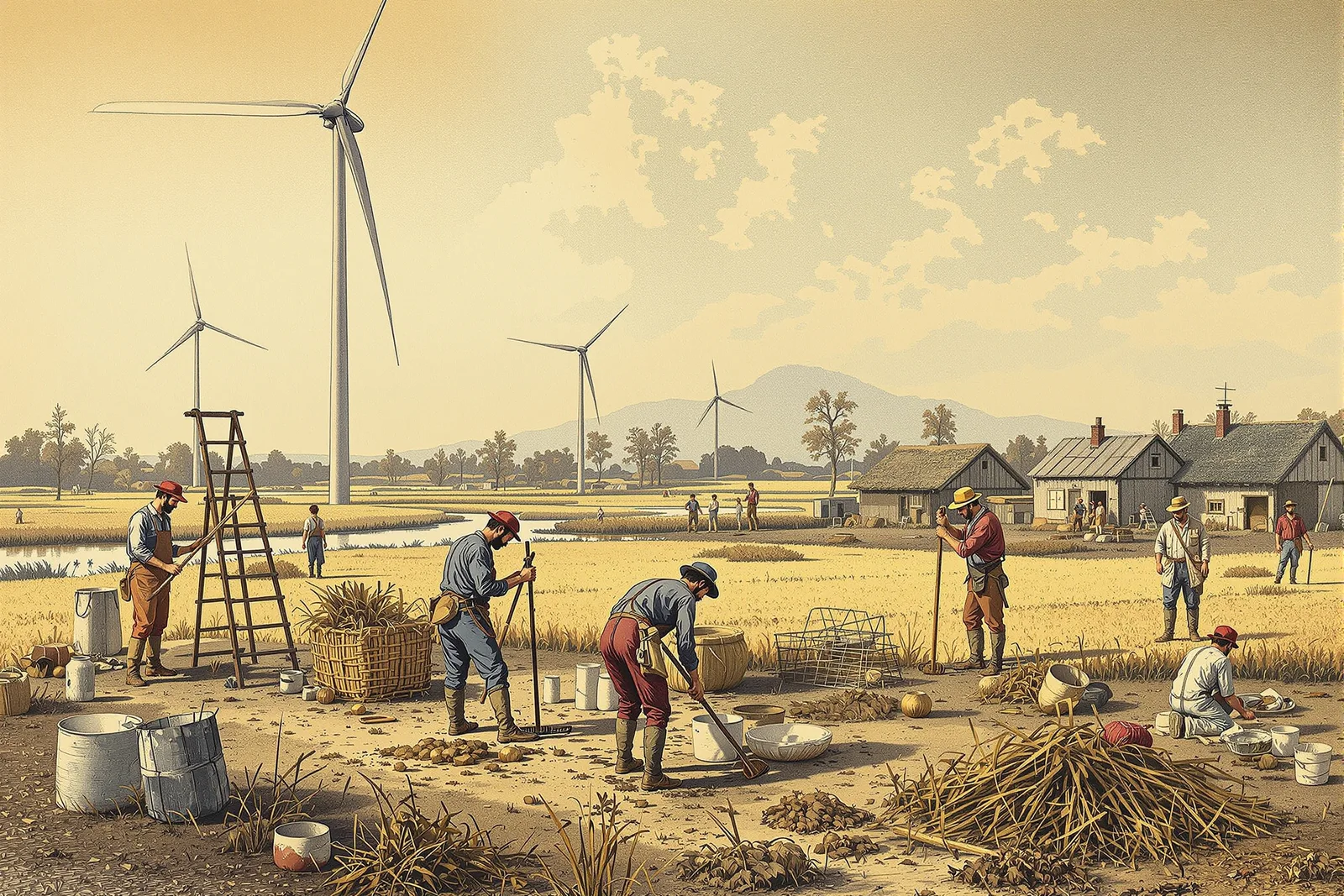
Complete Renewable Energy Systems: From Wind to Water to Sun
Renewable energy provides power without depleting resources. This campaign covers water wheels, windmills, solar thermal, biogas, and the mechanical systems that convert natural forces into useful work.
Chapter 1: Water Power
| System | Head (Drop) | Flow Needed | Output | Difficulty | Best For |
|---|---|---|---|---|---|
| Undershot wheel | 1-5 ft | High flow | 0.5-5 HP | Moderate | Rivers, low head |
| Overshot wheel | 5-30 ft | Moderate flow | 2-20 HP | High | Streams with drop |
| Breastshot wheel | 3-15 ft | Moderate flow | 1-10 HP | Moderate-high | Medium head sites |
| Pelton wheel (impulse) | 30-1000+ ft | Low flow OK | 1-100+ HP | High | High head, low flow |
| Turbine (reaction) | 5-100 ft | Moderate-high | 5-500+ HP | Very high | Large installations |
| Ram pump | 3-30 ft drive | Moderate flow | Pumping (not power) | Moderate | Water lifting |
Overshot water wheel design: 1) Measure head (vertical drop available). 2) Wheel diameter = 80-90% of head. 3) Width = 2-4 feet (wider = more power). 4) Buckets: 12-24 around circumference (hold water). 5) Water enters at top, fills buckets, weight turns wheel. 6) Efficiency: 60-80% (best of all wheel types). 7) Shaft connects to gearing for mill, generator, or other machinery. 8) Flow control: adjustable gate/sluice at water inlet. 9) A 6-foot wheel with 2 cubic feet/second flow produces approximately 1 HP.
Chapter 2: Wind Power
| System | Wind Speed Needed | Output | Rotor Size | Difficulty | Application |
|---|---|---|---|---|---|
| Savonius (vertical axis) | 5+ mph | Low (0.1-0.5 HP) | 3-6 ft | Low | Water pumping, small charging |
| American farm windmill | 8+ mph | 0.5-2 HP | 6-14 ft | Moderate-high | Water pumping |
| Dutch-style windmill | 10+ mph | 5-50 HP | 20-80 ft | Very high | Grain milling, sawing |
| Small wind turbine | 8+ mph | 0.2-5 kW | 4-12 ft | Moderate-high | Battery charging, small power |
| Large wind turbine | 10+ mph | 10-100+ kW | 20-60 ft | Very high | Community power |
Savonius rotor (simplest wind device): 1) Cut oil drum in half lengthwise (two half-cylinders). 2) Offset halves on vertical shaft (S-shape when viewed from top). 3) Mount shaft in bearings (top and bottom). 4) Wind pushes concave side, slides off convex side = rotation. 5) Works in any wind direction (no yaw mechanism needed). 6) Low efficiency (15-20%) but extremely simple and reliable. 7) Connect to pump or small generator via shaft. 8) Best for water pumping where consistent power isn't critical.
Chapter 3: Solar Energy
| System | Type | Output | Complexity | Cost | Application |
|---|---|---|---|---|---|
| Solar cooker (box) | Thermal | 300-400°F | Very low | Very low | Cooking |
| Solar cooker (parabolic) | Thermal | 500-700°F | Low-moderate | Low | Cooking, boiling |
| Solar water heater | Thermal | 120-180°F water | Low-moderate | Low-moderate | Hot water |
| Solar dehydrator | Thermal | 100-160°F air | Low | Very low | Food drying |
| Solar still | Thermal | Pure water | Very low | Very low | Water purification |
| Passive solar building | Thermal | Heating/cooling | Moderate (design) | Low (materials) | Building climate |
| Photovoltaic panel | Electrical | DC electricity | Very high (manufacturing) | High | Electrical power |
Solar box cooker: 1) Inner box: cardboard or wood (painted black inside). 2) Outer box: larger, with insulation between (newspaper, straw, wool). 3) Reflector lid: inner lid lined with aluminum foil (reflects sun into box). 4) Glass or plastic cover: seals top of inner box (greenhouse effect). 5) Cooking pot: dark-colored, with lid. 6) Aim reflector toward sun. 7) Reaches 300-400°F on sunny day. 8) Cooks rice, beans, stews, bread in 2-4 hours. 9) No fuel needed — free cooking from sunlight.
Solar water heater (batch type): 1) Paint water tank black (30-80 gallon). 2) Place in insulated box with glass/plastic front. 3) Angle toward sun (latitude angle). 4) Connect cold water inlet at bottom, hot water outlet at top. 5) Thermosiphon: hot water rises, cold water sinks = natural circulation. 6) Reaches 120-160°F on sunny day. 7) Insulate pipes to storage tank. 8) Provides free hot water for bathing, cleaning, cooking preheat.
Chapter 4: Biogas
| Feedstock | Gas Yield | Retention Time | C:N Ratio | Preprocessing | Quality |
|---|---|---|---|---|---|
| Cattle manure | 1-2 cu ft/lb | 20-30 days | 25:1 | Mix with water | Good |
| Pig manure | 1.5-2.5 cu ft/lb | 15-25 days | 15:1 | Mix with water | Good |
| Chicken manure | 2-3 cu ft/lb | 20-30 days | 10:1 (add carbon) | Mix with water + carbon | Good |
| Food waste | 3-5 cu ft/lb | 15-25 days | 15-20:1 | Chop, mix with water | Very good |
| Crop residue | 1-2 cu ft/lb | 30-60 days | 50-80:1 (add N) | Chop fine, add manure | Moderate |
| Human waste | 1-2 cu ft/lb | 30-60 days | 8:1 (add carbon) | Mix with water + carbon | Good |
Simple biogas digester: 1) Container: sealed drum or tank (50-200 gallon). 2) Inlet: pipe for adding feedstock (manure + water slurry). 3) Outlet: pipe for removing digested slurry (fertilizer). 4) Gas outlet: pipe at top to gas storage. 5) Gas storage: inner tube or balloon (expandable). 6) Fill with manure:water slurry (1:1 ratio). 7) Seal completely (anaerobic = no air). 8) Gas production begins in 5-15 days. 9) Biogas is 60% methane, 40% CO2 — burns for cooking, lighting. 10) One cow's daily manure produces enough gas for 2-3 hours of cooking.
Chapter 5: Energy Storage and Transmission
| Method | Storage Type | Efficiency | Duration | Complexity | Best For |
|---|---|---|---|---|---|
| Battery (lead-acid) | Electrical | 80-85% | Hours-days | High (manufacturing) | Electrical storage |
| Elevated water (pumped) | Potential energy | 70-80% | Hours-weeks | Moderate | Large-scale storage |
| Flywheel | Kinetic energy | 80-90% | Minutes-hours | Moderate | Short-term smoothing |
| Compressed air | Pressure energy | 50-70% | Hours-days | Moderate | Moderate storage |
| Thermal mass | Heat energy | 50-70% | Hours-days | Low | Building heating |
| Firewood/charcoal | Chemical energy | N/A (primary) | Months-years | Low | Cooking, heating |
| Biogas (stored) | Chemical energy | N/A (primary) | Days-weeks | Moderate | Cooking, lighting |
Reference Card
- Water is the most reliable (water wheels run 24/7 with consistent flow — wind and sun are intermittent). 2. Overshot wheels are most efficient (60-80% efficiency — let gravity do the work). 3. Wind needs height (wind speed increases with height — mount turbines on towers, not ground level). 4. Solar cooking is free (a box, foil, and glass = free cooking forever — no fuel, no smoke). 5. Biogas from manure (one cow's waste = 2-3 hours of cooking gas daily — waste becomes fuel). 6. Storage is the challenge (generating energy is easier than storing it — plan for intermittency). 7. Match source to need (water power for milling, wind for pumping, solar for heating — each excels differently). 8. Combine sources (wind + solar + water + biogas = reliable system — diversity beats dependence on one source).