Sovereignty Module: Fire the Vessel
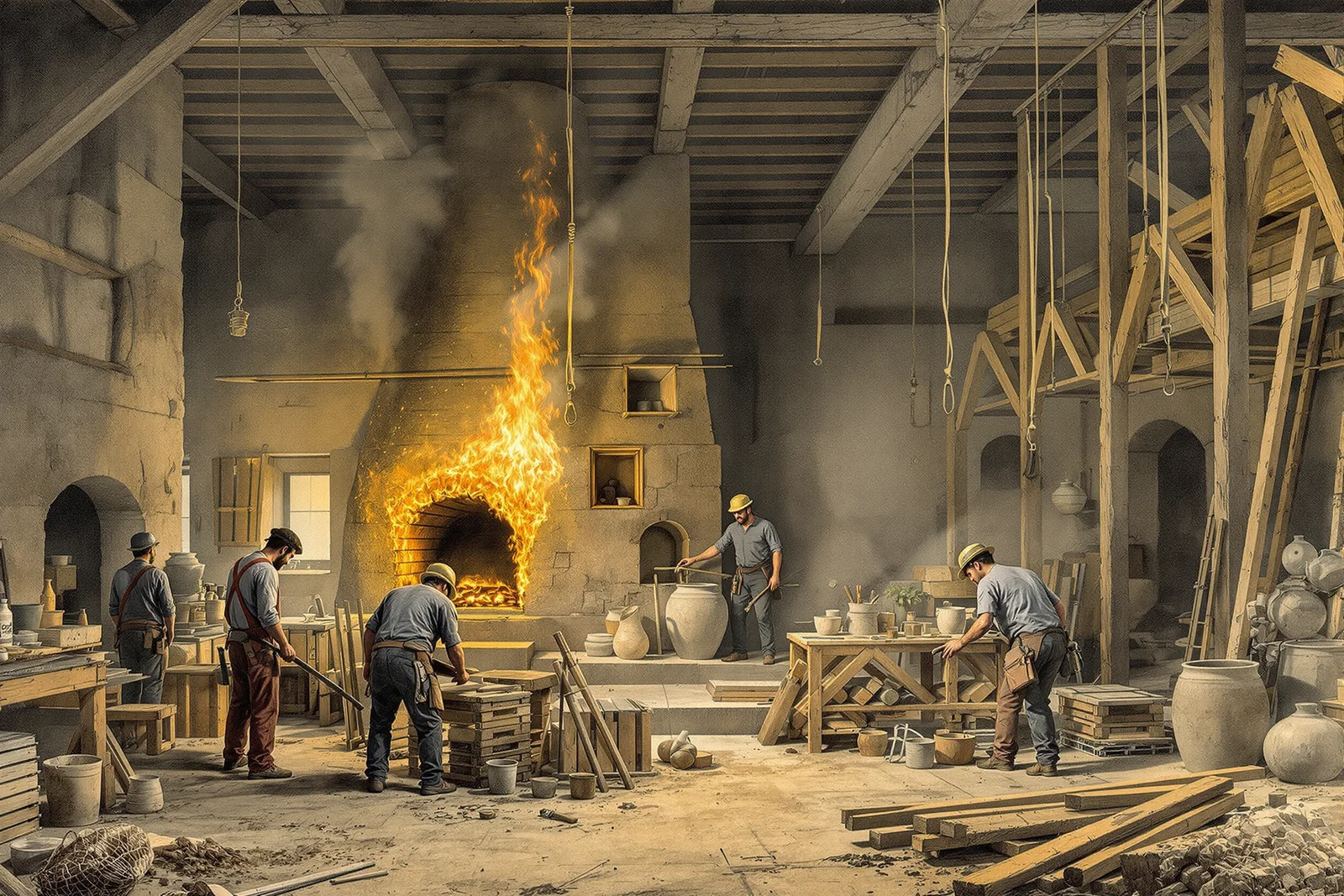
Fire the Vessel
Complete Kiln Construction: From Pit Firing to Updraft Kilns
Complete Kiln Construction: From Pit Firing to Updraft Kilns
Pottery requires fire. The kiln determines what temperatures you can reach, what glazes you can melt, and what strength your vessels achieve. This campaign covers every kiln type from primitive to advanced.
Chapter 1: Kiln Types and Temperatures
| Kiln Type | Max Temperature | Complexity | Fuel | Products |
|---|---|---|---|---|
| Open pit fire | 1,200-1,500°F | Very low | Wood | Earthenware (fragile, porous) |
| Pit kiln (covered) | 1,500-1,800°F | Low | Wood | Better earthenware, some stoneware |
| Updraft kiln (single chamber) | 1,800-2,300°F | Moderate | Wood | Stoneware, basic glazes |
| Downdraft kiln | 2,000-2,400°F | High | Wood | High-fire stoneware, porcelain |
| Anagama (tunnel kiln) | 2,300-2,500°F | Very high | Wood (tons) | Ash-glazed stoneware |
| Charcoal kiln (small) | 1,800-2,200°F | Low-moderate | Charcoal | Small items, high temperature |
Chapter 2: Pit Firing (Simplest Method)
| Step | Action | Details | Notes |
|---|---|---|---|
| 1 | Dig pit (2-3 feet deep, 3-4 feet wide) | Flat bottom, sloped sides | Size depends on number of pots |
| 2 | Line bottom with fuel (dry wood, bark, dung) | 4-6 inch layer | This is the base heat source |
| 3 | Place bone-dry pottery on fuel layer | Space between pots for heat circulation | Pots MUST be completely dry (weeks of drying) |
| 4 | Cover with more fuel (wood, bark, dung) | Surround and cover all pots | Even coverage = even heating |
| 5 | Optional: cover with large potsherds or metal sheet | Retains heat, controls oxygen | Reduction atmosphere = darker colors |
| 6 | Light fire from top (let it burn down through) | Or light from bottom through side hole | Top-lighting = slower, more even heating |
| 7 | Burn 2-6 hours (maintain fire, add fuel as needed) | Don't disturb pots | Thermal shock = cracking |
| 8 | Let cool completely (12-24 hours) | DO NOT remove pots while hot | Rapid cooling = cracking |
| 9 | Remove pots, inspect for cracks | Some loss is normal (10-30%) | Surviving pots are functional earthenware |
Chapter 3: Updraft Kiln Construction
| Component | Material | Dimensions | Function |
|---|---|---|---|
| Firebox | Firebrick or stone | 18" wide × 24" deep × 12" tall | Where fuel burns |
| Grate/floor | Firebrick with gaps | Spans firebox top | Allows heat to rise into chamber |
| Chamber (ware space) | Firebrick or cob | 24" × 24" × 24" (minimum) | Where pottery sits |
| Walls | Double-wall with insulation | 4-8 inches thick | Retains heat |
| Door | Removable bricks | Full front opening | Loading/unloading access |
| Chimney/flue | Brick or pipe | 6-12 inch diameter, 4-6 feet tall | Creates draft, removes exhaust |
| Damper | Flat plate over chimney | Adjustable | Controls temperature and atmosphere |
| Spy hole | Small hole in door/wall | 1-2 inch diameter | Observe cones/color inside |
Chapter 4: Temperature Indicators (Without Thermometer)
| Color Inside Kiln | Temperature | Cone Equivalent | What Fires At This Temp |
|---|---|---|---|
| No visible glow | Below 900°F | - | Drying only |
| Faint red (barely visible in dark) | 900-1,100°F | 022-020 | Bisque begins |
| Dark red | 1,100-1,300°F | 018-015 | Low bisque, burnout |
| Cherry red | 1,300-1,500°F | 012-010 | Earthenware matures |
| Bright cherry red | 1,500-1,700°F | 08-06 | Low-fire glazes melt |
| Orange | 1,700-1,900°F | 04-02 | Mid-fire glazes |
| Yellow-orange | 1,900-2,100°F | 1-4 | Stoneware begins |
| Yellow | 2,100-2,300°F | 6-10 | Stoneware matures |
| Light yellow/white | 2,300-2,500°F | 11-13 | Porcelain, high-fire |
Chapter 5: Firing Schedule
| Phase | Temperature Range | Rate | Duration | Purpose |
|---|---|---|---|---|
| Water smoking | Room temp → 400°F | Very slow (100°F/hour) | 3-4 hours | Drives off remaining moisture |
| Burnout | 400-1,100°F | Slow (150°F/hour) | 4-5 hours | Burns off organic matter in clay |
| Ceramic change | 1,100-1,300°F | Moderate (200°F/hour) | 1-2 hours | Quartz inversion (critical: go steady) |
| Maturation | 1,300 → target temp | Moderate-fast | 2-4 hours | Clay vitrifies, glazes melt |
| Soaking | Hold at target | Zero (maintain) | 15-30 minutes | Even heat distribution |
| Cooling | Target → room temp | Slow (natural) | 12-24 hours | DO NOT OPEN KILN. Thermal shock kills pots. |
CRITICAL: The quartz inversion at 1,063°F (573°C) causes a sudden volume change in the clay. Heat too fast through this zone = cracking. Slow and steady through 900-1,200°F range.
Chapter 6: Fuel Requirements
| Kiln Type | Fuel Amount (per firing) | Firing Duration | Temperature Achieved |
|---|---|---|---|
| Pit fire | 50-100 lbs dry wood | 2-6 hours | 1,200-1,500°F |
| Small updraft | 100-200 lbs dry wood | 8-12 hours | 1,800-2,200°F |
| Large updraft | 300-500 lbs dry wood | 12-24 hours | 2,000-2,300°F |
| Anagama (tunnel) | 1-3 tons dry wood | 3-7 days continuous | 2,300-2,500°F |
| Charcoal kiln | 20-50 lbs charcoal | 4-8 hours | 1,800-2,200°F |
Wood preparation: Split to wrist-thickness or smaller. Dry 6-12 months (under 20% moisture). Softwood for fast heat (initial), hardwood for sustained high temperature. Stack near kiln before firing (you'll need constant feeding).
Reference Card
- Pottery MUST be bone-dry before firing. Any moisture = steam explosion = shattered pot. Dry 2-4 weeks minimum.
- Pit firing: simplest method. Dig pit, layer fuel + pots + fuel, light, burn 2-6 hours, cool 12-24 hours.
- Updraft kiln: firebox below, chamber above, chimney creates draft. Reaches stoneware temperatures (2,200°F+).
- Quartz inversion at 1,063°F: go SLOW through 900-1,200°F range. Rapid heating/cooling here = cracking.
- Never open kiln while hot. Cool naturally 12-24 hours. Thermal shock from cold air = cracks in finished pots.
- Temperature by color: cherry red = 1,300-1,500°F, orange = 1,700-1,900°F, yellow = 2,100-2,300°F.
- Expect 10-30% loss in pit firing. Updraft kiln with proper schedule: 5-10% loss. Experience reduces losses.
- Fuel: 100-200 lbs dry split wood for small updraft kiln firing. Have ALL fuel ready before starting. Can't stop mid-fire.
TransmissionCOMPLETE — unaltered & unabridged
Words1,100 — every one of them
SHA-256 of source text6120ac993463504234b6f4723eb7db6d3035f01a4d47d1f9a68d2de4d6c18722
Canonical textdownload campaign-kiln-construction.md — byte-identical to what this page renders