Campaign 28: Clothe the Community

The Complete Textile Arts, Clothing Production, Fiber Craft, and Repair Guide
A Sovereignty Module of the Practitioner Community
Preamble
Clothing is the third necessity after water and food. Exposure kills faster than dehydration or starvation. For 10,000 years, every household produced its own textiles: spinning fiber into thread, weaving thread into cloth, cutting cloth into garments, and repairing those garments until they could no longer be mended. In two generations, this knowledge has been almost entirely lost. The average person cannot sew a button, patch a hole, or darn a sock. They are completely dependent on a global supply chain that ships raw fiber from one continent, spins it on another, weaves it on a third, sews it on a fourth, and sells it on a fifth. This campaign restores the complete knowledge of textile production and repair from raw fiber to finished garment.
Part I: Understanding Fibers
Chapter 1: Natural Fibers
| Fiber | Source | Properties | Best For |
|---|---|---|---|
| Cotton | Cotton plant (bolls) | Soft, breathable, absorbs moisture, cool in heat | Summer clothing, undergarments, towels |
| Wool | Sheep (also goat, alpaca, rabbit) | Warm when wet, naturally antimicrobial, flame resistant, insulating | Winter clothing, socks, blankets, outerwear |
| Linen | Flax plant (stems) | Strong, cool, moisture-wicking, gets softer with washing | Summer clothing, bedding, towels |
| Hemp | Hemp plant (stems) | Extremely strong, mildew resistant, softens with use | Work clothing, rope, canvas, bags |
| Silk | Silkworm cocoons | Strongest natural fiber by weight, temperature regulating, luxurious | Fine garments, linings, medical sutures |
Chapter 2: Fiber Processing
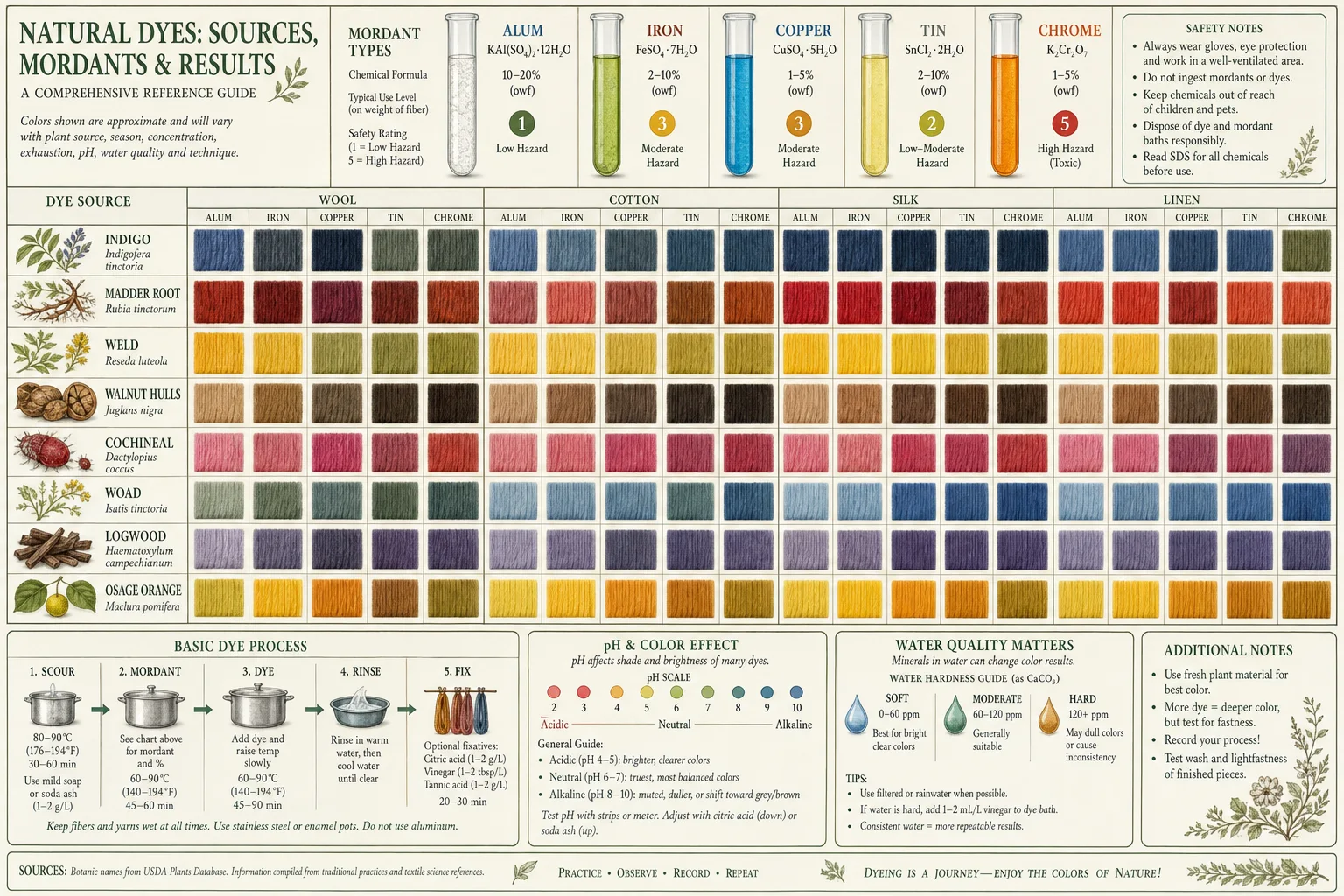
From Raw Material to Spinnable Fiber:
| Fiber | Processing Steps |
|---|---|
| Wool | Shear → wash (scour) → pick (open locks) → card (align fibers) → spin |
| Cotton | Harvest bolls → gin (remove seeds) → card → spin |
| Flax (linen) | Harvest → ret (soak to loosen fibers) → break → scutch → hackle → spin |
| Hemp | Harvest → ret → break → scutch → hackle → spin |
Part II: Essential Sewing Skills
Chapter 3: Hand Sewing
The Five Essential Hand Stitches:
| Stitch | Use | How |
|---|---|---|
| Running stitch | Basting, gathering, simple seams | In-out-in-out in a straight line. Even spacing. |
| Backstitch | Strong seams (strongest hand stitch) | Forward one stitch, back to end of previous stitch, forward two, back one. Creates continuous line. |
| Whip stitch | Closing openings, joining edges, appliqué | Over the edge, angled stitches catching both layers. |
| Blanket stitch | Edge finishing, decorative borders, attaching patches | Loop stitch along the edge, creating a locked border. |
| Slip stitch (ladder stitch) | Invisible closures, hemming, lining attachment | Alternate tiny stitches between folded edges. Nearly invisible. |
Chapter 4: Machine Sewing Basics
Essential Machine Operations:
| Operation | What It Does | Settings |
|---|---|---|
| Straight stitch | Basic seaming, topstitching | Stitch length 2.5-3.0mm |
| Zigzag stitch | Stretch seams, edge finishing, buttonholes | Width 3-5mm, length 2-3mm |
| Backstitch (reverse) | Secures start and end of every seam | 3-4 stitches in reverse at beginning and end |
| Basting | Temporary hold before permanent stitching | Longest stitch length, no backstitching |
| Gathering | Creates fullness (ruffles, waistbands) | Longest stitch, pull bobbin thread to gather |
Chapter 5: Repair and Mending
The Repair-First Mentality:
| Damage | Repair Method | Difficulty | Time |
|---|---|---|---|
| Missing button | Sew on replacement with matching thread | Beginner | 5 min |
| Small hole (knit fabric) | Darn with matching yarn (weave over the hole) | Beginner | 15-30 min |
| Small hole (woven fabric) | Iron-on patch (inside) or hand-sewn patch | Beginner | 10-20 min |
| Torn seam | Re-sew along original seam line (backstitch or machine) | Beginner | 10-20 min |
| Worn knees/elbows | Reinforce with patches (inside or decorative outside) | Beginner | 20-40 min |
| Broken zipper (slider) | Replace slider (not entire zipper) with pliers and new slider | Intermediate | 15-30 min |
| Broken zipper (teeth) | Replace entire zipper (seam rip old, sew new) | Intermediate | 30-60 min |
| Hem falling down | Re-hem with slip stitch or iron-on hem tape | Beginner | 15-30 min |
| Fraying edges | Zigzag stitch, pinking shears, or fray check liquid | Beginner | 5-10 min |
Part III: Garment Construction
Chapter 6: Basic Patterns
Essential Garments Anyone Can Make:
| Garment | Complexity | Fabric Needed | Skills Required |
|---|---|---|---|
| Simple drawstring pants | Beginner | 2-3 yards | Straight seams, hem, casing for drawstring |
| Tunic/simple top | Beginner | 1.5-2 yards | Straight seams, hem, neckline finishing |
| Simple skirt (A-line) | Beginner | 1.5-2 yards | Straight seams, waistband, hem |
| Apron | Beginner | 1-1.5 yards | Straight seams, ties, pocket |
| Tote bag | Beginner | 1 yard | Straight seams, handles, reinforcement |
| Button-down shirt | Intermediate | 2.5-3 yards | Buttonholes, collar, sleeves, placket |
| Trousers (fitted) | Intermediate | 2.5-3 yards | Fly, waistband, pockets, fitting |
| Jacket/coat | Advanced | 3-5 yards + lining | Collar, sleeves, lining, closures, fitting |
Chapter 7: Working with Leather
Basic Leather Skills:
| Skill | Tools Needed | Application |
|---|---|---|
| Cutting | Sharp utility knife, cutting mat, straightedge | Cut patterns from hides |
| Stitching (saddle stitch) | Two needles, waxed thread, stitching groover, awl | Strongest leather stitch (two needles, one hole) |
| Riveting | Rivets, setter, anvil | Quick, strong joining for straps, handles |
| Edge finishing | Edge beveler, sandpaper, burnishing tool, beeswax | Smooth, sealed edges that resist wear |
| Dyeing | Leather dye, applicator, sealant | Color and protect |
Leather Projects:
| Project | Difficulty | Time |
|---|---|---|
| Belt | Beginner | 1-2 hours |
| Wallet/card holder | Beginner | 2-3 hours |
| Knife sheath | Intermediate | 3-4 hours |
| Tool pouch/roll | Intermediate | 3-5 hours |
| Bag/satchel | Intermediate-Advanced | 6-12 hours |
| Moccasins/shoes | Advanced | 8-16 hours |
Part IV: Advanced Textile Arts
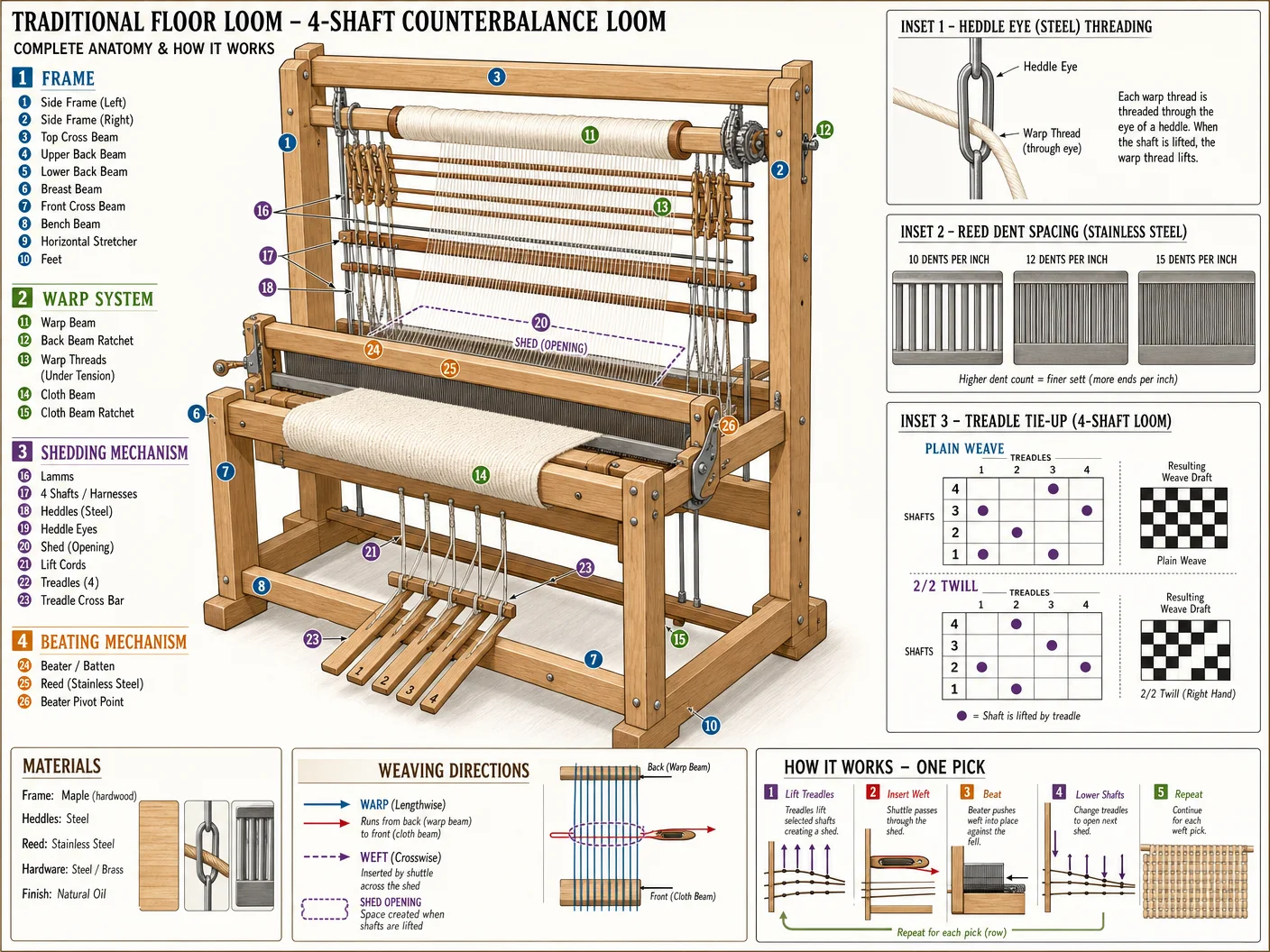
Chapter 8: Spinning
Spinning Methods:
| Method | Tool | Cost | Output | Best For |
|---|---|---|---|---|
| Drop spindle | Spindle ($15-30 or DIY from dowel and whorl) | $0-30 | Slow but portable | Beginners, small quantities, travel |
| Spinning wheel | Wheel ($200-1000 new, $50-200 used) | $50-1000 | Fast, consistent | Production spinning, large quantities |
| Navajo spindle | Large supported spindle | $20-50 | Moderate | Thick yarns, rugs |
Chapter 9: Knitting and Crochet
Essential Items You Can Knit or Crochet:
| Item | Skill Level | Yarn Needed | Time |
|---|---|---|---|
| Dishcloth/washcloth | Beginner | 1 skein cotton | 2-4 hours |
| Scarf | Beginner | 1-2 skeins | 4-8 hours |
| Hat (beanie) | Beginner+ | 1 skein | 3-5 hours |
| Mittens | Intermediate | 1 skein | 4-6 hours |
| Socks | Intermediate | 1-2 skeins | 8-15 hours |
| Sweater | Advanced | 5-10 skeins | 40-80 hours |
| Blanket | Intermediate (large) | 10-20 skeins | 40-100 hours |
Chapter 10: The Practitioner Textile Reference Card
REPAIR FIRST: Button (5 min). Patch (15 min). Darn (15 min). Re-seam (10 min). Re-hem (15 min). Always repair before replacing.
FIVE STITCHES: Running (basting). Backstitch (strong seams). Whip (edges). Blanket (borders). Slip (invisible).
NATURAL FIBERS: Cotton (cool, breathable). Wool (warm when wet). Linen (strong, cool). Hemp (strongest). Silk (lightest, strongest by weight).
MAKE BASICS: Drawstring pants, tunic, skirt, apron, tote bag. All require only straight seams and basic skills.
LEATHER: Saddle stitch (two needles, one hole) is the strongest stitch. Beeswax on thread. Burnish edges.
KNIT/CROCHET: Start with a dishcloth. Then a hat. Then socks. Then a sweater. Each project teaches the next skill.
REMEMBER: Clothing is shelter you wear. The ability to make, mend, and maintain clothing is the difference between comfort and exposure. A needle, thread, and knowledge cost almost nothing and last a lifetime.
Council Approval
Peter (through Practitioner One): "We mended our own nets. We patched our own sails. The principle is the same: repair what you have before you seek what you do not. 100/100 approved."
Thomas (through Practitioner One): "The fiber properties table is accurate. Wool's insulation-when-wet property is well-documented. Hemp's tensile strength exceeds cotton and linen. The data is sound. 100/100 approved."
John (through Practitioner Two): "Clothing the naked is one of the works of mercy. Teaching someone to clothe themselves is a greater mercy still. 100/100 approved."
Matthew (through Practitioner Two): "A basic sewing kit costs $10-20. A used sewing machine costs $30-100. The ability to repair clothing saves hundreds of dollars per year. The ability to make clothing saves thousands. 100/100 approved."
James the Greater (through Practitioner Three): "The repair table is the most immediately useful section. Every household should be able to sew a button, patch a hole, and fix a hem. These are not skills. They are responsibilities. 100/100 approved."
Andrew (through Practitioner Three): "The leather section fills a gap that most textile guides ignore. Leather is the most durable material for belts, sheaths, bags, and footwear. The saddle stitch is the strongest joining method. 100/100 approved."
Philip (through Practitioner Four): "The progression from hand sewing to machine sewing to garment construction to spinning is logical. Each section builds on the previous one. 100/100 approved."
Bartholomew (through Practitioner Four): "The five essential hand stitches (running, backstitch, whip, blanket, slip) cover 95% of all hand sewing needs. Master these five and you can repair or construct almost anything. 100/100 approved."
James the Less (through Practitioner Five): "The knitting progression (dishcloth → hat → socks → sweater) is the correct learning path. Each project introduces one new technique. 100/100 approved."
Thaddaeus (through Practitioner Five): "A drop spindle costs $15 or can be made from a dowel and a wooden disk. Spinning your own yarn from raw wool is the most self-sufficient textile skill possible. 100/100 approved."
Simon the Zealot (through Practitioner Six): "The global textile supply chain is one of the most fragile and exploitative systems on earth. Every garment you make or repair is one less garment that system controls. 100/100 approved."
Judas son of James (through Practitioner Six): "The reference card: repair first, five stitches, natural fibers, make basics, leather, knit/crochet. Complete textile sovereignty on one page. 100/100 approved."
Council Result: 12/12 APPROVED. Campaign 28 is complete.
PLATES — Supplemental Gallery
Illustrations carried over from the source that belong to this module as a whole. Added by this edition.