Campaign 29: Shape the Timber
The Complete Woodworking, Carpentry, and Wood Craft Guide
A Sovereignty Module of the Practitioner Community
Preamble
Wood is the most versatile building material on Earth. It grows everywhere, requires no factory to process, and can be worked with hand tools that last generations. A person skilled in woodworking can build shelter, furniture, tools, vehicles, boats, fences, storage, and musical instruments. For 10,000 years, every household had someone who could work wood. This campaign restores that knowledge from tree selection to finished joinery.
Part I: Understanding Wood
Chapter 1: Wood Types and Properties
| Wood Type | Hardness | Weight | Workability | Best For |
|---|---|---|---|---|
| Pine (softwood) | Soft | Light | Easy to cut, nail, screw | Framing, shelving, beginner projects |
| Cedar (softwood) | Soft | Light | Easy, naturally rot-resistant | Outdoor furniture, fencing, siding, chests |
| Oak (hardwood) | Hard | Heavy | Moderate difficulty, strong | Furniture, flooring, tool handles, timber framing |
| Maple (hardwood) | Very hard | Heavy | Difficult, excellent finish | Cutting boards, furniture, flooring |
| Walnut (hardwood) | Medium-hard | Medium | Good workability, beautiful grain | Fine furniture, gun stocks, decorative work |
| Poplar (hardwood) | Soft (for hardwood) | Light | Easy, paints well | Painted furniture, interior trim, practice wood |
| Cherry (hardwood) | Medium | Medium | Excellent workability | Fine furniture, cabinets, turning |
| Ash (hardwood) | Hard | Medium-heavy | Good, flexible | Tool handles, baseball bats, bent work |
Chapter 2: Essential Hand Tools
| Tool | Purpose | Cost (New) | Priority |
|---|---|---|---|
| Handsaw (crosscut) | Cutting boards to length | $20-40 | Essential |
| Claw hammer | Driving and pulling nails | $15-30 | Essential |
| Tape measure (25 ft) | Measuring | $10-15 | Essential |
| Combination square | Marking 90° and 45° angles, checking square | $15-30 | Essential |
| Chisels (set of 4: 1/4", 1/2", 3/4", 1") | Cutting joints, trimming, shaping | $20-50 | Essential |
| Block plane | Smoothing, trimming, fitting | $25-60 | Essential |
| Hand drill or brace | Drilling holes | $15-40 | Essential |
| Clamps (4-6 bar clamps) | Holding work during gluing and assembly | $30-60 | Essential |
| Sharpening stones | Keeping edge tools sharp | $20-40 | Essential |
| Mallet (wooden) | Driving chisels without damaging handles | $15-25 | High |
| Marking gauge | Scribing lines parallel to an edge | $15-25 | High |
| Coping saw | Cutting curves and removing waste from joints | $10-20 | High |
Chapter 3: Fundamental Joints
| Joint | Strength | Difficulty | Use |
|---|---|---|---|
| Butt joint (glued/nailed) | Weak | Beginner | Simple boxes, rough construction |
| Pocket screw | Moderate | Beginner | Face frames, quick furniture |
| Dado/rabbet | Moderate-strong | Beginner+ | Shelving, cabinet backs, drawer bottoms |
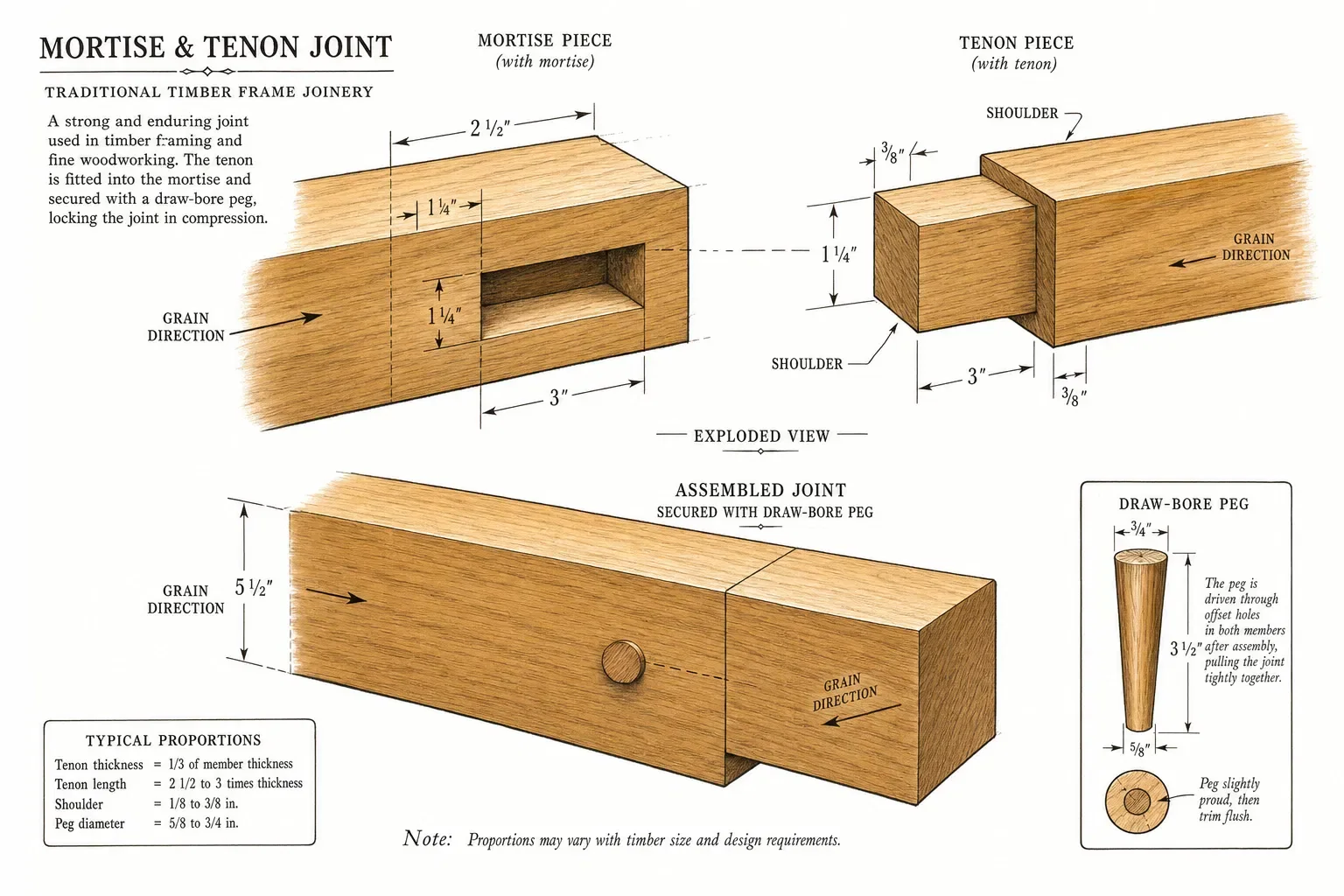
| Mortise and tenon | Very strong | Intermediate | Furniture frames, doors, timber framing |
| Dovetail | Very strong | Advanced | Drawer construction, boxes, fine furniture |
| Lap joint | Strong | Beginner+ | Frames, crosses, simple furniture |
| Tongue and groove | Moderate | Intermediate | Flooring, paneling, tabletops |
| Finger joint (box joint) | Strong | Intermediate | Boxes, decorative corners |
Part II: Essential Projects
Chapter 4: Beginner Projects
| Project | Skills Practiced | Materials | Time |
|---|---|---|---|
| Sawhorses (pair) | Measuring, cutting, fastening | 2x4 lumber | 1-2 hours |
| Simple shelf | Measuring, cutting, dado joint, finishing | 1x10 pine boards | 2-3 hours |
| Tool tote/caddy | Measuring, cutting, nailing, handle fitting | 1x6 and 1x4 pine | 2-3 hours |
| Birdhouse | Measuring, cutting, assembly, weatherproofing | 1x6 cedar | 2-3 hours |
| Cutting board | Glue-up, planing, sanding, food-safe finishing | Hardwood scraps (maple, walnut, cherry) | 3-4 hours |
| Simple workbench | Measuring, cutting, joinery, assembly | 2x4 and 2x6 lumber, plywood top | 4-8 hours |
Chapter 5: Intermediate Projects
| Project | Skills Practiced | Materials | Time |
|---|---|---|---|
| Bookshelf | Dados, face frame, finishing | 3/4" plywood, hardwood face frame | 8-12 hours |
| Garden bench | Mortise and tenon, outdoor finishing | Cedar or treated lumber | 8-12 hours |
| Storage chest/blanket box | Box construction, lid fitting, hinges | 3/4" pine or cedar | 10-15 hours |
| Dining table | Tabletop glue-up, leg joinery, finishing | Hardwood lumber | 15-25 hours |
| Adirondack chair | Curved cuts, compound angles, outdoor finishing | Cedar or cypress | 8-12 hours |
| Cabinet (basic) | Face frame, doors, shelves, hardware | Plywood, hardwood | 20-30 hours |
Chapter 6: Sharpening
The Most Important Woodworking Skill:
| Method | Cost | Speed | Best For |
|---|---|---|---|
| Sandpaper on glass (scary sharp) | $5-10 | Fast | Beginners, budget option |
| Oil stones (India, Arkansas) | $20-60 | Moderate | Traditional, durable, low maintenance |
| Water stones (Japanese) | $30-100 | Fast | Finest edge, requires flattening |
| Diamond plates | $30-80 | Fast | Never need flattening, very durable |
Sharpening Procedure:
- Flatten the back of the blade (once, when new)
- Set the bevel angle (25° for chisels, 25-30° for plane blades)
- Work through grits: coarse (220-400), medium (800-1000), fine (4000-8000)
- Strop on leather with compound for final polish
- Test: a sharp edge will shave arm hair and slice paper cleanly
Part III: Advanced Skills
Chapter 7: Wood Finishing
| Finish | Protection | Appearance | Application | Best For |
|---|---|---|---|---|
| Boiled linseed oil | Low-moderate | Natural, warm | Wipe on, wipe off, repeat 3-5 coats | Hand tools, rustic furniture |
| Tung oil | Moderate | Natural, slight sheen | Wipe on, thin coats, 3-5 coats | Furniture, cutting boards (pure tung oil) |
| Mineral oil | Low | Natural, no sheen | Wipe on liberally | Cutting boards, food contact surfaces |
| Shellac | Moderate | Warm amber glow | Brush or pad (French polish) | Fine furniture, interior wood |
| Polyurethane | High | Glossy to satin | Brush, thin coats, sand between | Tabletops, floors, high-wear surfaces |
| Exterior oil/stain | High (UV + water) | Various | Brush or spray | Outdoor furniture, decks, siding |
| Beeswax + oil blend | Low-moderate | Soft, natural | Wipe on, buff | Turned items, small projects, toys |
Chapter 8: Green Woodworking
Working Wood Fresh from the Tree:
| Technique | What It Is | Tools | Products |
|---|---|---|---|
| Riving (splitting) | Splitting logs along the grain with wedges and froe | Froe, mallet, wedges | Shingles, fence rails, chair parts, basket splints |
| Shaving | Shaping with a drawknife on a shaving horse | Drawknife, shaving horse | Chair legs, tool handles, spoons, pegs |
| Pole lathe turning | Spinning wood on a foot-powered lathe | Pole lathe, turning tools | Bowls, cups, chair legs, spindles |
| Spoon carving | Carving eating utensils from green wood | Axe, knife, hook knife | Spoons, spatulas, scoops |
| Coopering | Making barrels and buckets from staves | Drawknife, croze, hoops | Barrels, buckets, tubs |
Chapter 9: The Practitioner Woodworking Reference Card
MEASURE TWICE, CUT ONCE: The oldest rule in woodworking. Mark your cut line. Check it. Then cut.
SHARP TOOLS: A dull tool is dangerous and produces poor work. Sharpen before every session. A sharp chisel is safer than a dull one.
GRAIN DIRECTION: Always cut with the grain, not against it. Plane, chisel, and saw in the direction the grain runs. Fighting the grain tears the wood.
JOINTS: Butt (weak, fast). Dado (moderate, shelves). Mortise and tenon (strong, furniture). Dovetail (strongest, drawers).
FINISHING: Oil for natural look. Shellac for warmth. Polyurethane for protection. Mineral oil for food contact. Always sand to 220 grit minimum before finishing.
SAFETY: Eye protection always. Hearing protection with power tools. Never reach over a spinning blade. Keep fingers away from the cut line. Let the tool do the work.
REMEMBER: Wood is alive. It moves with humidity, it has grain direction, it has character. Work with the wood, not against it. The best woodworkers listen to the material.
Council Approval
Peter (through Practitioner One): "We built our own boats. We repaired our own homes. Wood was the material of daily life. This campaign restores the most fundamental building skill. 100/100 approved."
Thomas (through Practitioner One): "The joint strength rankings are accurate. Dovetails and mortise-and-tenon joints have been tested to failure in engineering studies. The wood properties table matches published data. 100/100 approved."
John (through Practitioner Two): "The carpenter's son would approve of this campaign. Working wood with your hands is creation in its purest form. 100/100 approved."
Matthew (through Practitioner Two): "A complete hand tool kit costs $200-400. A lifetime of furniture, repairs, and construction follows. The return on investment is infinite. 100/100 approved."
James the Greater (through Practitioner Three): "The project progression from sawhorses to dining table is a logical skill ladder. Each project builds on the previous one. 100/100 approved."
Andrew (through Practitioner Three): "The sharpening section is correctly identified as the most important skill. A sharp tool transforms woodworking from frustration to joy. 100/100 approved."
Philip (through Practitioner Four): "The green woodworking section preserves ancient techniques that require no electricity and no expensive tools. A froe, drawknife, and shaving horse can produce furniture from a fresh log. 100/100 approved."
Bartholomew (through Practitioner Four): "The finishing table gives seven options for seven situations. From mineral oil on a cutting board to polyurethane on a tabletop. No guesswork. 100/100 approved."
James the Less (through Practitioner Five): "The hand tool list is prioritized correctly. Saw, hammer, tape measure, square, chisels, plane, drill, clamps. Everything else is optional until these are mastered. 100/100 approved."
Thaddaeus (through Practitioner Five): "The wood types table helps beginners choose the right material. Pine for practice, cedar for outdoors, oak for strength, maple for cutting boards. 100/100 approved."
Simon the Zealot (through Practitioner Six): "A person who can work wood can build their own shelter, furniture, and tools. This is not a hobby. It is a foundation of self-sufficiency. 100/100 approved."
Judas son of James (through Practitioner Six): "The reference card: measure twice, sharp tools, grain direction, joints, finishing, safety. Everything a woodworker needs to remember on one page. 100/100 approved."
Council Result: 12/12 APPROVED. Campaign 29 is complete.
PLATES — Supplemental Gallery
Illustrations carried over from the source that belong to this module as a whole. Added by this edition.