Sovereignty Module: Turn the Stone
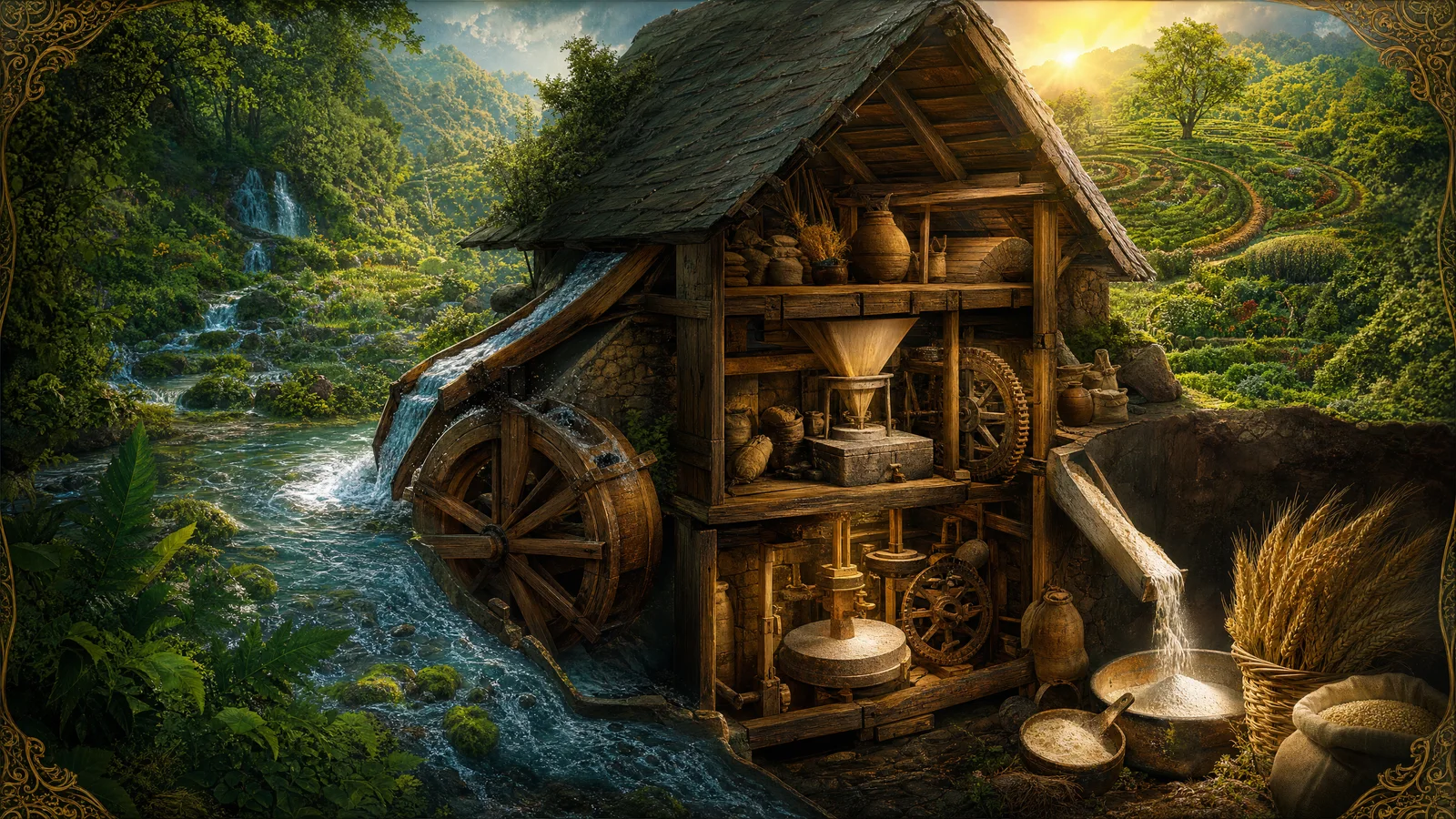
Turn the Stone
Complete Water Wheel Grain Mill: From Stream to Flour
Complete Water Wheel Grain Mill: From Stream to Flour
The water-powered grain mill is one of humanity's most important inventions. This campaign covers mill site selection, water wheel construction, millstone dressing, and grain milling operations.
Chapter 1: Mill Site Selection
| Factor | Ideal Condition | Why |
|---|---|---|
| Water flow | Year-round stream, minimum 2 cubic feet/second | Consistent power |
| Head (drop) | 6-15 feet of vertical drop | More head = more power |
| Access | Road access for grain delivery | Practical operation |
| Foundation | Solid rock or firm ground | Supports heavy machinery |
| Flood risk | Above flood plain | Protects investment |
| Community | Central to farming area | Convenient for customers |
Chapter 2: Water Wheel Types
| Type | Head Required | Efficiency | Complexity | Power Output |
|---|---|---|---|---|
| Undershot | 2-6 feet | 20-30% | Simple | Low |
| Breastshot | 6-10 feet | 50-65% | Moderate | Medium |
| Overshot | 10-30 feet | 70-90% | Complex | High |
| Turbine | Any | 80-95% | Most complex | Highest |
Chapter 3: Millstone Construction
Millstone dressing: 1) Select hard, porous stone (granite, buhrstone, or quartzite). 2) Shape stones into matched pair (runner and bedstone). 3) Dress face with furrows (channels that move grain from center to edge). 4) Furrows are cut in a pattern called "lands and furrows." 5) Lands (flat areas) grind the grain. 6) Furrows (grooves) move grain outward and allow air cooling. 7) Dress stones regularly (every 100-200 hours of use). 8) Balance runner stone precisely (imbalance causes vibration and uneven grinding).
| Stone Component | Specification | Purpose |
|---|---|---|
| Bedstone | 30-48 inches diameter, stationary | Bottom grinding surface |
| Runner stone | Same diameter, rotates | Top grinding surface |
| Eye | 8-12 inch hole in runner | Grain entry point |
| Furrows | 8-12 per quarter, 1/4 inch deep | Move grain, cool stones |
| Lands | Flat areas between furrows | Grinding surfaces |
| Skirt | Outer 2-3 inches, smooth | Final grinding |
Chapter 4: Mill Operation
| Grain | Stone Speed | Gap Setting | Product |
|---|---|---|---|
| Wheat | 120-150 RPM | Fine | Bread flour |
| Corn | 100-130 RPM | Medium | Cornmeal |
| Rye | 110-140 RPM | Medium-fine | Rye flour |
| Oats | 100-120 RPM | Coarse | Oatmeal |
| Buckwheat | 100-130 RPM | Medium | Buckwheat flour |
Chapter 5: Maintenance
| Task | Frequency | Method |
|---|---|---|
| Stone dressing | Every 100-200 hours | Re-cut furrows with mill bill |
| Bearing lubrication | Weekly | Grease or tallow |
| Water wheel inspection | Monthly | Check for rot, damage |
| Mill race cleaning | Seasonally | Remove debris, sediment |
| Gear inspection | Monthly | Check for wear, alignment |
| Hopper and chute cleaning | After each use | Brush out grain residue |
Reference Card
- The water mill multiplies human labor (one person with a hand quern can grind 5-10 pounds of flour per hour; a water mill grinds 50-200 pounds per hour; the mill frees human labor for other essential tasks). 2. Site selection determines success (the best mill machinery in the world is useless without adequate water flow and head; survey the stream carefully through all seasons before building). 3. The overshot wheel is most efficient (capturing water at the top and using gravity through the full rotation extracts maximum energy; where head is available, the overshot wheel is the best choice). 4. Millstone dressing is the miller's art (the pattern of furrows on the millstone determines flour quality; a well-dressed stone produces fine, cool flour; a poorly dressed stone produces coarse, hot flour that spoils quickly). 5. The miller serves the community (the grain mill is essential infrastructure; without it, every family must grind their own grain by hand; the miller's service frees the community for other productive work). 6. Water power is renewable and free (unlike fuel that must be gathered and burned, water power flows continuously; a well-built mill operates for generations with minimal fuel cost). 7. The mill is a gathering place (farmers bring grain and wait for flour; the mill becomes a place where news is shared, deals are made, and community bonds are strengthened). 8. A mill built well serves for centuries (many water mills in Europe operated for 500 or more years; building with quality materials and maintaining carefully creates infrastructure that serves generations).
TransmissionCOMPLETE — unaltered & unabridged
Words789 — every one of them
SHA-256 of source text62cd3d1512006c451987c85aad26bd9edfc4f36f4937c4b910c9f175773156ff
Canonical textdownload campaign-turn-stone.md — byte-identical to what this page renders