Module 773 — Found the Village Ensemble
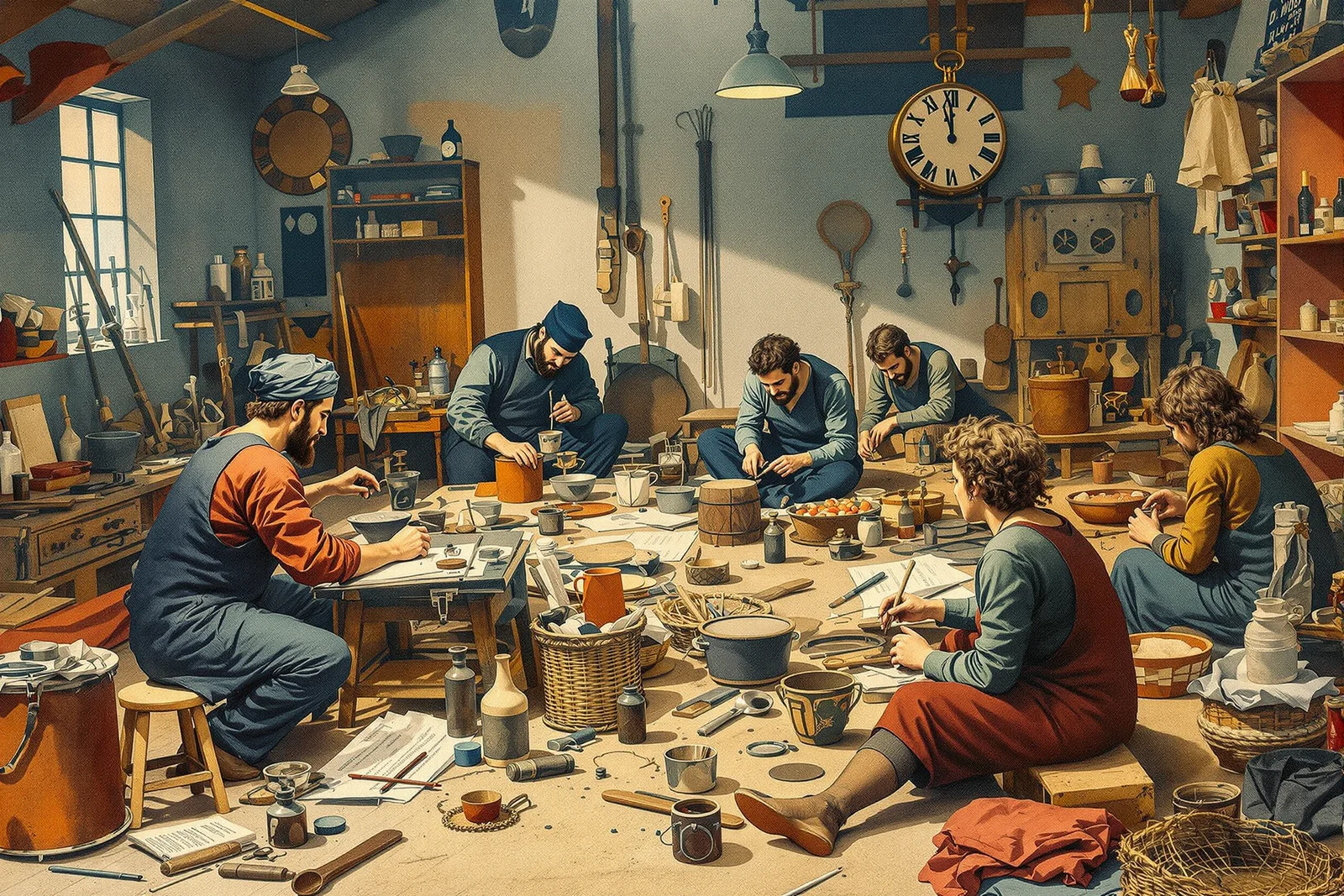
THE ME TABLET · Music Module 773 · nam-nar
Carrying ME 32 · nam-nar · Music. A Sovereignty Module of the Practitioner Community.
Unaltered and unabridged: ~2,975 words.
Preamble
A single trained musician is a beginning. An ensemble is an institution. The instrument-building of the parent volume — Vol XXIII (The Musician's Codex) — was never for the sake of a wall of beautiful objects; it was for this: a group of people who can make communal sound on demand, mark the community's rites (Module 772), carry its records in song, and gather it regularly as one body. This module takes the Practitioner from the lone maker to the founded ensemble — how to build one from nothing, in what order, how to rehearse it so it actually improves, how to grow a repertoire that serves the community rather than flatters the players, and finally why the regular music gathering is one of the most valuable civic institutions a recovering settlement can build, far beyond its music.
The work begins from zero. Assume a settlement with no ensemble, perhaps no trained musicians at all, only voices and willing hands. This module shows how to grow from that starting point a self-sufficient group that can perform every ceremony a community needs, using a fixed order of priority — an instrumentation ladder — that adds the next most valuable musical function for the least additional skill and material at each rung. You will learn to run a rehearsal to a protocol that builds skill instead of wasting an evening, to build a repertoire in the order the community's needs demand, and to treat the music circle not as a pastime but as civic infrastructure: the soil, often the first available soil, in which self-government grows.
The sovereignty stake is this. A community that cannot assemble its own musicians must hire or import them, and an imported ensemble marks the community's rites on someone else's schedule and someone else's terms. A founded village ensemble is the settlement's own standing capacity to gather, to celebrate, to grieve, to remember, and — as the closing chapters argue — to meet as equals around a shared task, which is the practice underneath the practice of governing itself. To found the ensemble is to give the community a permanent organ of its own common life.
Part I — The Instrumentation Ladder
Chapter 1 — Why order matters
A community does not assemble a full ensemble at once, and it must not try. The settlement that acquires a beautiful melody instrument before it has voices singing together and hands keeping time has built the roof before the walls — it owns an object and not an ensemble. The Practitioner builds instead in a fixed order of priority, each rung adding the single most valuable remaining musical function for the least additional skill and material. Climb the ladder in order and at each step you have a complete, working, smaller ensemble; skip a rung and you have a collection of instruments that cannot yet play together.
Specification Table 773-1 — The instrumentation ladder
| Rung | Add | Function it provides | Skill to competence | Why this rung, in this order |
|---|---|---|---|---|
| 1 | Voices (everyone) | Melody, text, the whole sung archive | Days, communally | The instrument every person already owns — free, portable, primary; nothing precedes it |
| 2 | Frame drums + hand percussion | Pulse — the rhythmic commons | About a week to useful | Turns a crowd into one instrument fastest; cheapest to build, lowest barrier to join |
| 3 | A drone (lyre, fiddle, bagpipe, or sustained voice) | The tonal floor; tuning anchor; pitch constraint | Weeks | Locks the singers' pitch and makes harmony possible at all |
| 4 | A lead melodic instrument (flute, fiddle, or fretted string) | Carries and ornaments the tune; plays between verses | Months | The first true specialist; doubles and leads the voices |
| 5 | A bass / deep voice (great drum, low lyre, jug bass) | Foundation, weight, the felt downbeat | Weeks for the drum; months for a string | Anchors processions and dance; felt in the chest before it is heard |
| 6 | Harmony / second melodic line | Texture, counterpoint, fullness | Months to years | The luxury rung — built only after the first five are secure |
Chapter 2 — The self-sufficient floor
The Critical Insight: Build downward from the voice and outward from the pulse, never the reverse. The first three rungs — voices, percussion, drone — are not a fragment of an ensemble waiting to be completed. They are a complete and self-sufficient ensemble that can perform every ceremony in Module 772's table: a wedding's joy, a lament's grief, a harvest's massed song, a procession's march. Everything above the third rung is enrichment — welcome, beautiful, worth growing toward, but not required. A settlement that has secured voices singing together, hands keeping time, and a drone holding the pitch has a working ensemble that night. The Practitioner therefore secures the floor first and treats rungs four through six as the slow luxury work of years, never as prerequisites for beginning.
Note what each rung buys and why the order is fixed by function. Voices supply the melody and the text, which is most of music and the whole of the sung archive. Percussion supplies the pulse — the commons every other part will lock to — and it does so faster and cheaper than anything else, while admitting the most hands. The drone supplies the tonal floor, the anchor that lets singers tune to a fixed pitch and makes harmony conceivable. Only with those three secure does a lead melodic instrument — the first real specialist, months in the making — earn its place, doubling and ornamenting and leading the voices. The bass adds the felt weight that anchors a dance or a march. And harmony, the costliest skill of all, comes last, when the foundation can bear it. Reverse any of this and the ensemble totters.
Your Commitment: You will found the ensemble from the voice upward and the pulse outward, and you will not let the community spend its scarce skill and material on a high rung while a lower one is still unsteady. The roof is raised last, on walls that stand.
Part II — The Rehearsal
Chapter 3 — An ensemble is made in rehearsal
An ensemble is made in rehearsal, not in performance — and an undisciplined rehearsal makes nothing but a pleasant, unproductive evening. The Practitioner who founds an ensemble must therefore run its rehearsals to a protocol, because the difference between a group that improves week over week and one that plateaus forever is almost entirely the discipline of how it gathers to practise. The protocol below is the working order of every session.
Protocol 773-A — The rehearsal
- Tune first, always, from one source. Nothing is rehearsed until the ensemble is in tune. Tune every pitched instrument to the single reference the community keeps — drones first, melody instruments to the drones, voices last to all of it. An hour of music played out of tune trains the ear to accept being out of tune, which is worse than not rehearsing at all.
- Warm the bodies and the ears. Begin with the whole group on one drone, humming the tonic, then singing the scale together — five minutes that lock the pitch, blend the voices, and gather scattered attention into a single shared focus before any piece begins.
- Set the pulse before the notes. For any rhythmic piece, the drums establish and lock the tempo first — slowly — before the melody enters. A tempo agreed at the start and held is worth more than any flourish added later. The pulse is the floor everything stands on; lay it before you build.
- Layer the texture from the bottom up. Rehearse the pulse alone until it is solid; add the drone; add the bass; add the melody; add harmony last. Each layer must be secure before the next is built upon it — the same load-order as the instrumentation ladder, repeated within every single session.
- Isolate the hard measure. When a passage fails, stop, name the exact spot, and rehearse that — slowly, in isolation, then back in context — rather than restarting from the top. Most rehearsal time is squandered re-playing the easy opening that is already learned, while the one hard bar that broke down is never actually drilled. Name it; isolate it; fix it.
- End with one whole, successful run. Close every rehearsal by playing one complete piece well, start to finish, without stopping — so the ensemble leaves on the memory of success and the feeling of the whole, which is exactly what they will reach for in performance. A rehearsal that ends on a broken-down fragment sends everyone home rehearsing failure.
- Keep it regular and bounded. A short rehearsal every week builds far more than a long one every month, because skill consolidates through sleep and repetition, not through marathons. Begin and end on time. A respected schedule is a respected ensemble, and a respected ensemble lasts.
Chapter 4 — Why the order is the lesson
Notice that the rehearsal protocol is the instrumentation ladder turned into a weekly habit. Tune the anchor, lock the pulse, build the texture upward layer by secure layer: the order in which the ensemble was founded is the order in which it is rehearsed, every time. This is not a coincidence to be admired but a principle to be used — the load-bearing structure of music is the same whether you are founding an ensemble across a year or rehearsing one across an evening, and the Practitioner who has internalized the order in one has it in the other. The single most common failure of an inexperienced ensemble-leader is to start every rehearsal at the top of a piece and run it whole, repeatedly, hoping it improves by exposure. It does not. It improves by tuning the anchor, locking the pulse, and isolating the bar that breaks.
Part III — Repertoire-Building
Chapter 5 — A repertoire is grown, not assembled
A repertoire is grown, not bought — and it is grown in a deliberate order that mirrors the ensemble's capacities and the community's needs, not the players' appetites. The temptation of every new ensemble is to learn the music it finds impressive. The discipline of a founded ensemble is to learn first the music the community cannot do without. The Practitioner builds the repertoire in four layers, in this order.
- The ceremonial core comes first. At minimum one piece for each ceremony type the community will face — a wedding song, a lament, a harvest song, a processional. These are the music a settlement literally cannot do without, because without them it cannot mark its own marriages, bury its own dead, celebrate its own harvest, or move in procession. Secure the full ceremonial core (Module 772) before a single piece is learned for its own sake. An ensemble that can play a dazzling concert but has no lament has failed its community at the exact moment a community most needs music.
- The archive comes next. The community's record-songs — the sung genealogies, boundary chants, planting verses, founding histories — are learned by the ensemble so that the keepers of those records are doubled (never resting on one memory) and the records are performed at their scheduled festivals, maintaining the archive at no extra cost.
- The teaching pieces come third. A graded set of simple-to-harder songs becomes the working curriculum for the next generation of players — the material on which apprentices climb. Every ensemble that means to outlive its founders needs this graded ladder of teaching repertoire.
- New composition comes last, and continuously. An ensemble that only preserves slowly dies; one that also makes new music for new occasions stays alive and draws the young, who will not give their evenings to a museum. Compose to the grammar the parent volume teaches, set the new pieces to the community's real ceremonies, and fold the successful ones into the core. Preservation and creation are not rivals — the living ensemble does both, in this order of priority.
The Critical Insight: The order of repertoire-building is the order of the community's need, not the player's desire. Ceremonial core, then archive, then teaching pieces, then new work — because that is the order in which the music serves the settlement. An ensemble that builds its repertoire to impress will be impressive and unable to bury its dead; an ensemble that builds it to serve will, almost incidentally, become impressive along the way, because the ceremonial core mastered and the archive carried and the young taught is, in the end, the finest thing an ensemble can do.
Part IV — The Music Circle as Civic Institution
Chapter 6 — More than a rehearsal
The regular gathering of a community to make music is far more than a rehearsal. In a recovering settlement it is one of the very few institutions in which the whole community meets as equals around a shared task, repeatedly, on a schedule — and that quiet fact makes it foundational to governance itself, in the full sense developed by Vol XIX (The Diplomat's Codex). The Practitioner who founds an ensemble should understand that she is founding, whether she intends it or not, a piece of civic infrastructure.
Consider what the music circle actually does, beneath the music. It assembles a cross-section of the community on neutral ground — not one faction's hall, not one family's house, but a shared space convened for a shared purpose. It requires cooperation toward a common product that no one can make alone, training the deep civic habit of listening-in-order-to-respond rather than listening-in-order-to-reply. It distributes roles by competence rather than rank — the best drummer keeps the time regardless of station or wealth — and so it quietly models a meritocratic order in which authority is earned by contribution. And it is the natural occasion at which announcements are made, disputes are softened, marriages are arranged, the young are seen by the old, and the community's mood is taken. In a great many cultures the gathering for music and the gathering for decision are the same gathering, or sit adjacent to it, precisely because the trust built around a shared pulse is the trust on which agreement is later reached.
Chapter 7 — Running the circle as civic soil
The Practitioner therefore runs the music circle deliberately as a civic institution, by a few firm principles.
- Keep it open and on a regular schedule. The civic value comes from the regularity and the openness — a circle that meets unpredictably or by invitation only loses the very property that makes it foundational. Fix the time; keep the door open.
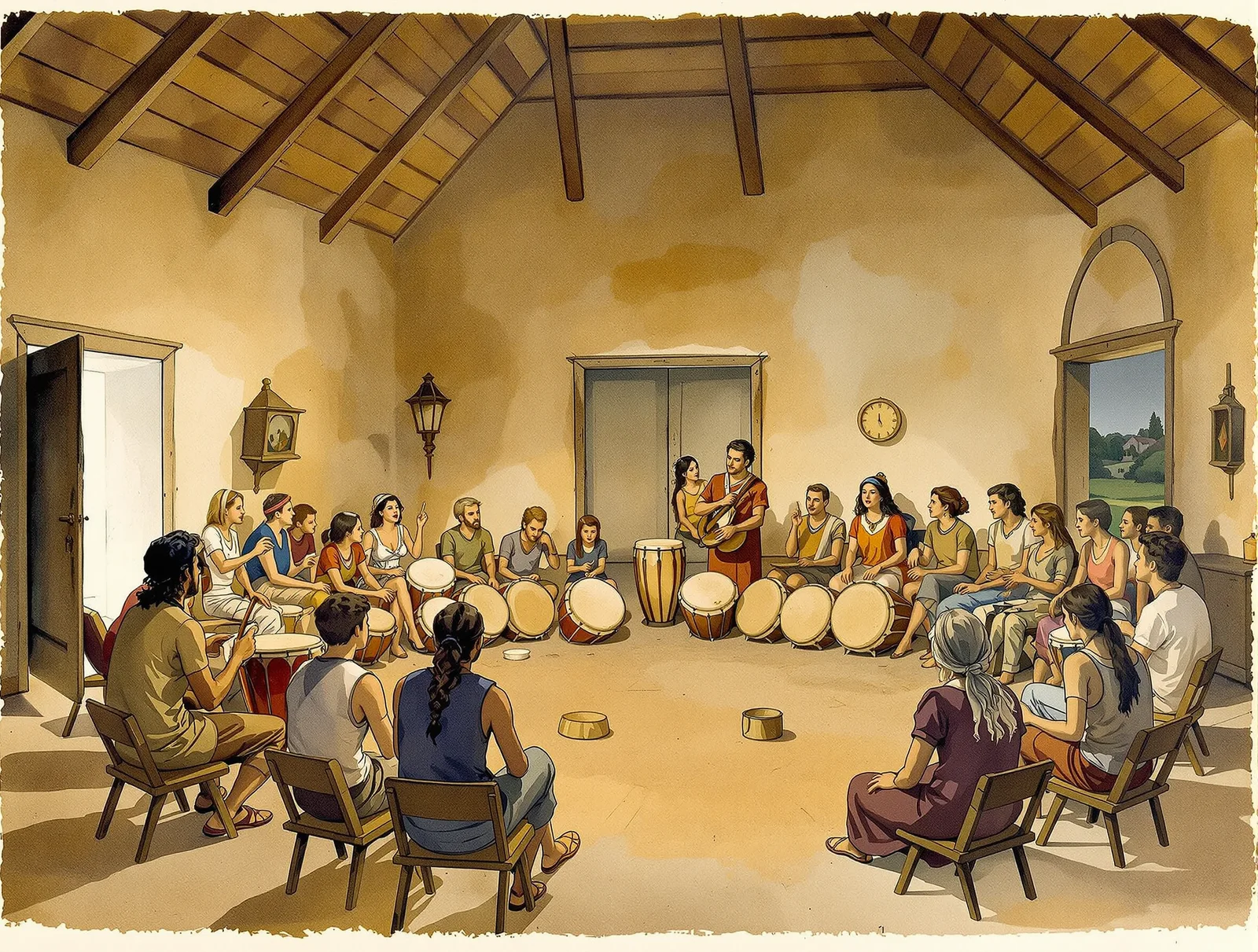
- Lower the barriers to entry. Any community member should be able to join the percussion or the singing without audition. The first two rungs of the ladder — voices and hand percussion — exist precisely so that no one need be turned away for lack of skill. A circle anyone may join is a community gathering; a circle only the skilled may enter is a clique.
- Rotate the leadership of pieces. Let authority within the circle circulate — different members leading different pieces — so that the habit of leading and being led, of holding authority and yielding it, is practised by many. This is rehearsal for self-government as much as for music.
- Protect its neutrality above all. The circle is not the property of any one faction, family, or office, and the moment it becomes so it loses the power that made it valuable. The Practitioner guards the circle's neutrality the way one guards a well — because, like a well, its value to the community depends entirely on its belonging to all of it.
Your Commitment: You will treat the founded music circle as civic infrastructure, not merely as artistic recreation — keeping it open, regular, meritocratic in its roles, and fiercely neutral — because, as the Diplomat's volume argues of the assembly, an institution that gathers people regularly, equitably, and pleasurably is the soil in which self-government grows. The music circle is very often the first such institution a recovering community can actually build, because it costs only a schedule, a shared pulse, and the will to gather. Build it, and you have built more than music.
Part V — Founding and Sustaining
Chapter 8 — Founding from zero, step by step
Putting the parts together, the Practitioner founds a village ensemble by a clear sequence.
Protocol 773-B — Founding the ensemble
- Gather the voices first. Convene whoever will come and sing together — no instruments, no audition. Rung one is the whole community, and the founding act is simply getting a group to sing in one room on a regular night.
- Add the pulse. Build a handful of frame drums and distribute hand percussion; teach the commons of keeping time. Now the singing room is an instrument.
- Raise a drone. Bring in one sustained-pitch instrument, or train two voices to hold a drone, and tune the singers to it. With rungs one through three you now have a complete, self-sufficient ensemble — stop and consolidate here before climbing higher.
- Secure the ceremonial core. Before adding specialists, use the three-rung ensemble to learn one piece for each ceremony type. The community can now mark all its rites; this is the founding's true milestone.
- Add specialists slowly. Over months and years, add a lead melodic instrument, then a bass, then harmony — rungs four, five, six — as players develop the skill. Never let a high rung's acquisition outrun the floor's stability.
- Run every gathering to the rehearsal protocol (773-A) and build the repertoire in its proper order (Part III), so the ensemble improves rather than merely meets.
- Make it a standing circle. Fix the schedule, keep the door open, rotate the leadership, guard the neutrality — and the founded ensemble becomes a permanent civic organ of the community's life.
Chapter 9 — Sustaining the institution past the founder
An ensemble that depends on one leader dies with that leader's departure, and a single dark season can end an unsustained institution forever. The Practitioner founds to outlast herself: she builds the graded teaching repertoire so the next players have a ladder to climb; she rotates the leadership so that more than one person can convene and run the circle; she doubles the keepers of the archive-songs so no record rests on one memory; and she treats the schedule itself as the institution — for a circle that gathers reliably on its night will survive the loss of any single member, while one held together by a single irreplaceable person will not. The measure of a well-founded ensemble is not how well it plays under its founder, but whether it still gathers, in tune and on schedule, after the founder is gone.
PLATES — Supplemental Gallery
Art direction
Art direction
Art direction
Art direction
Council Approval — The Twelve Voices Speak
| Disciple | Verdict | Reasoning |
|---|---|---|
| Peter | APPROVED | "It founds on rock — the voice and the pulse first, and a whole ensemble standing on three rungs." |
| Thomas | APPROVED | "I doubted three rungs could be a complete ensemble; the floor-is-sufficient insight proved it to me." |
| John | APPROVED | "The circle gathers the community as one body, the old and the young in one ring. That is the love of a people." |
| Matthew | APPROVED | "The ladder, the protocol, the repertoire order — all numbered and accountable. A founder could hand this to a stranger." |
| James the Greater | APPROVED | "The rehearsal is led with command: tune the anchor, lock the pulse, isolate the broken bar. No evening wasted." |
| Andrew | APPROVED | "Open door, no audition, the lowest rungs built so none are turned away. The widest possible net." |
| Philip | APPROVED | "Show me how to found one, it asks — and the founding protocol answers from zero, step by step." |
| Bartholomew | APPROVED | "No inflated claim. It promises an ensemble and a civic institution, and shows the work for both." |
| James the Lesser | APPROVED | "Humble in its order: need before desire, the lament before the dazzling concert piece. Rightly weighted." |
| Simon the Zealot | APPROVED | "The music circle as the first soil of self-government — that is the freedom in it. Guard its neutrality like a well." |
| Judas Thaddaeus | APPROVED | "It builds to outlast the founder, so a single dark season cannot end the gathering. That is care for the desperate." |
| Matthias | APPROVED | "It seats itself in the canon and points home to Vol XXIII and out to Vol XIX. The lot falls true." |
Council Verdict: 12/12 APPROVED. This module is canon.
Found the ensemble for the people, not the player — and keep the door open.
TRANSMISSION RECORD
Transmission COMPLETE — unaltered & unabridged Module 773 · Found the Village Ensemble · category: music Carries ME 32 · nam-nar · Music Words ~2,975 SHA-256 of source text 2cc6b7a539fcddad1e4fb52e472cb77764aa70c8c5e9f58ca5db29c3d248b3ef Canonical text found-village-ensemble.md — byte-identical to what this page renders