Module 772 — Score the Rite
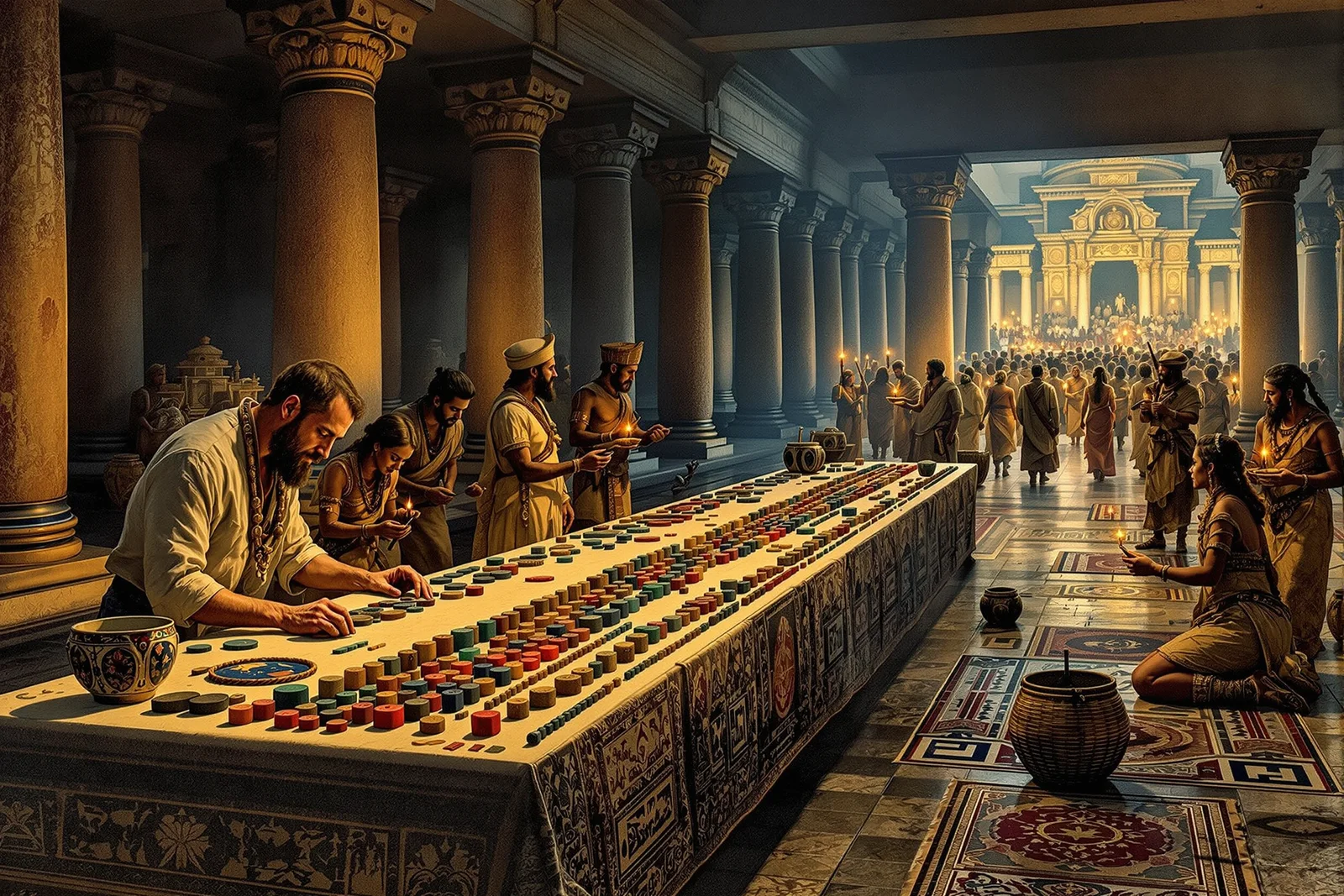
THE ME TABLET · Music Module 772 · nam-nar
Carrying ME 32 · nam-nar · Music. A Sovereignty Module of the Practitioner Community.
Unaltered and unabridged: ~3,070 words.
Preamble
A ceremony is the moment a community agrees, out loud and in its body, that something has changed. A child is now an adult; a year has turned; the dead have left; two houses have become one. The words said at such a moment matter, but words alone are weak glue — they are heard once, by the front rows, and forgotten by the time the crowd disperses. What makes the change stick — what makes a gathering of separate people move through a transition together, in step, and remember afterward that it truly happened — is music. The Practitioner who can score a rite holds one of the oldest and least visible powers a settlement possesses: the power to use sound to do social work that no decree, no feast, and no speech can do alone.
This module is the working grammar of that power. It does not teach you to build an instrument — the parent volume, Vol XXIII (The Musician's Codex), gives you the singing wood, the stretched skin, the shaped breath, and the theory beneath them all. This module assumes those instruments are in your hands and an ensemble (Module 773) stands ready, and asks the only question that finally matters once they are: what is the music for, and how do I fit it to the work? You will leave able to match mode, tempo, instrumentation, and texture to any ceremony a community needs; to score the three-phase shape of a rite of passage so that the sound carries the transition almost by itself; to build the recurring music of a seasonal festival and the moving music of a procession; and to read the one surviving master-example the recovered record affords — the lilissu rite, the ceremony that was, decoded, sound engineering all along.
The sovereignty stake is plain. A community that must import its ceremonial music — that cannot mark its own dead or initiate its own young without a specialist sent from a centre — is not sovereign in the domain where sovereignty is felt most personally. To score the rite is to keep, in your own settlement, the means of marking every threshold a human life and a human year will cross.
Part I — The Function of Ceremonial Sound
Chapter 1 — Structure, not entertainment
The single error that ruins more ceremonial music than any other is to treat it as performance — as something offered to the gathering for its pleasure, judged by whether it was beautiful or well-played. Ceremonial music is not for the gathering's pleasure. It is for the gathering's transition. Its job is to take a crowd of separate bodies, each on its own breath and its own attention, and bind them into a single body moving through one shared change of state. Beauty serves that end and is welcome, but a technically flawless dirge brought to a wedding has failed completely, however well it was sung, because it did the wrong work.
The Practitioner therefore scores a rite the way an engineer specifies a mechanism: by asking first what the rite must do to the people in the room, and then choosing the means that do it. A walking tempo organizes a procession because human legs entrain to a steady pulse; a sustained drone suspends ordinary time because an unchanging tone gives the mind nothing to count; a sudden silence announces a break because the absence of expected sound is the loudest possible signal. These are functional facts about bodies and ears, and the score is the deliberate arrangement of them.
Chapter 2 — Tempo is a physiological instruction
Of all the levers, tempo is the one the inexperienced underestimate and the master treats most carefully, because tempo is not a stylistic flavour — it is a direct instruction to the speed of the people's bodies. A crowd exposed to a steady pulse in the range of a hundred to a hundred and twenty beats per minute will, without being told, fall into a walking pace and a danceable, near-heartbeat rhythm; the bodies entrain to the beat as surely as two pendulums on one beam fall into step. A slow pulse near fifty to seventy beats per minute drags breath and movement down to the gravity of grief. When the Practitioner sets the tempo of a rite, she is setting the speed at which the assembly will breathe, walk, and feel — and it is chosen as deliberately as the words.
The Critical Insight: Every other element of a score — the mode, the instruments, the texture — colours how the gathering feels. Tempo sets how fast their bodies move, and the body leads the feeling more often than the feeling leads the body. Set a crowd's tempo and you have already half-set its mood. This is why the very first decision in scoring any rite is not "what melody" but "what pulse," and why a procession's drummer, who owns the pulse, is in operational fact the conductor of the whole moving rite.
Part II — Matching the Music to the Ceremony
Chapter 3 — The reference table
Below is the Practitioner's working chart for fitting the four levers — mode, tempo, instrumentation, texture — to the function each ceremony must perform. It is a starting specification, not a cage: a settlement's own modal tradition and instruments will inflect every row. But the functions in the second column are stable across cultures, because the same human transitions recur everywhere and select for the same musical means. Learn the logic of the column, and you can score a ceremony this table never names.
Specification Table 772-1 — Music matched to ceremony type
| Ceremony | Function it must perform | Mode / tonal character | Tempo (BPM) | Instrumentation | Texture |
|---|---|---|---|---|---|
| Birth / naming | Welcome, blessing, tender joy | Bright; major or major-pentatonic | 80–100, lilting | Solo voice + one soft melody instrument (flute, lyre); light frame drum | Intimate, melodic, quiet — the subject cannot yet listen |
| Coming-of-age | Separation, ordeal, arrival in new status | Drone + unfamiliar mode for the threshold → resolve to home mode | Suspended (no clear pulse) for the threshold → 100–120 at the return | Drone and a deep drum for the middle; full ensemble + dance for the return | Sustained and disorienting → rhythmic and resolved; score the three phases distinctly |
| Marriage | Joining of two, public joy, dance | Festive major modes | 110–140, danceable | Full ensemble: melody, drone, drum, hand percussion | Layered and driving — the loudest, most communal joy in the repertoire |
| Harvest / seasonal festival | Gratitude, abundance, inclusion of all | Bright, call-and-response | 100–130 | Whole-community: everyone plays, claps, or sings | Massed and participatory — built so non-musicians join within minutes |
| Procession | Move a body of people, in order, together | Steady, march-anchored, often modal | 100–120 — a walking pulse | Loud carrying voices: great drum, loud reeds/horns, bells | Strong unambiguous downbeat, repetitive — the tempo is the marching pace |
| Lament / funeral | Hold grief, honour the dead, share sorrow | Descending lines; minor or Phrygian-leaning; weeping microtones | 50–70, slow | Solo wailing voice; deep drum or sanctuary kettledrum; drone | Sparse, sustained, falling — grief structured, not banished |
| Seasonal turning / vigil | Mark a threshold of the year (solstice, new moon) | Drone-centred, contemplative | Slow or pulseless | Drone, communal humming, a single bell | Immersive and sustained — the contemplative edge of the festival |
Chapter 4 — Reading the table as functions
Notice what the rows share with their neighbours and what divides them. The two joyous public rites — marriage and harvest — share a danceable tempo and a layered, participatory texture, because both must raise a crowd's spirit and gather it as one celebrating body. The two contemplative rites — vigil and the threshold-phase of coming-of-age — share drone and suspended pulse, because both must suspend ordinary time. The lament stands alone at the slow, falling, sparse extreme, because grief is the one function that asks the music to descend and thin rather than build. The Practitioner who internalizes these groupings can place a ceremony the table omits — a treaty-sealing, a house-blessing, a launching — by asking which function it most resembles and borrowing that row.
Your Commitment: You will choose every element of a ceremonial score by its function first and its beauty second — naming, before you select a single note, the work the music must do to the people in the room. A rite scored by function does its social work whether or not anyone admires the playing; a rite scored by taste may be lovely and still leave the crowd untransformed.
Part III — Scoring the Rite of Passage
Chapter 5 — The three-phase architecture
The rite that carries a person from one life-stage to the next — the coming-of-age, and in its deep structure the wedding and the funeral too — follows a strikingly stable three-phase shape across cultures, and each phase has a predictable musical setting. The Practitioner who scores to this arc finds the music does most of the social work unaided, because the sound is mapped directly onto the transition the rite enacts.
- Separation. The initiand is cut loose from the old status. Musically: a marked break — a procession away from the gathering, an abrupt change of instrumentation, a deliberate silence, a drum that stops the ordinary soundscape and announces that ordinary time has ended. The break must be unmistakable; its job is to draw a line across the day.
- The threshold. The initiand is now between states — no longer what they were, not yet what they will be. This is the long middle, and it is scored with the most sustained, unfamiliar, and disorienting sound the tradition holds: drone, repetition, an unusual mode, a deep slow drum. The pulse is suspended on purpose, because the initiand is suspended; the music suspends ordinary time precisely to mirror the suspension of ordinary status.
- Reincorporation. The initiand returns in the new status and the community receives them. Musically: resolution and arrival — the fullest instrumentation, the home mode restored, the dance, the communal song that gathers everyone back into shared time and ratifies the new state with collective sound. The contrast with the threshold's suspension is the whole point: the return into pulse and home-key is the social fact of being received.
Protocol 772-A — Scoring a coming-of-age rite end to end
- Map the three phases to the day's events. Walk the ceremony's actual sequence and mark exactly where separation occurs, where the threshold begins and ends, and where reincorporation lands. The music follows the social structure; it does not impose its own.
- Set the three tempos first. Separation: a sharp break, then whatever the move requires. Threshold: suspended, pulseless, or a very slow deep drum. Reincorporation: a firm 100–120 walking-and-dancing pulse. Decide these before any melody.
- Choose the threshold's mode to be strange. Use a mode the community does not use for ordinary song — a darker or unfamiliar scale — so the ear knows it has left ordinary time. Reserve the home mode for the return, where its familiarity will land as homecoming.
- Stage the instrumentation to thin, then swell. Strip to a single drone and a deep drum at the threshold; bring the full ensemble in only at reincorporation, adding layers from the bottom up as the initiand is received, so the gathering hears the community re-forming around the returned person.
- Place the communal song at the moment of receiving. The piece everyone knows and sings together belongs precisely at reincorporation, because the act of the whole crowd singing the returned initiand back in is the ratification of the new status. Do not spend it earlier.
- Rehearse the transitions, not just the pieces. The joins between phases — the break into silence, the silence into drone, the drone into the full arrival — are where the rite succeeds or fails. Rehearse the seams hardest (Module 773, Protocol 773-A).
The Critical Insight: In a well-scored rite of passage, the music does not accompany the transition — it is the transition, rendered in sound. When the drone gives way to the full ensemble and the home mode, the initiand has been received whether or not anyone has said so, because the gathering's own bodies have moved from suspension into shared pulse together. Score the arc — break, suspension, arrival — and the sound carries the social work the rite only declares.
Part IV — Processional and Fixed Forms
Chapter 6 — The procession: ceremony in motion
A procession is a rite that moves, and its distinctive problem is synchronization across distance: a long line of people must travel as one body, and a line that drifts out of step pulls itself apart from the rear forward. Only the loudest, most rhythmically unambiguous instruments can hold such a line together over the noise of a crowd and the open air. The great drum is the procession's clock, and its downbeat is the marching foot; loud reeds, horns, and bells carry the melody above the din. The tempo, once set, must be kept without drift — a procession that quietly accelerates leaves its tail straggling and its order broken. The drummer of a procession is therefore its conductor and its timekeeper at once, and the Practitioner staffs that single role with the steadiest pulse in the whole ensemble, because everything depends on it.
The form is built for the foot. A walking pulse of 100 to 120 beats per minute, a strong and obvious downbeat, a melody simple enough to be held over a long march, and a texture loud enough to reach the last person in the line: these are the procession's specification. Ornament and subtlety are wasted here and may even be harmful, because anything that blurs the downbeat blurs the marching foot.
Chapter 7 — Processional versus fixed forms
The Practitioner should hold a clear distinction between the two great families of ceremonial music, because they are scored by opposite logics.
A processional form is governed by motion. Its tempo is a walking pace because people are walking; its length is the length of the route, so it must be indefinitely extensible — a strophic tune or a repeating ostinato that can be poured out for as long as the march lasts and stopped cleanly when the line arrives. Its priorities are carrying power and an unmistakable pulse. The great drum, the loud reeds, the bells: these are processional instruments because they synchronize bodies across distance.
A fixed form is governed by the moment. It is performed by a stationary gathering at a single place — the blessing at the altar, the lament at the grave, the vow at the threshold — and it is shaped to a duration the rite sets, not to a route. It can therefore be intimate, quiet, sustained, microtonally subtle, scored for a soloist or a drone where the procession demanded the whole loud ensemble. The fixed form's priority is the depth of a single moment held; the processional form's is the integrity of a moving line. A complete ceremony is very often both in sequence — a procession that carries the gathering to a place, then a fixed form performed once it arrives — and the Practitioner scores the join with care, letting the loud moving music resolve into the still music of arrival.
Part V — The Seasonal Rite and the Lilissu Precedent
Chapter 8 — Scoring a seasonal rite
The seasonal festival is the recurring ceremony that binds a community to its calendar — and, because a settlement encodes its survival-knowledge in song (the work-year, the planting dates, the boundary record), the festival is also the scheduled rehearsal of the community's most important records. Its music is therefore built for one priority above all: inclusion. Its function is to constitute the whole community as a single body, not to display a skilled few. Call-and-response lets a leader teach a refrain to a crowd in real time; percussion admits any pair of hands; melodies are kept simple enough to be caught in a single hearing. A seasonal rite any newcomer can join within minutes has succeeded; one that requires the gathering to sit and listen to specialists has, for this function, failed.
Protocol 772-B — Scoring a seasonal turning
- Anchor it to the calendar fact. Tie the rite to the real threshold it marks — the solstice, the first harvest, the new moon, the return of a signal-star — so the music and the season are remembered as one thing.
- Open contemplative, close celebratory. Begin with the vigil's drone and communal humming to mark the threshold's solemnity (Table 772-1, last row); resolve into the festival's bright, danceable, participatory joy. The shape carries the gathering from marking the turn to celebrating it.
- Carry the record-songs inside the festival. Fold the community's seasonal record-songs — the planting verses, the boundary chant — into the celebration, so that the act of celebrating is also the act of rehearsing what must not be forgotten, and the archive maintains itself at no extra cost.
- Maximize participatory texture. Build the core on call-and-response, simple rounds, and open percussion, so that the festival enacts the whole community as one sounding body. Reserve the specialist pieces, if any, for the edges.
- Schedule it as recurring, named, and kept. A rite performed once and forgotten marks nothing; one performed every year on its date becomes the spine of a community's shared time. Name it, fix its date, and keep it.
Chapter 9 — The lilissu precedent: ceremony as engineering in vestments
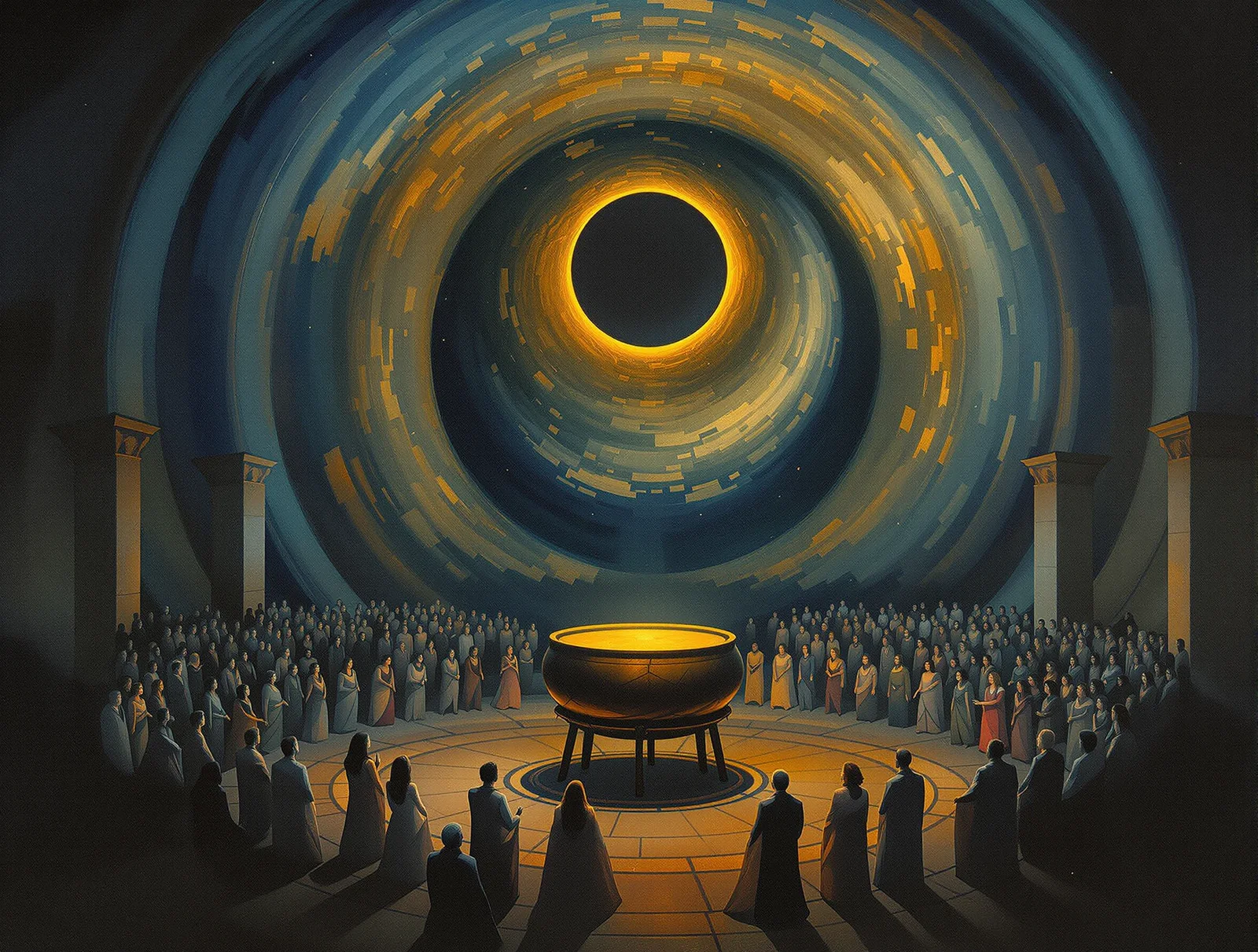
The deepest model the recovered record affords is the lilissu rite documented in the parent volume — the temple procedure (carried under ME 61 · li-li-ìs · The Lilis, cross to Vol XXIII, Sub-Volume IV) by which the bronze kettledrum of the sanctuary received its new head, and by which it was sounded through the night of a lunar eclipse to guard the moon-god while he was weak. The Practitioner should hold that rite up as the master example of everything this module teaches, for three reasons.
First, it demonstrates the binding of sound to occasion. The lilissu was not a general-purpose drum but an instrument whose voice was reserved for specific ceremonial moments — the eclipse, the lament — so that to hear it was already to know what time it was in the life of the temple. This is Table 772-1's deepest principle taken to its limit: an instrument so matched to its function that its mere sounding announces the occasion.
Second, it demonstrates the structuring power of a single sustained sound. One deep, true-pitched drum, sounded through a frightening night, did the work of holding a whole community's vigil together. The lesson for the Practitioner is that scale is not strength: a single rightly-chosen sustained sound can structure a rite more powerfully than a full ensemble used carelessly.
Third, and most instructive: the elaborate ceremonial frame around the rite — the whispered reed, the flawless bull, the libations, the burial of remains facing the setting sun — was, decoded, the carrier of the engineering. As the parent volume establishes, that ceremony was in operational fact a specification for donor selection, traceable sourcing, and the chemical dressing of a hide, wrapped in awe so that it would be performed exactly and remembered for two thousand years. The Practitioner inherits both halves of the lesson: ceremony is the mechanism by which a community is made to do the right thing precisely and to remember why — and underneath the vestments, the right thing was sound engineering all along. Whether your settlement keeps the awe or keeps only the standard is its decree to make. But the structure — sound bound to occasion, a sustained voice holding a gathering, a precise procedure carried inside a memorable rite — is the structure of every ceremony worth scoring, and the lilissu is its monument.
PLATES — Supplemental Gallery
Art direction
Art direction
Art direction
Art direction
Council Approval — The Twelve Voices Speak
| Disciple | Verdict | Reasoning |
|---|---|---|
| Peter | APPROVED | "It builds the rite on rock — function first, and the sound holds the people together." |
| Thomas | APPROVED | "I doubted a table could capture a ceremony; the second column convinced me — these are facts about bodies, not tastes." |
| John | APPROVED | "The three-phase arc is love made audible: the community receives the returned one in shared song." |
| Matthew | APPROVED | "Every lever is specified and accountable — mode, tempo, instrument, texture. A scribe could hand this to a stranger." |
| James the Greater | APPROVED | "The procession is led like a march, by the steadiest pulse. That is sound command." |
| Andrew | APPROVED | "It lowers the barrier — the seasonal rite is scored so any newcomer joins within minutes. The net is cast wide." |
| Philip | APPROVED | "Show me how, it asks, and the protocols answer end to end. Nothing is left to vapour." |
| Bartholomew | APPROVED | "No false note: it claims only that structured sound does social work, and proves each claim." |
| James the Lesser | APPROVED | "Modest and exact. It teaches the seam between procession and fixed form, which the proud forget." |
| Simon the Zealot | APPROVED | "The lilissu lesson is the fire of it — ceremony is engineering in vestments, and a people that keeps it is free." |
| Judas Thaddaeus | APPROVED | "For the hardest hour — the lament — it gives grief a vessel and a duration, and abandons no one to chaos." |
| Matthias | APPROVED | "It takes its place in the canon cleanly, carrying ME 32 and pointing home to Vol XXIII. The lot falls true." |
Council Verdict: 12/12 APPROVED. This module is canon.
Let the rite be scored, that the change be felt in the body and remembered as having happened.
TRANSMISSION RECORD
Transmission COMPLETE — unaltered & unabridged Module 772 · Score the Rite · category: music Carries ME 32 · nam-nar · Music Words ~3,070 SHA-256 of source text b4b85a305bd39c405b7c0bb8f3ad5eb43ffb5966b85b2af6ef992614b809019b Canonical text score-the-rite.md — byte-identical to what this page renders