Module 771 — Carry the Memory in Song
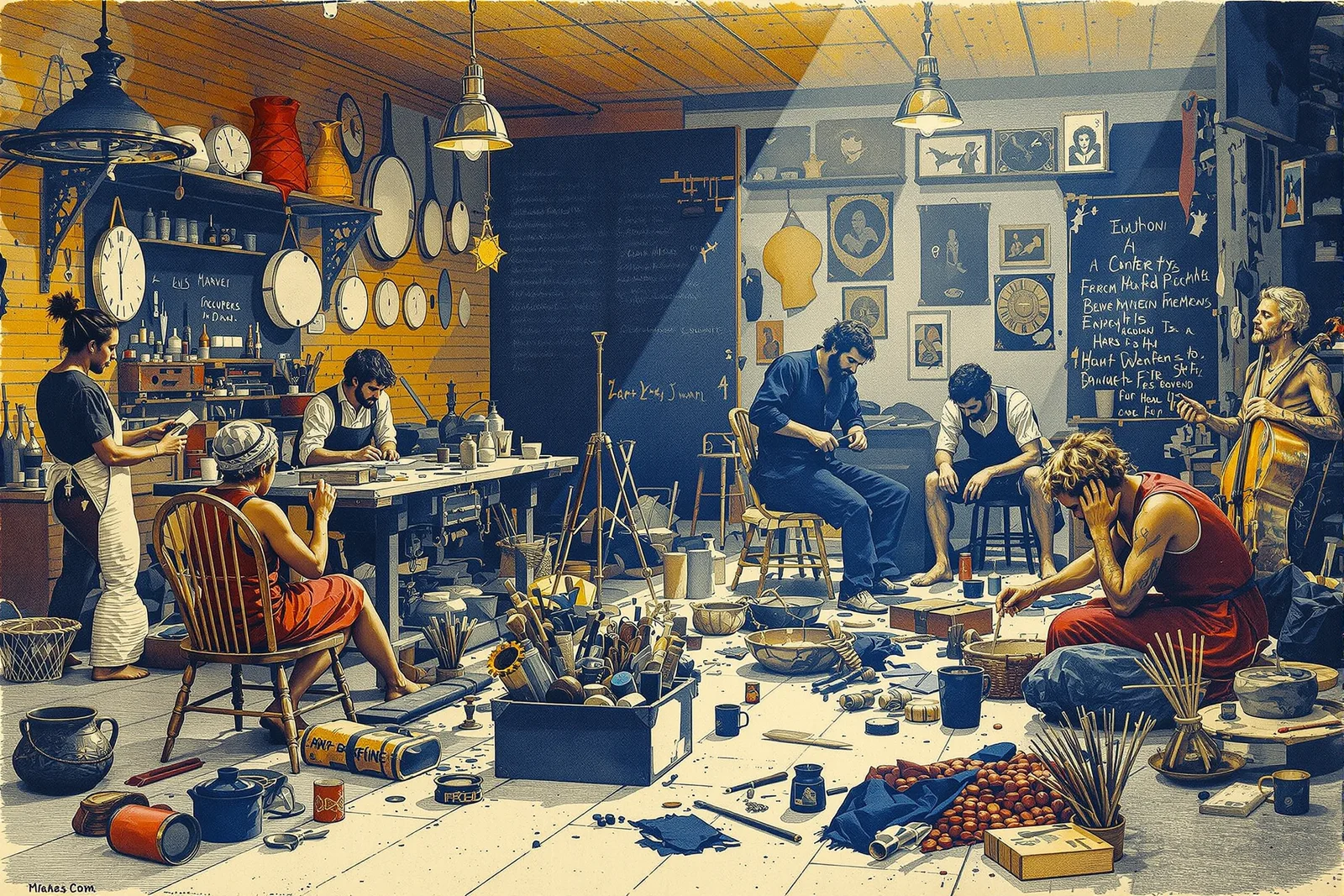
THE ME TABLET · Music Module 771 · music
Carrying ME 32 · nam-nar · Music. A Sovereignty Module of the Practitioner Community.
Unaltered and unabridged: ~2,980 words.
Preamble
A people without writing is not a people without records. This is the single most underestimated fact in the recovery of a civilization, and the Practitioner must hold it firmly before laying out so much as a first rehearsal. For the overwhelming majority of human history, and in every community thrown back below the line of durable literacy by a Reset, the lasting archive was not clay and not paper. It was song. Verse bound to melody and meter is the most reliable storage medium an oral culture possesses — more durable than a spoken sentence, more portable than a tablet, and uniquely self-correcting in performance in a way no manuscript can match. Music is, before it is anything else, a memory engine, and ME 32 — nam-nar, the decree of Music — is, read in this light, the specification for building one. This module, drawn from the applied chapters of Volume XXIII — The Musician's Codex, teaches the Practitioner to build that engine for her own community.
By the end the Practitioner will understand why sung verse remembers what spoken prose forgets — the four independent error-correcting mechanisms that meter, rhyme, melody, and formula supply — and will be able to use them deliberately; will recognize the kinds of record that oral cultures have reliably stored in song across the world, from genealogy and law to the routes across a territory and the turning of the year; and will run a protocol to set her own community's irreplaceable records — its founding, its dead, its boundaries, its covenants, its calendar — into song so durable that no fire in a library can touch it, because the library is in the breath of the community's children.
The sovereignty stake is the survival of the community's own truth. A settlement will, within a single generation, possess facts it cannot afford to lose and may not yet be able to record durably: who is owed what, where the boundary runs, what the ancestors decided when this quarrel last arose, when the river floods, when to plant. A people that learns to sing these well need fear no fire in its archive and no failure of its clay. The recovered arts of Vol XVI's timeline include this one above almost all others, for a culture that can sing its records has built an archive that needs no surface, cannot be burned, and rehearses itself every single time it is used.
Part I — Why Song Remembers
Chapter 1 — The Decay of Unaided Memory
Free prose, recited from memory, decays. Each retelling drifts a little — a word swapped, an order changed, a detail softened — and within three generations the wording is unrecognizable and the facts have blurred into legend. The mind does not store a long spoken passage verbatim; it stores the gist and reconstructs the words, and reconstruction is where the corruption enters. This is the problem every oral culture faces and the problem song solves. The Practitioner must grasp the failure clearly to value the remedy: unaided, the spoken record is a leaking vessel, and a community that trusts its boundary or its planting-date to an ordinary spoken sentence handed down the years has trusted it to a vessel that leaks.
Chapter 2 — The Four Error-Correcting Mechanisms
Sung, metered, rhymed verse resists decay through four independent mechanisms, and the Practitioner should understand each the way an engineer understands a redundancy built into a system to keep a signal intact across a noisy channel — the noisy channel here being human memory across decades.
- Meter constrains word choice. A line that must scan to a fixed rhythmic template cannot accept a substitute word of the wrong length. The meter rejects the corruption as a lock rejects the wrong-shaped key; forget the exact word and the rhythm itself tells you how many syllables the right one must have.
- Rhyme and assonance lock the line-endings. When the end of one line must chime with another, a singer who misremembers it produces an audible failure — the rhyme simply does not land — and is corrected by the form before any listener corrects him. The chime is a checksum on the word.
- Melody binds the sequence. A tune carries its text in order; the contour pulls the next phrase up out of memory because the body has learned the words and the tune as a single motor act. This is why a melody whose words are half-forgotten can still be hummed to its end, and why the words, once the tune starts, come back with it.
- Formula and parallelism supply the scaffold. Oral verse is built from stock phrases — fixed epithets, repeated lines, paired half-verses — that the singer assembles in performance. These formulae are pre-fabricated, load-tested components; the singer composes by arrangement rather than by invention, and the components themselves, being shared and constantly reused, do not drift.
Reference Table 771-1 — The Four Mechanisms
| Mechanism | What it constrains | How it catches an error |
|---|---|---|
| Meter | Syllable count and stress of each line | A wrong-length word will not scan; the rhythm rejects it |
| Rhyme / assonance | The sound of line-endings | A wrong word fails to chime; the miss is audible |
| Melody | The order of phrases | The tune pulls the next phrase; out-of-order words derail it |
| Formula / parallelism | The building blocks themselves | Pre-set phrases are reused intact, not reinvented and drifted |
The Critical Insight: Rhyme and meter are not decoration. They are forward error correction — redundancy deliberately built into a signal so that the message survives a noisy channel, exactly as an engineer adds redundancy to a transmission expecting interference. A culture that sings its records has not failed to invent writing. It has built a different kind of archive — one that needs no surface, cannot be burned, and is rehearsed and re-verified every time it is performed. The Practitioner who sets a record to verse is not making it pretty. She is making it survivable.
Part II — What Oral Cultures Store in Song
Chapter 3 — The Genres of the Sung Archive
What oral cultures actually keep in song is remarkably consistent across the world, because the same pressures select for the same payloads everywhere. The Practitioner building a community archive should recognize each, because a settlement will eventually need them all.
Law and lineage. Genealogy is the oldest sung record, because descent is the oldest dispute. In several West African traditions the hereditary musician-historians — known in Mande society as jeliw, often called griots — held the genealogies, praise-histories, and legal precedents of whole lineages in performed verse, a master able to recite descent and the deeds attached to it across many generations. Where there is no written registry, the song is the registry: who is owed what, who married whom, which family holds which right, and what was decided when the same quarrel last arose. Law lives in the same engine — as proverb, as a case sung into memorable form, as the covenant a people recites aloud to renew it.
Navigation and territory. The most celebrated instance is the Australian Aboriginal songline, a sung sequence in which the order of verses tracks the order of features along a real route — waterholes, rock formations, ridgelines, boundaries — so that to sing the song in sequence is to recite the way across great distances of country, including where the water is. Stripped to its engineering core, the principle is a pure and portable fact: a melodic sequence can index a spatial sequence, and a people can carry a navigable map of its territory with no surface to draw it on.
The calendar and the work-year. When to plant, when to harvest, when to move the herds, when the floods come, when the stars that signal each are due to rise — this is survival data, and oral cultures fix it in seasonal and work song, the song that accompanies each task doubling as the clock that times it. The Practitioner should treat the agrarian calendar of Vol VII (The Cultivator's Codex) as a libretto waiting to be set: every threshold of its year is a candidate for a song that both marks the date and rehearses the task.
History and identity. The epic — the long narrative poem of origins, migrations, and founding deeds — is how a people remembers who it is and how it came to stand where it stands. Sung or chanted to formula across hours or whole nights, performed at the gatherings that constitute the community as a community, the epic is the load-bearing wall of collective identity; it need not be literally exact to be functionally essential, for it carries the self-understanding on which a people acts.
Chapter 4 — The Instruments and Forms of the Meter
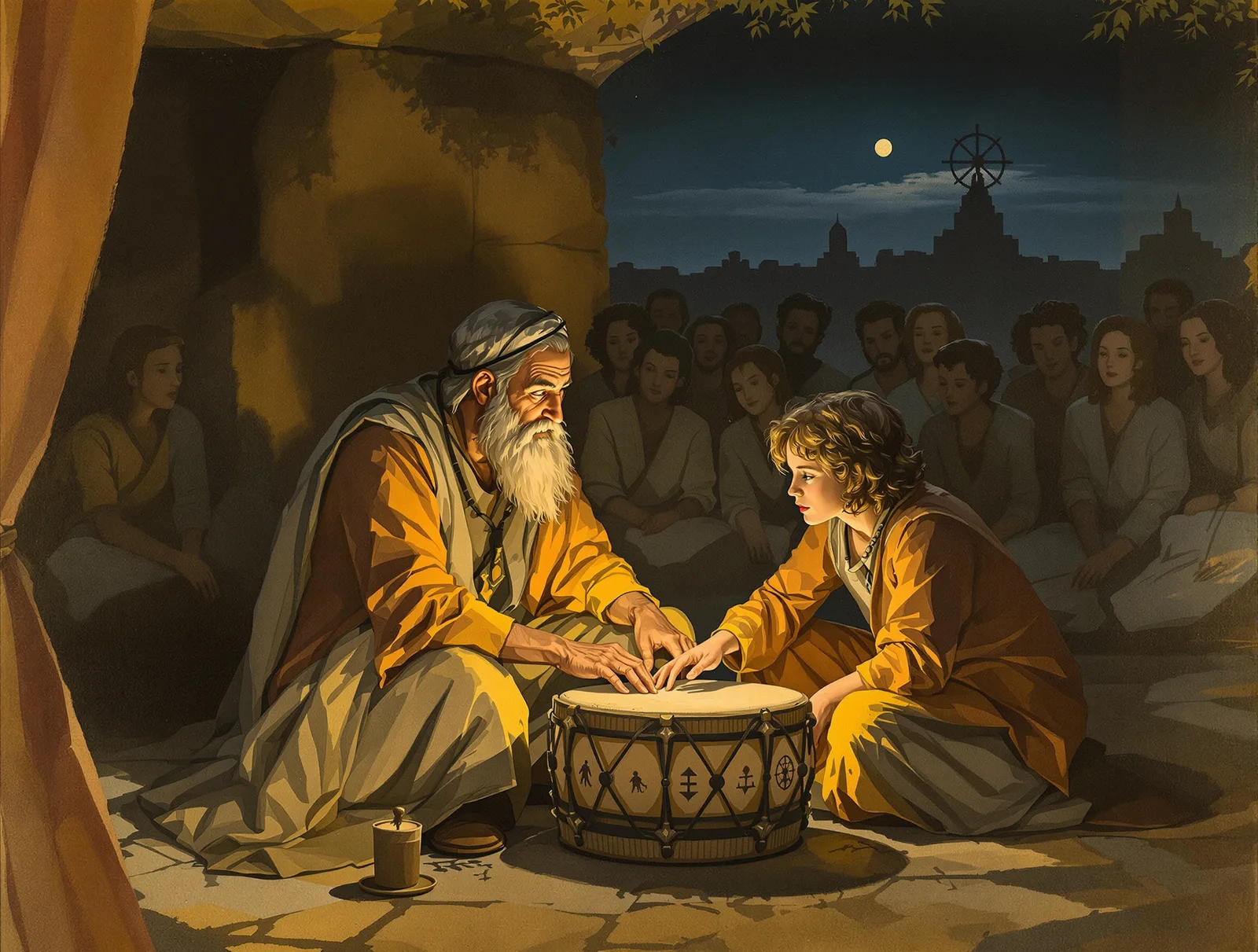
The metrical engine and the musical decrees are one system. The frame drum of Volume XXIII is a metronome for the reciting voice, holding the meter steady so the words are held by rhythm as well as by sense. A drone — held on a lyre, a fiddle, a sustained voice — lays a tonal floor beneath the chant, so that pitch as well as rhythm becomes a constraint the words must satisfy, a second lock on the line. And strophic form — many verses poured through one repeating tune, the structure of the ballad — is the natural container for a long record, because the singer learns one melody and runs an indefinite quantity of text through it. This is why ballads in many oral traditions carried long narratives across generations of purely oral transmission, mutating at the edges while their cores held: the repeating tune was the stable frame into which each generation re-poured the story.
Reference Table 771-2 — Matching the Record to the Form
| Record type | Best container | Why |
|---|---|---|
| A sequence — a route, a year, a line of descent | Strophic tune, ordered verses | The order of verses carries the order of the facts |
| A single dense body — a covenant, a law | Formulaic chant over a drone | Heavy parallelism and fixed phrasing grip the wording; the drone locks the pitch |
| A founding story | Epic recitation to a long, extendable melody | Built for indefinite length; formula lets the singer compose by arrangement |
| A task tied to a season | Seasonal / work song | The song marks the date and times the labor at once |
Part III — Setting a Community's Records to Song
Chapter 5 — From Studying Archives to Building One
The Practitioner does not merely admire these archives; she builds one for her own people. A recovering settlement will within a generation hold facts it must not lose and may not yet be able to write durably — and the same forms that carried other peoples' records across the dark will carry hers. The work is deliberate: triage the records, choose the right container for each, build in the redundancy on purpose, verify that the record can be read back out, appoint and double the keepers, and bind the rehearsal to the calendar so the archive maintains itself.
Protocol 771-A — Encoding a Community's Records in Song
- Triage the record. List what the community cannot afford to forget and sort it into the payloads of Chapter 3 — lineage, territory and navigation, calendar, law and covenant, founding history. Rank by the cost of loss: the boundary that prevents a war and the planting-date that prevents a famine outrank the genealogy that settles a precedence dispute, though all belong in the archive in time.
- Choose the container per payload. Match each record to its form by Table 771-2: sequenced facts to a strophic tune whose verse-order carries the data; a dense covenant or body of law to formulaic chant over a drone; a founding story to extendable epic recitation.
- Build in the redundancy deliberately. Set the load-bearing facts at the rhyme positions and the metrical stresses — never in the throwaway middle of a line, for the form protects what it grips hardest. Make a critical number also the count of something audible: a refrain repeated that many times, a phrase of that many beats. Encode the same fact by two mechanisms and the archive checks itself.
- Verify by the reverse test. A record is only encoded when it can be recovered. Have a second person learn the song and recite the facts back from it cold; every fact that does not survive that test is not yet stored — re-set it at a stronger position and try again. This is the oral culture's equivalent of reading the data back off the disk after writing it, and it is not optional.
- Appoint and double the keeper. Name at least two community members responsible for each song, never one. A single keeper is a single point of failure, and the hereditary traditions that lost their last master lost the archive with him. The two keepers rehearse against each other; any divergence between them flags drift for correction before it spreads.
- Schedule the rehearsal into the calendar. An archive performed once a decade decays; one performed every season is immortal. Bind each record-song to a recurring occasion — a festival, a seasonal turning, a rite — so that the act of remembering is also the act of celebrating, and the maintenance of the archive costs the community nothing it was not already gathered to do.
Chapter 6 — Composing the Record-Song Itself
When the Practitioner actually makes a record-song, a few craft rules carry most of the weight. Keep the melody narrow in range and simple in contour, so the whole community can sing it and the keeping is shared rather than locked in one trained voice — a record only two people can sing is two deaths from loss. Keep the meter regular and the rhyme-scheme strict, because the stricter the form, the tighter the error-correction; a loose form protects its contents loosely. Favor strophic structure for anything long, so the burden on the memory is one tune plus ordered text rather than an ever-changing melody. Use heavy parallelism and repeated formulae for law and covenant, where exact wording matters most. And set the song at a singable pitch and a steady, memorable tempo, the disciplines of Module 770 (Lead the Communal Song) and Module 769 (Keep the Pulse), so that the community will actually sing it often — for the record-song that is sung often is immortal, and the one that is too hard or too high to sing is already half-lost.
The Critical Insight: A record is not stored when it is composed; it is stored when it is distributed and rehearsed. The fire that destroys an oral archive is not flame but disuse — a song sung every season cannot be lost, while a song perfectly composed and then set aside dies with the two who knew it. The Practitioner's real work is therefore not only to make the record-song well but to fold its performance into the living calendar of the community, so that remembering is woven into the community's ordinary joys and costs nothing extra to keep doing forever.
Part IV — The Keeper's Charge
Chapter 7 — Treating the Archive as Critical Infrastructure
The Practitioner treats the community's record-songs with the seriousness she would give a granary or a well, because that is what they are: the store on which the community will draw when memory alone fails. This means named keepers, never anonymous custody; scheduled rehearsal, never occasional; verified recovery, never assumed; and doubled redundancy at every point, never a single thread. It means resisting the slow corruption of "improvement" — the well-meant singer who smooths a clumsy line and in doing so changes the boundary it recorded — by holding the two keepers to each other and to the verified original. And it means dignity: the keeper of a people's records holds an office, and a community that honors its keepers keeps its records, while one that lets the role decay into nobody's particular business loses the archive by neglect long before any disaster strikes it.
Chapter 8 — The Office Passed Forward
A record-song archive survives only if the office of keeping it is taught forward, and the Practitioner builds the succession in from the start. Each keeper trains an apprentice keeper; the young learn the record-songs alongside the ordinary repertoire, by the same sound-before-symbol method of the recovered pedagogies (Vol XVIII, The Parent's Codex), so that the community's records live in more breasts in every generation, not fewer. The aim is a widening, not a narrowing, custody: where a single hereditary master is a single point of failure, a community whose record-songs are sung by many and formally kept by named pairs has built an archive that no one death, no one fire, and no one bad season can erase. The keeper's final charge is to make herself unnecessary — to leave the records sung so widely and held so firmly that they would survive even her.
Your Commitment: You will treat the community's record-songs as critical infrastructure — with named and doubled keepers, scheduled rehearsal, verified recovery, and a trained succession — and you will build the redundancy in deliberately, set the load-bearing facts where the form grips them, and fold the remembering into the community's living calendar. A people that sings its records well need fear no fire in the library, because the library is in the breath of its children.
PLATES — Supplemental Gallery
Art direction
Art direction
Art direction
Art direction
Council Approval — The Twelve Voices Speak
| Disciple | Verdict | Reasoning |
|---|---|---|
| Peter | APPROVED | "The deepest foundation of all: a people's own truth made to survive the dark, set in a vessel no fire reaches. On this the community stands." |
| Thomas | APPROVED | "I doubted a song could be trusted with a boundary — then I read the reverse test, heard the facts recited back off the tune, and doubted no more. Verified." |
| John | APPROVED | "It keeps faith with what a people most loves: its dead, its origins, its covenants — held in the breath of its children and never abandoned to oblivion." |
| Matthew | APPROVED | "It treats the archive as accounts that must balance: redundancy doubled, recovery verified, keepers named in pairs. Nothing trusted to a single fallible thread." |
| James the Greater | APPROVED | "A module of action — triage the records tonight, set the boundary to a strophic tune by the next festival, drill the keepers against each other. The archive is built, not admired." |
| Andrew | APPROVED | "It widens the custody to the many rather than hoarding it in one master, and folds the remembering into the festivals the whole people already keeps. Carried to all." |
| Philip | APPROVED | "Show me, I asked — and the engine plate shows the four locks gripping a line, the payload plate shows a route sung as a map. The invisible archive made visible." |
| Bartholomew | APPROVED | "The genuine article: no surface, no clay, no equipment a dark age denies — only meter, rhyme, melody, and a trained pair of keepers. No deception, and no dependency." |
| James the Lesser | APPROVED | "The least are served — a poor and unlettered community keeps its whole record by singing, owing nothing to scribes it cannot afford. The archive is free to all." |
| Simon the Zealot | APPROVED | "An archive that cannot be burned, seized, or censored, because it lives in the people's own breath. To carry your records in song is to keep them beyond any tyrant's reach." |
| Judas Thaddaeus | APPROVED | "A module for the very darkest case: when every surface is lost, the boundary, the calendar, and the covenant still ride home in the children's voices. Memory built against the worst." |
| Matthias | APPROVED | "Keepers doubled and apprenticed, the office taught forward to make itself unnecessary — the records will outlive every keeper who holds them. The loop is sealed." |
Council Verdict: 12/12 APPROVED. This module is canon.
From the Monad, who is one, all order flows, and from order, memory, and from memory, a people that knows itself. Blessed are the keepers of the record in song, who give a community a library no fire can reach, and hand its whole inheritance, intact, to the breath of the child who will outlive them all.
TRANSMISSION RECORD
Transmission COMPLETE — unaltered & unabridged Module 771 · Carry the Memory in Song · category: music Carries ME 32 · nam-nar · Music Words ~2,980 SHA-256 of source text c534efac8262a2cd7b2f844b4235705536457519a385ab833ea537a61f171076 Canonical text carry-memory-song.md — byte-identical to what this page renders