Module 770 — Lead the Communal Song

THE ME TABLET · Music Module 770 · music
Carrying ME 32 · nam-nar · Music. A Sovereignty Module of the Practitioner Community.
Unaltered and unabridged: ~2,950 words.
Preamble
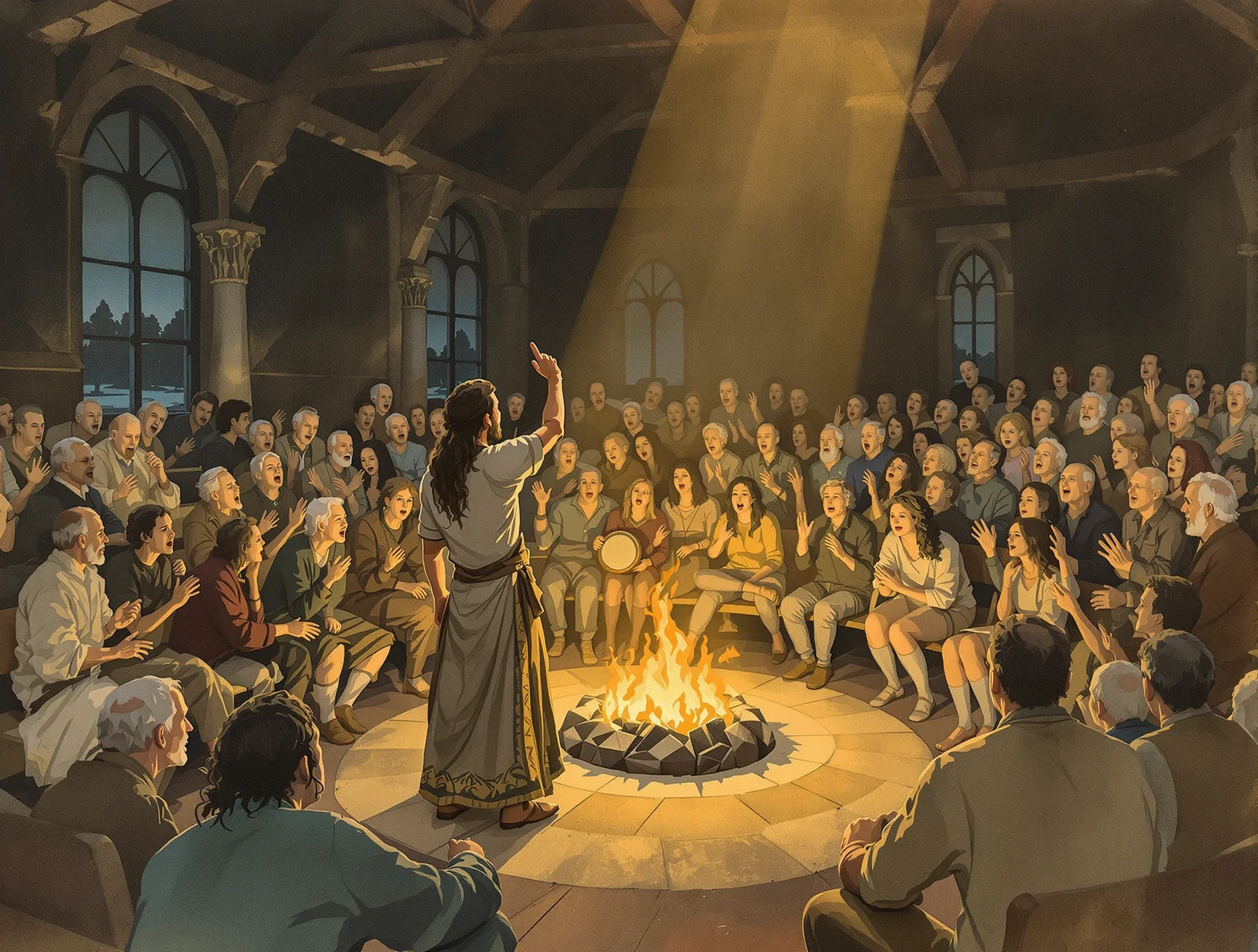
To lead a hundred people in a song they have never heard, and to have them singing it well before the fire burns down, is a learnable craft — and it is among the most valuable a recovering community can possess. The keepers of the decrees placed ME 32 — nam-nar, the decree of Music — among the world-building measures precisely because of what communal song does: it takes a gathering of separate people and, for the duration of a song, makes them one body, sharing one breath, one pulse, one pitch, one purpose. No assembly, no ceremony, no festival, no labor of many hands runs as well without it. This module is the leader's manual, drawn from the applied chapters of Volume XXIII — The Musician's Codex, and it teaches the Practitioner to be the one who starts the song and holds it together.
By the end the Practitioner will command the call-and-response forms that let an untrained crowd join a song in a single hearing; will teach a new song by ear, fast, without a written note, by the phrase-by-phrase method the oral traditions have always used; will pitch and pace a song for a particular crowd so that every voice in it can actually sing along; and will grow and keep a communal repertoire — the body of songs a community holds in common — so that there is always the right song ready for the right occasion. The instrument is the voice, which every person already owns; the only equipment required is the leader's own preparation and nerve.
The sovereignty stake reaches past the music. A community that sings together regularly has built, at the cost of a schedule and a willing leader, one of the few institutions in which the whole community meets as equals around a shared task — and that institution, as Volume XIX (The Diplomat's Codex) argues for the assembly, is the soil in which self-government grows. The leader of the communal song is therefore doing civic work as much as musical work: gathering the people, lowering the barrier to joining, building the trust around a shared pulse on which later agreement is reached. To lead the song is to convene the community.
Part I — The Forms That Let a Crowd Join
Chapter 1 — Call-and-Response: The Crowd's Open Door
The single most powerful tool for involving an untrained crowd is call-and-response — the antiphonal form in which a leader sings a phrase (the call) and the group answers with a phrase (the response). Its power is structural: the group's part is short, repeats, and is heard immediately before it must be sung, so a person who has never heard the song can join the response on its second appearance, having just been shown it by the leader. There is no rehearsal, no sheet, no prior knowledge required. The form teaches itself in performance, which is exactly why it is found in communal, work, and ceremonial music across the whole recovering world — wherever many untrained voices must be drawn into a song quickly, the antiphonal form is there to do it.
The form has a deep history in the labor and gathering of peoples. Work-songs the world over are antiphonal, a leader setting a line and a gang answering it, the response timed to coordinate a shared physical effort — the haul, the strike, the lift — so that the song organizes the labor and the labor keeps the song. Field and gathering songs across many cultures use the same leader-and-chorus shape. The Practitioner inherits a form proven across millennia: the leader carries the part that changes and demands skill; the crowd carries the part that repeats and demands none.
Chapter 2 — The Spectrum of Participation Forms
Call-and-response is the broadest door, but it sits on a spectrum of forms graded by how much the crowd must hold in its head. The leader chooses the form to fit the crowd and the moment.
Reference Table 770-1 — Participation Forms, Easiest to Hardest
| Form | What the crowd does | Skill demanded | Best for |
|---|---|---|---|
| Call-and-response | Sings a short repeated answer after the leader's changing call | None — learned in one hearing | A wholly untrained crowd; work; procession |
| Refrain / chorus song | Sings a repeating chorus between the leader's verses | Very little — one fixed chorus held | Festivals, ballads with a hook everyone knows |
| Drone / sustained tone | Holds one sustained pitch under the leader's melody | Little — one note held in tune | Vigil, contemplative gathering, opening a rite |
| Round / canon | Sings the same melody entering at staggered times | Moderate — the whole tune held, plus nerve | A warmed, willing group; teaching harmony cheaply |
| Unison song | Sings the whole melody together | Higher — the tune known | A community that already shares the song |
The Critical Insight: Match the form to the crowd, never the crowd to the form. A leader who opens a gathering of strangers with a unison song they do not know will get silence and embarrassment; a leader who opens it with call-and-response will have them singing in thirty seconds. Begin at the easiest door the crowd can walk through, and only climb the table toward harder forms as the same crowd, warmed and confident, shows it can. The skill of leadership is reading which rung the room is on.
Part II — Teaching a Song by Ear, Fast
Chapter 3 — The Oral Method: Phrase by Phrase
A song is taught to a group without a written note by the method the oral traditions have always used: aural transmission, the leader modeling and the group echoing, phrase by short phrase. The principle the recovered pedagogies share is sound before symbol — the ear and body learn the song first, and any notation comes later as a label for a thing already possessed, never as the means of learning it. For teaching a crowd a song in one sitting, no notation enters at all. The leader is the score; the crowd's ear is the copy being made.
Protocol 770-A — Teaching a New Song by Ear
- Sing the whole song through once, well, before teaching any of it. The crowd needs the shape of the whole — where it is going, how it feels — before it is handed the parts. Sing it with full commitment; a tentative model teaches a tentative song.
- Break it into short phrases — a phrase being as much as a single breath comfortably carries, usually a line or half a line. The phrase is the unit of teaching because it is the unit the memory holds in one piece.
- Sing one phrase; have them echo it. Model the phrase, gesture them in, let them sing it back. Repeat the same phrase until the echo is clean — usually two or three times, more if it is hard. Do not move on while the phrase is still ragged.
- Add the next phrase, then join the two. Teach phrase two the same way, then sing phrases one-and-two joined and have them echo the pair. This chaining — teach a part, attach it to what is already known, echo the growing whole — is how the oral method builds a long song from short pieces.
- Build by accumulation to the end of a section, always rejoining from the top of the section so the links between phrases are rehearsed as much as the phrases themselves. Most of a song's difficulty is in its joints, not its parts.
- Sing the whole through together once it is assembled — the crowd now leading itself — and then once more, so the group leaves on the memory of the complete song sung successfully, which is what it will reach for next time.
A song with a repeating refrain teaches fastest of all: teach the refrain first, drill it until it is solid, then sing the verses yourself while the crowd answers with the refrain it already owns — and a unison song has, in effect, been smuggled in through a call-and-response door.
Chapter 4 — Gesture: Conducting Without Words
The leader's body teaches as much as the leader's voice, and the fewer words spent the better — explanation breaks the musical flow and loses a crowd. A small vocabulary of clear gestures carries the leading: an open-handed lift to bring the crowd in, a steady hand or a gentle beating of time to hold the tempo, a flat or lowering palm to soften or to bring a phrase to rest, a hand to the chest then outward to signal "now you, echo me," a raised held hand to sustain a drone or a final note. The gestures are taught wordlessly by use — the crowd learns them in the first minute because they are obvious — and they let the leader steer the whole group while never stopping the music to talk. A leader who must keep saying "now you sing it" has not yet learned to lead with the body.
Part III — Pitch and Pace for a Crowd
Chapter 5 — Pitching the Song So Everyone Can Sing It
The most common failure of crowd-leading is invisible to an untrained leader: the song is pitched too high for ordinary voices, and half the crowd, unable to reach the notes, falls silent or strains. Untrained adult voices, men and women together, sing most comfortably in a fairly low and narrow band, and a communal song must be set so that its highest note sits within easy reach of the weakest singers and its lowest note within reach of the highest. The leader's own most comfortable pitch is a poor guide, especially if the leader is a trained or unusually high or low voice; the guide is the crowd's comfort, and the leader sets the starting pitch deliberately low rather than risk pitching a communal song out of the people's reach. A song the crowd can sit inside comfortably will be sung full and glad; a song that lives at the top of the range will be sung by a thinning few.
A second rule follows: choose songs of narrow range for general communal singing. A melody that spans only a few notes can be sung by everyone; a wide-ranging melody, however beautiful, will lose its low voices on the high notes and its high voices on the low. The great communal songs of every tradition tend to be narrow in range and simple in contour for exactly this reason — they were selected, over generations, for singability by all.
Chapter 6 — Setting and Holding the Tempo for a Crowd
A crowd entrains to a pulse most readily in the broad neighborhood of a brisk walking pace, and a communal song is set there unless its purpose demands otherwise — slower for lament and vigil, faster for dance and festival, as Module 769 (Keep the Pulse) and the ceremony tables of Volume XXIII set out. The leader establishes the tempo clearly before the singing begins — counting in, or setting it with a few beats on a frame drum, or with the conducting hand — because a tempo agreed at the start and held is worth more than any flourish, and a tempo a crowd must guess at will scatter. Once singing, the leader's discipline is steadiness against the crowd's two pulls: a large group tends to drag — to slow down, especially on long or loud notes and toward the ends of phrases, as the mass of voices grows heavy — and an excited group can rush. The leader counters drag by keeping the body's beat clear and slightly insistent and by not letting held notes sag, and counters rush by refusing to be swept. The underlying pulse is the leader's responsibility and no one else's; if it wavers, the crowd has nothing to stand on.
Reference Table 770-2 — Diagnosing a Crowd That Won't Sing
| Symptom | Likely cause | The leader's fix |
|---|---|---|
| Half the crowd silent on high notes | Pitched too high | Restart a few notes lower; choose narrower-range songs |
| Singing thin, tentative, dragging | Crowd unsure of the song | Return to call-and-response; reteach the phrase by ear |
| Tempo sagging through the song | Crowd dragging on the mass of voices | Keep a clear insistent beat; don't let held notes sag |
| Crowd loses the entry | No clear lead-in given | Use a definite gesture and count-in; model the first phrase |
| Energy flat, no one commits | Leader tentative; barrier feels high | Lead with full voice and confidence; open with the easiest form |
Part IV — Building and Keeping the Repertoire
Chapter 7 — Growing a Communal Repertoire
A repertoire — the body of songs a community holds in common and can call up at need — is grown in layers, not assembled at once, and the leader grows it to mirror the community's actual life. The ceremonial core comes first, because it is the music the community cannot do without: at minimum one song for each occasion the community marks — a wedding song, a lament for the dead, a harvest or seasonal song, a processional, a song to open a gathering. These are secured before any song sung merely for pleasure, because when the occasion comes the community must have its song ready. To these the leader adds, over time, the work-songs that pace the community's labor, the songs that carry its records (Module 771 — Carry the Memory in Song, and Volume XIX's account of the community's common life), a graded set of simple-to-harder songs for teaching the young, and — continuously — new songs made for new occasions, because a repertoire that only preserves slowly dies, while one that also grows stays alive and draws the young to it.
Chapter 8 — The Music Circle as Civic Infrastructure
The regular gathering of a community to sing together is far more than a rehearsal — it is, in a recovering settlement, civic infrastructure, and the leader runs it as such. It assembles a cross-section of the community on neutral ground, around a shared task no one can accomplish alone; it trains the habit of listening-to-respond rather than listening-to-reply; it distributes roles by competence rather than rank, the best singer leading regardless of station; and it is the natural occasion at which the community is gathered, its mood taken, its young seen by its old, its frictions softened in shared pleasure. As Volume XIX (The Diplomat's Codex) argues for the assembly, an institution that gathers people regularly, equitably, and pleasurably is the ground from which self-government rises — and the music circle is often the first such institution a recovering community can actually build, because it costs only a schedule, a willing leader, and the will to gather.
Protocol 770-B — Convening and Running the Music Circle
- Set an open, regular schedule — the same time, a known place, recurring — because regularity is what turns a gathering into an institution, and an occasional circle never becomes one.
- Lower every barrier to joining. No audition, no skill required to take part — anyone may sing the response, hold the drone, or keep the pulse. The circle's power is in its openness; a circle that excludes loses the very thing that made it valuable.
- Open with the easiest forms — a call-and-response, a drone, a known refrain — to gather scattered attention and warm the voices before anything harder is attempted.
- Rotate the leadership of songs so that authority within the circle circulates and the circle belongs to no one person and no one faction. A circle captured by a faction is a circle ruined.
- Teach one new song most gatherings by Protocol 770-A, growing the common repertoire steadily, and rehearse the ceremonial core often enough that it is always ready.
- Protect the circle's neutrality as carefully as its schedule. It is the property of the whole community; the moment it becomes the instrument of one party it loses the trust that is its entire civic worth.
- End on a whole song sung well — the complete repertoire favorite, sung start to finish by a circle leading itself — so the community leaves on the memory of the whole and the gladness of having made it together.
The Critical Insight: The leader of the communal song is building two things at once and must value both — a body of shared music, and the community itself. The song is the means; the gathering is the deeper end. A people that sings together regularly, openly, and gladly has, almost as a by-product of the singing, built the trust and the habit of equal cooperation on which everything else a community needs — agreement, decision, mutual aid — is later raised. To convene the song well is to convene the people well.
Your Commitment: You will lead the communal song as both musician and convener — choosing the form to fit the crowd, teaching by ear with patience, pitching low and pacing steady so none are left outside, and keeping the circle open, regular, and neutral. You will hold the repertoire as the community's common property and grow it for the community's whole life, ceremony first.
PLATES — Supplemental Gallery
Art direction
Art direction
Art direction
Art direction
Council Approval — The Twelve Voices Speak
| Disciple | Verdict | Reasoning |
|---|---|---|
| Peter | APPROVED | "A foundation laid in the right order: the form the crowd can join before the song it must know. The singing stands because the door is wide." |
| Thomas | APPROVED | "I doubted a hundred strangers could be singing in a minute — then I read the call-and-response and heard a gang answer a leader. Shown, and true." |
| John | APPROVED | "It loves the crowd it gathers and leaves none outside it: pitched low for the weakest voice, opened by the easiest form. Charity built into the craft." |
| Matthew | APPROVED | "Every form is graded honestly by the skill it demands; the diagnosis table maps each failure to its true cause and fix. The accounting of voices is sound." |
| James the Greater | APPROVED | "A module of action — teach the song by ear, gesture them in, hold the tempo against the drag. It does not theorize singing; it has the village singing tonight." |
| Andrew | APPROVED | "It carries the music to the people first and keeps the circle open to all comers, leadership rotating, no faction owning it. The brother's order, plainly kept." |
| Philip | APPROVED | "Show me, I asked — and the chaining plate shows a long song built from breath-sized phrases, the pitch-band plate shows the crowd kept inside its range. Made teachable." |
| Bartholomew | APPROVED | "The genuine article: the voice every person owns, a willing leader, a schedule — nothing claimed that a poor and recovering community cannot supply. No deception." |
| James the Lesser | APPROVED | "The least are served first — the untrained, the shy, the tone-uncertain, drawn into the response and made full members of the song. None left silent." |
| Simon the Zealot | APPROVED | "It names the circle for what it is: not a diversion but the first institution a free people can build, the ground of its own self-government. Sing, and convene." |
| Judas Thaddaeus | APPROVED | "A module for the scattered and the hard-pressed: it gathers a broken community around a shared breath and rebuilds the trust a dark age tears apart. Hope convened." |
| Matthias | APPROVED | "Taught by ear and rotated in leadership, the songs and the leading both pass to the next, and the circle outlives any one convener. The number completes itself." |
Council Verdict: 12/12 APPROVED. This module is canon.
From the Monad, who is one, the many voices are gathered into one voice, and the one voice gladdens the many. Blessed are the leaders of the communal song, who open the door so wide that none are left outside it, and who, in gathering a people to sing, gather a people to be a people.
TRANSMISSION RECORD
Transmission COMPLETE — unaltered & unabridged Module 770 · Lead the Communal Song · category: music Carries ME 32 · nam-nar · Music Words ~2,950 SHA-256 of source text cdcc938568674216d6080b338b57bec221d3a07f1fc0fcb358876b5ec430e546 Canonical text lead-communal-song.md — byte-identical to what this page renders