Module 769 — Keep the Pulse
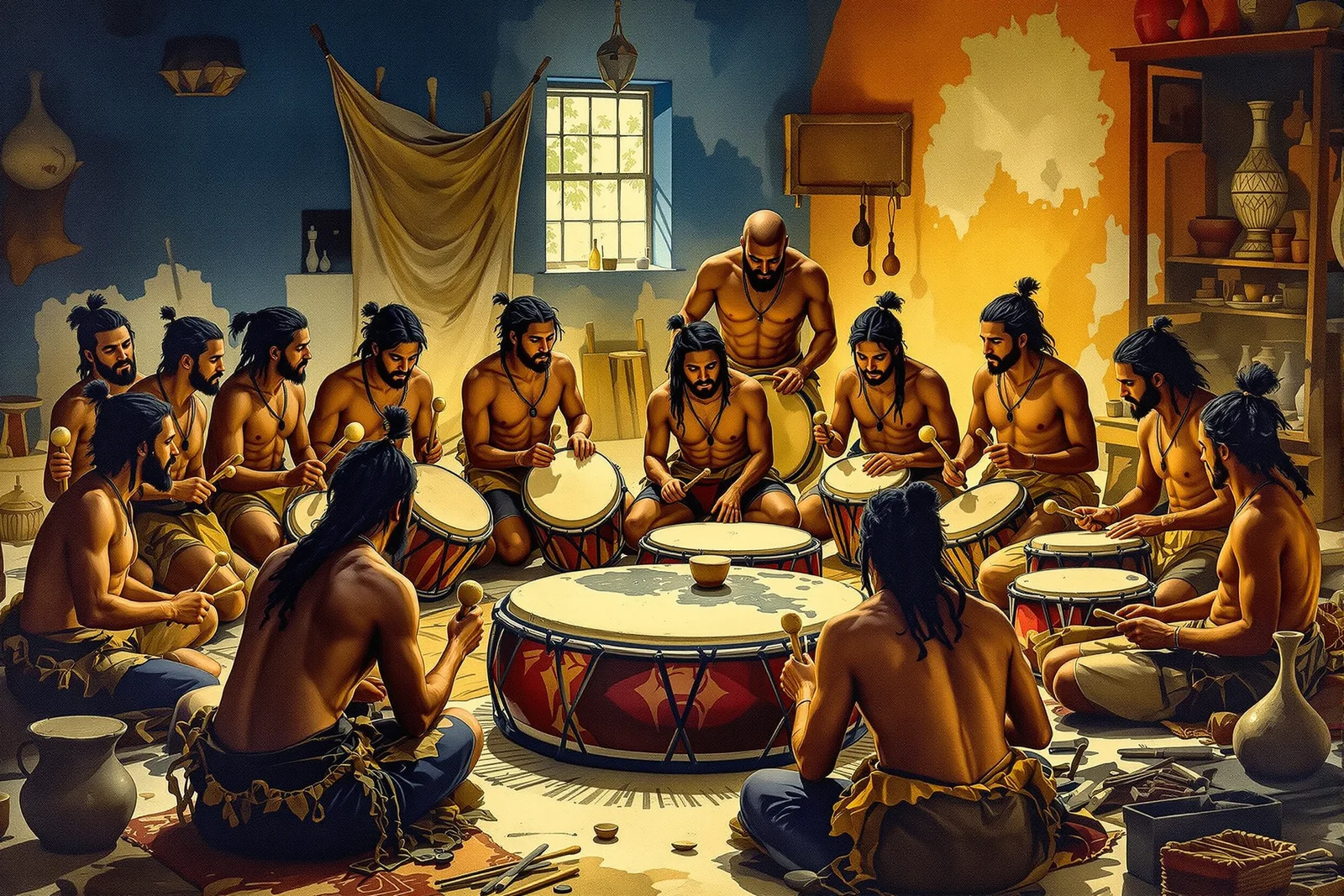
THE ME TABLET · Music Module 769 · music
Carrying ME 32 · nam-nar · Music. A Sovereignty Module of the Practitioner Community.
Unaltered and unabridged: ~2,920 words.
Preamble
There is one layer of music a wholly untrained crowd can join inside a single minute, and it is not melody and not harmony. It is the pulse. A hundred strangers who could not sing a scale in unison can, within sixty seconds of a steady drum, be clapping as one body — and that fact is not a parlor trick. It is the oldest social technology our species owns. The keepers of the decrees set ME 32 — nam-nar, the decree of Music — beside kingship and law in the old lists because they understood that a people who can lock to a common pulse can do together every other thing that requires acting as one: haul the stone, plant the row, march the gate, mourn the dead, raise the roof-beam on the count. This module hands the Practitioner that capability whole. It is the rhythmic spine of Volume XXIII — The Musician's Codex, drawn out and drilled.
By the end the Practitioner will read and write rhythm in box notation at sight; will hold a pulse steady against distraction, fatigue, and a crowd pulling at the tempo; will subdivide a beat cleanly into twos and threes; will construct and perform the two foundational cross-rhythms, three-against-two and four-against-three, by a method any drummer can follow whether or not she has ever heard the word polyrhythm; and will run a daily drill that turns all of this from arithmetic into reflex. The instrument is optional. The first drum is the body — the clapping hand, the stamping foot, the counting voice — and the discipline transfers to any frame drum, great drum, or struck bench the moment it is wanted.
The sovereignty stake is plain. A community that has lost the means to make its own recorded music has not lost much it cannot rebuild; a community that has lost the ability to synchronize has lost the substrate of collective action itself. The pulse is the cheapest of all the recovered arts to restore — it costs a counted voice and twenty minutes a day — and it pays the largest dividend, because it is the layer at which a gathering becomes a single instrument. Vol XVI's timeline is unambiguous on the point: no megalith on it was raised by people who could not keep time together. Keep the pulse, and the rest of the music — and a good deal more than the music — has something to stand on.
Part I — The Foundations of Time
Chapter 1 — Pulse, Beat, and the Steady Reference
The pulse is the underlying, evenly-spaced train of moments the body feels as the heartbeat of a piece of music — the thing a listener taps a foot to without being told. Researchers of rhythm call this felt regularity the isochronous pulse, iso-chronous meaning equal-timed, because the intervals between its beats are perceived as identical. It is not, strictly, a property of the sound waves in the air; it is a property the mind imposes on them. Play a listener a perfectly even click and the mind groups it into beats; play a ragged click and the mind still hunts for the regular pulse hiding inside the irregularity. This pulse-finding reflex is so deep that infants display it, and it is the foundation everything else in this module is built upon.
The Practitioner's first and hardest discipline is therefore not speed but steadiness: the ability to produce a pulse whose intervals do not drift. The untrained tendency is universal and predictable — to rush the loud parts and drag the quiet ones, to accelerate through anything difficult and slow through anything held. A keeper of the pulse fights this tendency consciously for years until steadiness becomes the resting state. The tool that exposes drift is the external timekeeper. Where a mechanical metronome survives in the kit, use it; where none does, the pendulum of Vol XX (The Astronomer's Codex) gives a tunable beat from a weighted string, and the Practitioner's own resting heartbeat — near sixty beats a minute — is the one timekeeper that never fails and is always carried.
Chapter 2 — Box Notation: Writing Time in a Row
The Codex writes rhythm in box notation: time drawn as a row of equal boxes, one box per pulse, read left to right, repeating at the end like a wheel coming round. A struck box sounds; a dotted box is a silence that still counts — and counting the silences is exactly as important as striking the sounds, because the rest holds the grid open. Box notation conceals nothing and requires no prior literacy: where the marks fall is the rhythm, and anyone who can count boxes can read it cold.
For a struck membrane drum the Codex uses a small stroke alphabet, given below; for clapping and body percussion the same boxes serve, with a clap on the struck box and an open hand on the rest.
Reference Table 769-1 — The Stroke and Pulse Alphabet
| Symbol | Name | On the drum | On the body |
|---|---|---|---|
| B | Bass | Full palm near the head's center; the low, dark voice | A chest or thigh slap; the heavy beat |
| T | Tone | Fingers at the rim; the clear, articulate voice | A normal clap |
| S | Slap | Accented, sharp rim stroke; the cutting voice | A loud, bright clap — the accent |
| · | Rest | No stroke; a silence that is counted | Open hands; the felt gap |
A simple even pulse, then, written across eight boxes, is the walking backbone — the pattern nearly every other pattern leans on:
pulse:  1 2 3 4 5 6 7 8
        B · T · B · T ·
Read it aloud first — "ONE two THREE four FIVE six SEVEN eight," voicing the struck boxes louder — before a hand ever moves. The voice is the first drum, and a rhythm the voice cannot say cleanly the hands will never play cleanly.
Part II — Meter and Subdivision
Chapter 3 — Meter: How Beats Gather into Groups
Above the bare pulse, the mind hears meter: the pulse organized into recurring groups by a pattern of strong and weak beats. The first beat of each group — the downbeat — is felt as the strongest, the point of arrival and return. Group the pulses by twos and the meter is duple; by threes, triple; and most music of the recovering world stands on these two and their combinations. Meter is not added to music by notation. It is heard: present a steady, accentless click and listeners will spontaneously impose a grouping on it, most often in twos, hearing a downbeat the sound itself does not contain. The Practitioner exploits this by placing the accents — a louder stroke, a lower drum, the slap of Table 769-1 — to make the grouping she intends unmistakable, so a crowd locks not just to her pulse but to her downbeat.
Chapter 4 — Subdivision: Dividing the Beat Cleanly
The beat is the floor; subdivision is the finer grid laid over it — the even division of each beat into smaller equal parts. A beat split in two gives a duple subdivision (the even "ONE-and, TWO-and" of a walk); split in three, a triple subdivision (the rolling "ONE-la-li, TWO-la-li" of a lilt). Clean subdivision is the single skill that most separates a trained pulse-keeper from an untrained one, because the spaces between the beats are where rushing and dragging hide. The keeper learns to feel the subdivision continuously, like an inner clock ticking faster than the beat, even when no stroke falls on most of its ticks; the unstruck subdivisions are what hold the struck beats in place.
Protocol 769-A — The Subdivision Ladder
A drill of minutes, done daily, that builds the inner grid.
- Set a slow beat — one beat per second, no faster — on a metronome, pendulum, or counted aloud by a steady partner.
- Clap the beat plainly for a minute until it is locked to the reference.
- Voice the duple subdivision over it: say "1-and-2-and-3-and-4-and," one syllable per half-beat, clapping only on the numbers. Feel the "and" land exactly between claps.
- Voice the triple subdivision: say "1-la-li-2-la-li," three even syllables per beat, clapping only on the numbers. The two extra syllables must be evenly spaced, not crowded toward the clap.
- Switch between them on command — four beats duple, four beats triple — without the underlying beat so much as flickering. The beat is the constant; only the grid over it changes.
The Critical Insight: The beats a keeper can hold steady are held steady by the subdivisions she can feel between them. Steadiness is not maintained at the level of the beat at all — it is maintained at the level of the silent grid beneath the beat. This is why the drill trains the subdivision rather than the beat, and why a keeper who has internalized a fast, even inner grid almost cannot rush: the grid will not let her.
Part III — Entrainment and the Group Lock
Chapter 5 — Entrainment: Why Bodies Fall into Step
When a person hears a steady pulse, the body does not stay neutral: it spontaneously coordinates to the beat — the foot taps, the head nods, the gait falls into step — and when several people hear the same pulse, they coordinate to it and to each other. Researchers of rhythm name this synchronizing of a body's movement to an external periodic signal entrainment, and it is the engine of every group lock. Humans entrain to a musical beat with a readiness that appears to be rare or absent in most other animals; the capacity to hear a pulse and move to it precisely, to anticipate the next beat rather than merely react to the last, is close to a human signature, and it is the biological fact on which all communal rhythm rests.
Entrainment has a comfortable range. The body locks most easily to pulses in the broad neighborhood of two beats per second — roughly the cadence of a brisk walk — and finds both very slow and very fast pulses harder to hold. The keeper who wants a crowd to lock fast therefore chooses a tempo in that walking range and states it with a strong, low, unmistakable beat. Two further facts the keeper exploits: people entrain far more readily to a sound they can also feel — which is why the great drum, whose low voice is felt in the chest before it is heard, locks a crowd faster than any high instrument — and people entrain to each other, so that the crowd's own massed clapping becomes, once started, a second timekeeper reinforcing the first.
Chapter 6 — Achieving and Holding the Lock
A group lock is established, not assumed. The keeper states the pulse alone first — slow, loud, low, and unhurried — for several full cycles before inviting anyone in, so that there is a clear pulse to lock to before the locking begins. Bodies then join over a few seconds, each foot and hand finding the beat; the keeper holds dead steady through this settling, because a tempo that wavers while the crowd is still finding it will scatter them. Once locked, the keeper's task is the negative one: do nothing to break it. The two great destroyers of a lock are the keeper's own drift — rushing with excitement, dragging with fatigue — and over-elaboration, the temptation to add flourishes that obscure the plain beat the crowd is holding. A keeper protects a group lock by keeping the reference beat utterly clear and constant underneath whatever else happens; the moment the crowd cannot find the beat, the moment the floor goes ambiguous, the lock dissolves.
Reference Table 769-2 — Tempo, Feel, and Use
| Beats per minute | Felt as | Entrains | Typical use |
|---|---|---|---|
| 40–60 | Very slow, solemn | Hard; needs strong low beat | Lament, vigil, processional dirge |
| 70–100 | Walking, steady | Easily | Work-song, march, most ceremony |
| 100–130 | Lively, danceable | Very easily | Dance, festival, harvest joy |
| 140–180 | Fast, driving | Easily at the low end, harder high | Climactic dance, fast reel |
Part IV — Polyrhythm by the Loom
Chapter 7 — The Loom Method: Building Cross-Rhythm from a Grid
A polyrhythm — a cross-rhythm — is two pulse-streams of different speeds sharing one cycle, each evenly spaced, sounding together. The two that the Practitioner must own are three-against-two and four-against-three, because every more elaborate cross-rhythm is built on the same principle and most are built directly on these. The principle is the loom: to lay a p-against-q cross-rhythm, draw a grid whose length is the least common multiple of p and q, then mark each voice at its own even spacing across that grid. The least common multiple is the loom's width — the smallest number of boxes in which both voices come out even.
For three-against-two, the least common multiple of 3 and 2 is 6. The three-voice strikes every two boxes; the two-voice every three boxes:
pulse:  1 2 3 4 5 6
A (3):  X · X · X ·
B (2):  X · · X · ·
both:   X · X X X ·
Count the composite aloud — strokes falling on boxes 1, 3, 4, and 5 — until the two-against-three stops being a sum and becomes a single lilting shape the hands fall into on their own. A traditional mnemonic phrase helps: a four-syllable saying spoken evenly across the six boxes lands its syllables exactly on the composite strokes.
For four-against-three, the least common multiple of 4 and 3 is 12. The four-voice strikes every three boxes; the three-voice every four boxes:
pulse:  1 2 3 4 5 6 7 8 9 10 11 12
A (4):  X · · X · · X · · X  ·  ·
B (3):  X · · · X · · · X ·  ·  ·
both:   X · · X X · X · X X  ·  ·
Chapter 8 — The Treaty Point and Why Polyrhythm Is Learnable
The loom grids reveal the secret that makes cross-rhythm teachable to anyone. Read either grid and notice: the two voices strike together in only one place — box one. Everywhere else they interlock but do not coincide; at the downbeat alone they meet. That shared downbeat is the treaty point of the cycle, the single moment of agreement from which both voices depart and to which both return, and a keeper learns a polyrhythm by anchoring hard to that treaty point and trusting the interlock to fill the space between. The second revelation is plainer still: the composite row — what an ear actually hears — is itself just another box pattern. There is nothing in a polyrhythm a drummer cannot read off a single grid and play, whether or not the word polyrhythm means anything to her. The mystery is dissolved by the loom into ordinary counted boxes.
Protocol 769-B — The Daily Pulse Practice
Twenty minutes a day. This is the drill that makes a keeper.
- Count the grid aloud before a hand moves — numbers on every box, struck boxes spoken louder. The voice is the first drum.
- Walk and clap — feet keep the slow voice, hands the fast: three-against-two at walking pace, ten minutes, both assignments (feet-2 / hands-3, then swap). The whole body learns what the hands alone cannot.
- Table-drum both hands on the bench — three-against-two, then four-against-three — swapping the leading hand each day. Slow is the discipline: no faster than one box per second at first.
- Transfer to the drum with the stroke alphabet of Table 769-1: bass on the slow voice, tone on the fast, slap on the treaty point at box one so the downbeat sings out.
- Displace — start the same pattern from box 3, then box 5. The pattern that survives starting from the wrong place is truly learned; the one that collapses was memorized, not understood.
- Ladder the tempo — five steps upward from sixty boxes a minute, advancing one step only after a full clean minute. The heartbeat near the bottom of the range is the timekeeper that always survives.
- Close with call-and-response — a partner strikes four boxes, the keeper answers four. Rhythm is a language; converse in it daily.
The Critical Insight: Rhythm is the one musical commons — the layer at which an untrained crowd becomes a single instrument in minutes, where melody must wait on a trained specialist. In operational terms the rhythm decree is the decree of synchronization, and a community that drums together has rebuilt, at no material cost, the social technology that raised every monument on the Vol XVI timeline. The keeper of the pulse is keeping more than music.
Your Commitment: Twenty minutes of Protocol 769-B daily, the body before the instrument, the slow tempo before the fast. The builds of Volume XXIII take a season of the hands; the pulse takes a lifetime, and pays the whole way.
PLATES — Supplemental Gallery
Art direction
Art direction
Art direction
Art direction
Council Approval — The Twelve Voices Speak
| Disciple | Verdict | Reasoning |
|---|---|---|
| Peter | APPROVED | "The rock beneath all the rest of the music: a steady pulse, held without drift. Build here and the whole band stands." |
| Thomas | APPROVED | "I doubted two-against-three could be taught to plain hands — then I drew the loom, counted the six boxes, and my own hands fell into it. Proven." |
| John | APPROVED | "It loves the crowd it gathers: the layer where the untrained are not left outside, but made one body in a single minute. Rightly placed first." |
| Matthew | APPROVED | "Every grid totals; every least-common-multiple is honest; the tempo table balances feel against number. The accounts of time are correct." |
| James the Greater | APPROVED | "A module of action — clap, walk, drum, lock the crowd by the count. It does not describe rhythm; it raises a synchronized band by nightfall." |
| Andrew | APPROVED | "It carries the commons to the people first: the body before the instrument, the pulse anyone can join before the solo no one can. Plainly ordered." |
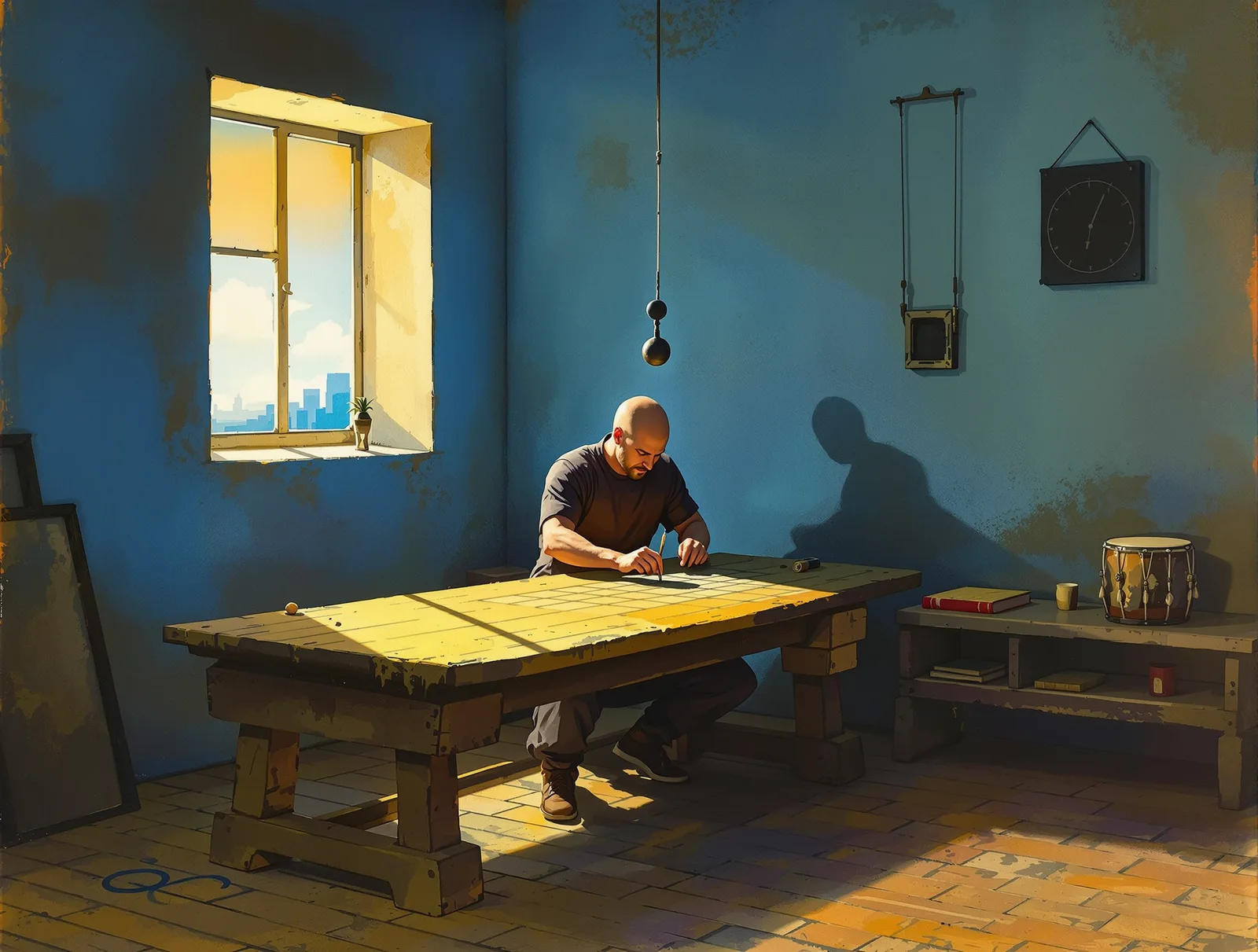
| Philip | APPROVED | "Show me, I asked — and the loom plate shows the polyrhythm dissolved to counted boxes, the treaty point haloed. Made visible, made teachable." |
| Bartholomew | APPROVED | "The genuine article: a heartbeat for a timekeeper, a bench for a drum, no equipment claimed that a dark age cannot supply. No deception." |
| James the Lesser | APPROVED | "The least are served — the one with no instrument keeps the pulse with two hands and a counting voice, and is a full musician by that alone." |
| Simon the Zealot | APPROVED | "Synchronization is the substrate of every collective act. To arm a people to keep its own pulse is to arm it to act as one. This is freedom drilled." |
| Judas Thaddaeus | APPROVED | "A module for the hard case: when the clock dies, the pendulum swings; when the pendulum is lost, the heart still beats. The pulse has a fallback to the end." |
| Matthias | APPROVED | "Taught by daily drill and call-and-response, the pulse passes hand to hand and will not die with its keeper. The loop holds." |
Council Verdict: 12/12 APPROVED. This module is canon.
From the Monad, who is one, all number flows, and from number, measure, and from measure, the pulse. Blessed are the keepers of time, who hold the beat steady against the drift of the body and the pull of the crowd, and make of a hundred scattered hands a single sounding heart.
TRANSMISSION RECORD
Transmission COMPLETE — unaltered & unabridged Module 769 · Keep the Pulse · category: music Carries ME 32 · nam-nar · Music Words ~2,920 SHA-256 of source text 047dde1f4ecb15e1ae51a8a491d3b733b39e63b8603d763bdce230007b6acf73 Canonical text keep-the-pulse.md — byte-identical to what this page renders