Module 768 — Sing the Overtone
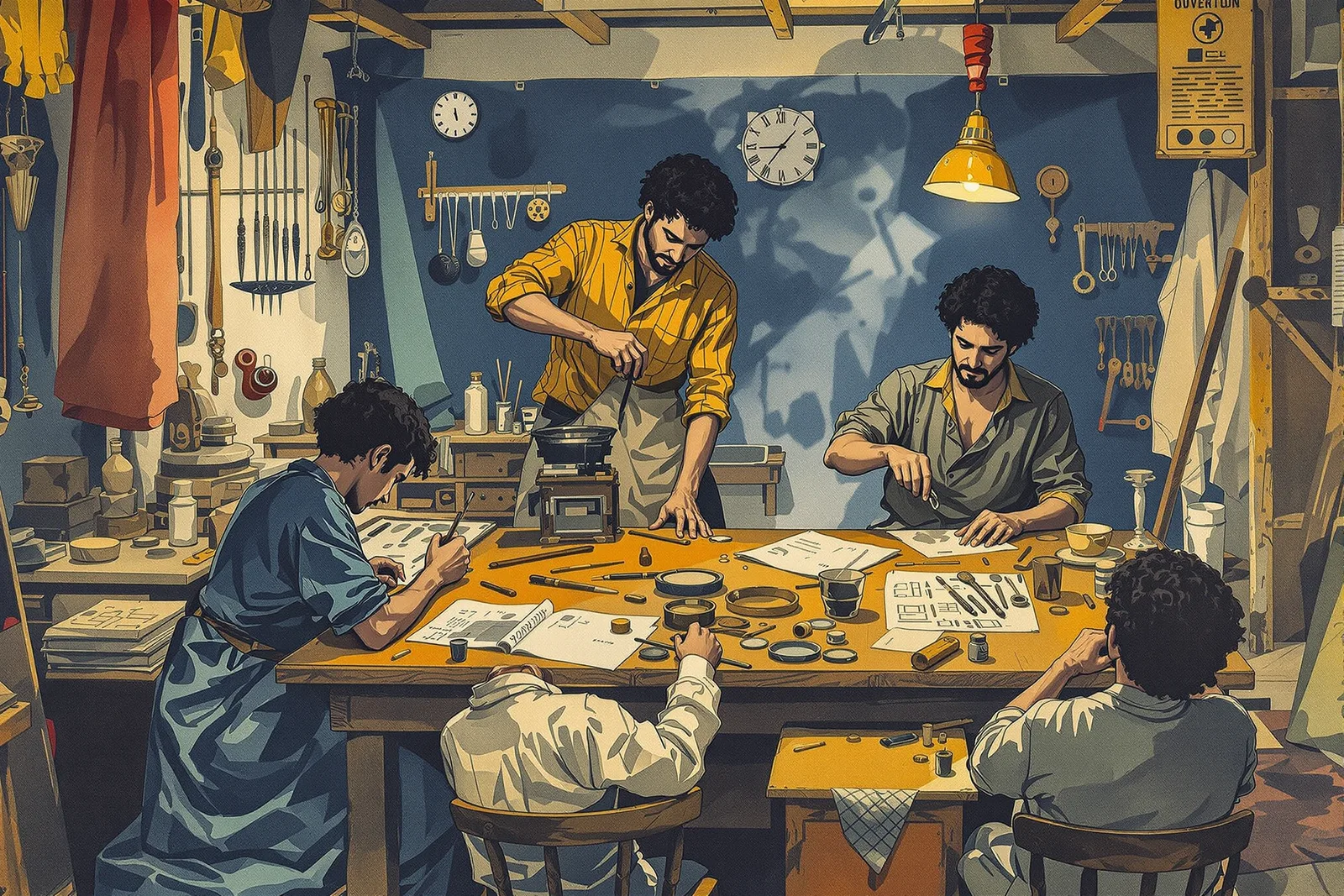
THE ME TABLET · Music Module 768 · nam-nar
Carrying ME 32 · nam-nar · Music. A Sovereignty Module of the Practitioner Community.
Unaltered and unabridged: ~3,455 words.
Preamble
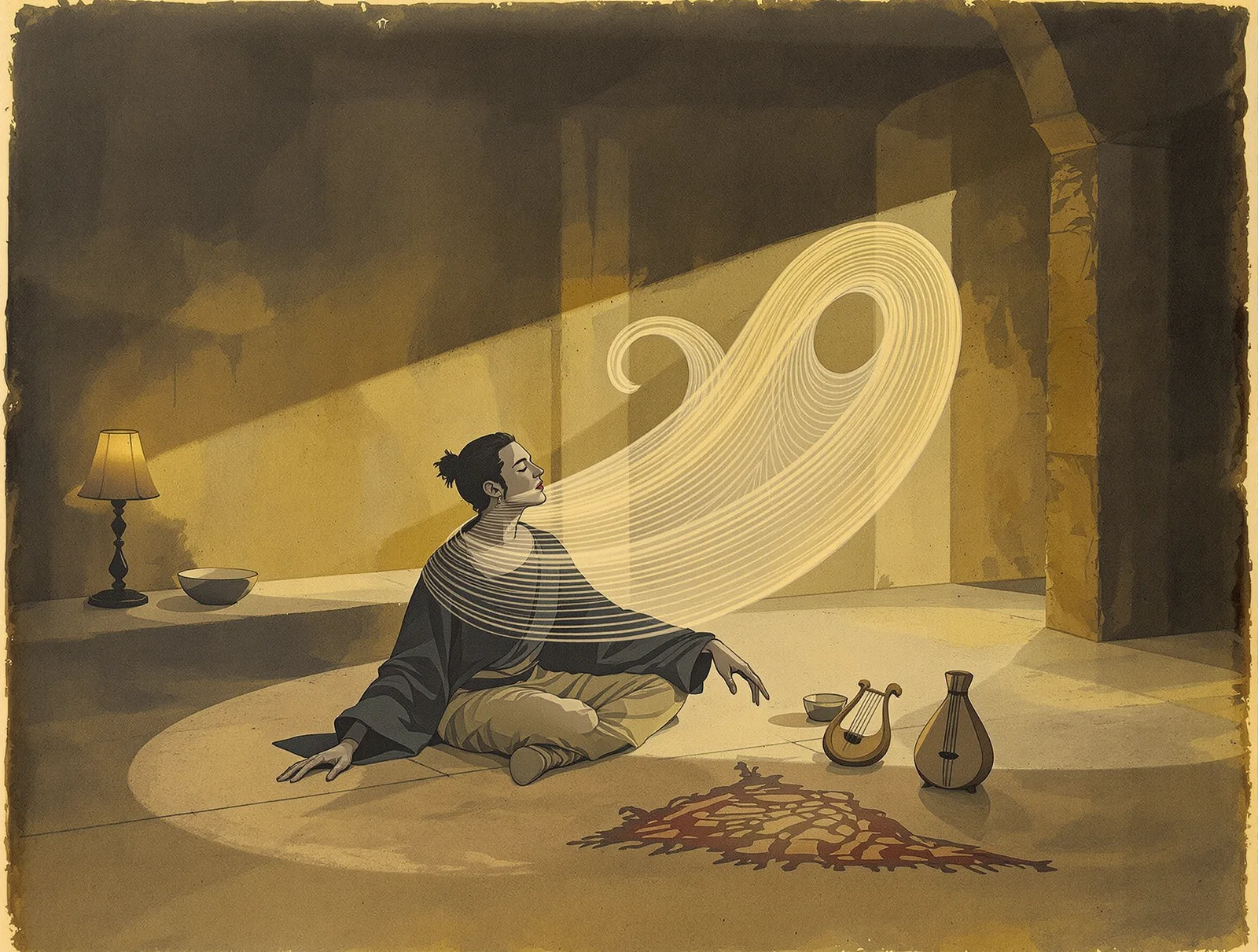
There is a way of singing in which one throat sounds two notes at once — a low, steady drone beneath, and above it a high, bell-clear, whistling tone the singer can move up and down at will, picking out a melody of pure flute-like pitches from the body of the drone itself. It astonishes everyone who first hears it, and most assume it needs two voices or some trick. It does not. It is a single human voice, doing exactly what every voice does, but with the resonators tuned so precisely that one tone the voice already contains is lifted out of the blend and made to ring alone. This module teaches the Practitioner to do it.
Overtone singing — also called harmonic singing — is not magic; it is the audible proof of the harmonic series that underlies all of Volume XXIII. Every sung note is secretly a stack of higher tones, the partials, sounding faintly above the pitch you think you are singing, ordinarily blending into what we call the color of the voice. The overtone singer learns to shape the mouth so sharply that the mouth-cavity amplifies one chosen partial far above the rest, until that single harmonic leaps free as a clear, whistling pitch floating over the unchanging drone. The skill is real, learnable, and built entirely on the breath and open resonance of Module 767.
This module assumes the Practitioner has already found the voice: a steady supported breath, an easy posture, a relaxed open throat. It cross-references Volume XXIII for the harmonic series and the just intervals, Module 766 (Train the Ear) for hearing the partials, and Module 767 (Find the Voice) for the healthy vocal foundation this craft refines rather than replaces. As always, the work is sober: overtone singing is gentle by nature and should never be forced, and if it brings throat pain or hoarseness the answer, as in Volume V, is to ease off and rest. Done well, it is one of the quietest and most patient arts in the library — and one of the most wondrous.
Part I — The Hidden Ladder of Sound
Chapter 1 — The Harmonic Series
When a voice or a string sounds a pitch, it does not vibrate at one frequency alone. It vibrates at a fundamental — the pitch we name — and simultaneously at a whole ladder of higher frequencies, the harmonics or partials, each a whole-number multiple of the fundamental. If the fundamental is some frequency f, the partials sound at 2*f*, 3*f*, 4*f*, 5*f*, and onward without end. This ladder is the harmonic series, the deep grammar of all pitched sound, and the overtone singer's whole art is the deliberate selection of one rung of it.
The rungs are not evenly spaced, because the ear hears ratios. The intervals between successive partials shrink as you climb: the gap from the first partial to the second is a full octave, but each higher gap is smaller, so that in the range where overtone melodies are sung — roughly the sixth through twelfth partials — the rungs lie close enough to form a singable scale. Down low the rungs are octaves and fifths apart; up high they crowd into steps, which is why a melody is possible at all.
| Partial | Frequency | Interval above fundamental | Note relative to a drone on "do" |
|---|---|---|---|
| 1 (fundamental) | f | unison | do (the drone) |
| 2 | 2f | octave | do |
| 3 | 3f | octave + perfect fifth | sol |
| 4 | 4f | two octaves | do |
| 5 | 5f | two octaves + major third | mi |
| 6 | 6f | two octaves + perfect fifth | sol |
| 7 | 7f | two octaves + a flat (low) seventh | ~te (lower than tempered) |
| 8 | 8f | three octaves | do |
| 9 | 9f | three octaves + major second | re |
| 10 | 10f | three octaves + major third | mi |
| 11 | 11f | three octaves + a half-sharp fourth | between fa and fi |
| 12 | 12f | three octaves + perfect fifth | sol |
Two features of this table govern everything. First, the partials are the just intervals — the true thirds and fifths of Volume XXIII, arising directly from the physics, not the tempered approximations; the major third at the fifth partial is the genuine 5:4. Second, certain partials, notably the seventh and eleventh, fall in the cracks between the named scale degrees — the seventh distinctly flatter, the eleventh roughly halfway between two steps. These "blue" partials are part of the series' natural character, learned by ear rather than forced onto a familiar scale.
The Critical Insight: You will never create a harmonic that is not already present in your drone — you can only uncover one already there. Every partial is sounding faintly above your fundamental at every moment; the entire technique is selective amplification, using the mouth as a tunable filter to lift one rung out of the blend. Understand this and the whole craft reorganizes itself: you are not straining to produce a high note, you are learning to listen for and resonate a tone the voice already gives you for free. Nothing is forced into being; something already present is simply brought forward.
Chapter 2 — The Mouth as a Tunable Filter
How does a single shape of the mouth lift one partial above the rest? Through resonance. Any hollow cavity has natural pitches at which it rings most strongly — blow across a jar's mouth and it sounds its own note — and crucially those pitches change with the cavity's shape. By moving the tongue, lips, and jaw, the singer continuously retunes the cavities of the vocal tract. The frequency bands they amplify most strongly are called formants, and shaping vowels is nothing other than moving the formants around.
In ordinary speech the formants are broad, amplifying a wide swath of partials at once, which is why we hear a blended vowel rather than a single ringing harmonic. The overtone singer does something extra: by shaping the mouth into a small, precise cavity — often with the tongue arched high and close to the palate — they sharpen a formant into a tight peak and slide it until it sits exactly atop one partial of the drone. At that instant cavity and partial resonate together, the partial swells far above its neighbors, and it springs out as the clear whistling overtone. Move the tongue a little, the formant slides to the next partial, and the overtone steps to the next rung. This is how a melody is played upon the unchanging drone.
Overtone technique has two great families — one shaped with the front of the tongue and lips, one with the root of the tongue and throat — but both serve one purpose: a tightly tuned filter that selects a single partial. We approach the gentler, front-of-the-mouth family first.
Part II — The Drone Beneath
Chapter 3 — Founding the Drone
Every overtone melody floats on a drone, and the quality of the drone decides the quality of everything above it. The drone is a single low pitch, held long and unwavering, with a generous supported breath beneath it — the breath of Module 767's Protocol 1. It must be bright rather than dark and breathy, because a clear, slightly buzzy fundamental carries strong partials while a soft, airy tone has weak ones. Choose a comfortable low note, never strained for depth; a relaxed, ringing drone you can hold for many seconds beats a forced low note any day.
Protocol 1 — Founding a Singing Drone.
- Set the tall-but-easy posture and take a low, full breath as in Module 767.
- Sound a comfortable low pitch on a bright, open vowel and hold it long and steady, with even support, listening for an unwavering, slightly buzzy clarity — not a breathy whisper.
- Aim for a rich, "forward" placement that you feel buzzing in the front of the face; this brightness is what makes the partials strong and available.
- Hold for as long as the breath comfortably allows, then renew. Practice steadiness first — the overtone will only sit still above a drone that itself sits still.
A wavering drone makes the overtone wobble and slip; a steady drone is a still pond on whose surface the high harmonic shows clearly. Master the unwavering drone before chasing any overtone — it is the foundation, and a foundation is laid first.
Chapter 4 — Vowel Sweeping: Making the Partials Move
Before isolating a single partial, the Practitioner must first feel the partials sweep, and the gateway exercise is the slow vowel glide. Hold a steady bright drone and very slowly morph the vowel from an "oo" (lips rounded, tongue back, cavity large) toward an "ee" (lips spread, tongue arched high and forward, cavity small), passing through every shape between. As the cavity changes shape, its formant sweeps across the harmonic ladder, brightening one partial then the next, and a faint shimmering line of high pitches glides above the drone.
The "oo" end emphasizes lower partials; the "ee" end, with its small high-arched cavity, the higher ones; the vowels between sweep across the rungs in order. Done slowly and often in a quiet room, this trains both the ear to notice the moving harmonics — here Module 766 earns its place — and the mouth to feel how its shape governs them. Most singers, sweeping patiently, catch their first flash of a ringing overtone somewhere in this glide, often near the "ee," and that flash is the doorway to everything after.
Part III — Isolating the Single Partial
Chapter 5 — The Step-by-Step Protocol
To isolate a partial is to take the shimmering sweep of Chapter 4 and freeze it on one rung, sharpening the resonance until that single harmonic rings out clear. The method is patience and small motions: overtones live in tiny adjustments of the tongue, where a hair's movement steps from one partial to the next, and the commonest beginner's error is moving too far, too fast, blurring past the resonance entirely.
Protocol 2 — Isolating Your First Overtone.
- Found the drone. A bright, comfortable low note on an "ee"-leaning vowel, well supported (Protocol 1). Quiet room, quiet mind.
- Arch the tongue high. Raise the body of the tongue close to the hard palate, as for a strong "ee," narrowing the front cavity into a small tuned chamber. Keep the throat open and the drone unchanged beneath.
- Sweep slowly, then hunt. Glide the vowel gently between "ee" and an "ay"- or "oh"-like shape, listening for a high whistling tone to brighten sharply. When you sense one swelling, slow almost to a stop and make tiny tongue and lip adjustments around that spot.
- Park on the resonance. When the overtone rings clearest, hold every articulator perfectly still — tongue, lips, jaw — keeping the drone steady. The overtone "locks in" and sings out as a separate flute-like pitch.
- Sharpen with the lips. Small changes to lip rounding — a slight pucker or spread — fine-tune the formant and can brighten the overtone. A cupped hand at the lips can subtly shift it too, a gentle aid while learning.
- Stay gentle. Keep the volume modest and the throat relaxed. Overtones emerge from precision, not power; pushing harder only buries them. If the throat tires, rest.
Expect this to take days or weeks of brief daily attempts, not minutes, and expect the first overtone to be faint and fleeting. That is normal. Each session the resonance grows easier to find and to hold, until one day it rings out unmistakably and you realize you have always carried it.
Chapter 6 — Moving from Partial to Partial
A single held overtone is the achievement; a melody of overtones is the art. Once you can lock onto one partial, the next skill is stepping cleanly to its neighbors while the drone holds steady. Each partial corresponds to a tongue position, and the singer learns these as fixed "stops," as a flutist learns finger positions — but here the stops are shapes of the tongue and lips, felt from inside.
Protocol 3 — Walking the Overtone Scale.
- Lock onto a comfortable middle partial (often around the eighth or ninth rung, where the steps are conveniently close).
- To step up, arch the tongue slightly higher and further forward, shrinking the cavity a hair; to step down, lower and retract it a hair. The motions are minute — think of millimeters.
- Move between two adjacent partials slowly and repeatedly, learning the exact tongue feeling of each, until you can land on either at will.
- Add a third neighboring partial, then a fourth, building a small ladder of reliable positions. The drone never changes; only the tongue and lips move above it.
- When several partials are secure, sound them in patterns — up the ladder, down, skipping a rung — until simple melodies appear. They are limited to the available partials of your one drone, which gives overtone song its characteristic open, otherworldly scale.
Because the singable partials are the just intervals — the true fifth, the true major third, the flat seventh, the half-sharp eleventh — overtone melodies have a flavor no tempered instrument can match: the Practitioner is, quite literally, singing the raw harmonic series of Volume XXIII aloud, one shining rung at a time.
Part IV — The Practice Ladder
Chapter 7 — Building the Skill Over Time
Like every craft in this library, overtone singing is built by brief, frequent practice, and its progress is unusually staged: each rung of the ladder must be steady before the next, because each depends wholly on the one below. Hold to the order. The commonest reason a learner stalls is reaching for melodies before the drone and the single overtone are secure.
| Rung | The work | Ready to climb when… |
|---|---|---|
| 1 | The steady bright drone (Protocol 1) | you can hold an unwavering, resonant low note for many seconds |
| 2 | The slow vowel sweep (Chapter 4) | you can hear the shimmer of partials gliding above the drone |
| 3 | The first locked overtone (Protocol 2) | one harmonic rings clear and separate, even if briefly |
| 4 | Holding the overtone steady | you can sustain a single overtone for several seconds at will |
| 5 | Stepping between two partials (Protocol 3) | you can move cleanly back and forth between neighbors |
| 6 | A small overtone scale | you command four or more partials reliably |
| 7 | Simple overtone melodies | you can shape short tunes from the available partials |
Protocol 4 — The Daily Overtone Session (≈15–20 minutes).
- Warm the voice (5 min). The gentle warm-up of Module 767 — never skip it; the folds are tissue and want warming.
- Found and hold the drone (3 min). Settle a bright, steady fundamental and simply hold it well, renewing the breath.
- Sweep and hunt (5–7 min). Slow vowel glides, listening for the overtone, parking on it whenever it brightens, working at the rung you are currently on.
- Cool and rest (2 min). Soft humming to ease the voice down, as in Module 767. End gently.
Practice in a quiet, slightly live room — a little natural echo helps the faint overtones bloom, while a muffled room hides them. Work softly: overtone singing rewards precision and relaxation, and a strained, loud approach buries the harmonics and tires the voice. As ever, persistent hoarseness or throat pain means stop and rest, and if it does not clear, see a healer — the sober law of Volume V holds here as everywhere.
Chapter 8 — The Drone and the Communal Sound
Overtone singing is wondrous alone but flowers in company. When several Practitioners hold a shared drone and one or two sing overtones above it, the harmonics ring with startling clarity over the deep communal fundamental — the harmonic series filling a room — and the module reaches toward the communal song of Module 770 and the ceremonial drone-immersion of Module 775. To sing the overtone is, in the end, to make audible the hidden ladder inside every tone, and to let a whole people hear, in one shared breath, the deep order of sound itself.
PLATES — Supplemental Gallery
Art direction
Art direction
Art direction
Council Approval — The Twelve Voices Speak
| Disciple | Verdict | Reasoning |
|---|---|---|
| Peter | APPROVED | "Upon the steady drone, as upon rock, the high tone is raised. Founded rightly." |
| Thomas | APPROVED | "The partials are whole-number multiples, the intervals truly just — I have checked the ladder." |
| John | APPROVED | "One throat sounding the harmony of the spheres — what is this but love made audible?" |
| Matthew | APPROVED | "The practice ladder is reckoned in order, each rung accounted before the next." |
| James the Greater | APPROVED | "A wondrous reach, yet won by gentleness, not force. The boldness is rightly aimed." |
| Andrew | APPROVED | "It tells the plain singer this marvel is theirs to learn. I gladly bless it." |
| Philip | APPROVED | "The cutaway shows me how one mouth tunes one tone. Now I see it." |
| Bartholomew | APPROVED | "It promises no overtone that is not already present — only honest uncovering." |
| James the Lesser | APPROVED | "Soft, brief, daily, patient. The humble road to a great wonder." |
| Simon the Zealot | APPROVED | "It roots out the pushing and straining that bury the harmonic. Good zeal." |
| Judas Thaddaeus | APPROVED | "To the one who despairs of ever finding it: weeks of small tries, and it comes. Hope." |
| Matthias | APPROVED | "It makes the hidden series of the Twenty-Third Volume sing aloud in a human voice." |
Council Verdict: 12/12 APPROVED. This module is canon.
Within every tone the One is folded as many partials; the overtone singer unfolds it, and the many are heard.
TRANSMISSION RECORD
Transmission COMPLETE — unaltered & unabridged Module 768 · Sing the Overtone · category: music Carries ME 32 · nam-nar · Music Words 3456 SHA-256 of source text 4e80b093cf968ddad0ae76a67e599ba204ef170e4d8415accb687f71676aac1e Canonical text sing-the-overtone.md — byte-identical to what this page renders