Module 813 — Mask the Dancer
THE ME TABLET · Creation Module 813 · ĝír-ba-da-ra
Carrying ME 19 · ĝír-ba-da-ra · The Girbadara. A Sovereignty Module of the Practitioner Community.
Unaltered and unabridged: ~3,000 words.
Preamble
When a figure steps before a gathering wearing a mask and a costume, something happens faster than any line of speech can manage: the crowd knows, in an instant and in the body, that the person they knew a moment ago is now someone — or something — else. A face is hidden and a new face declared; ordinary cloth is exchanged for a silhouette that reads across a whole court; and the figure becomes, by the community's agreement, the season, the ancestor, the god, the beast, the dead. Mask and costume are the fastest signifying instruments a community owns. They are how a sacred performance shows, rather than tells, who has arrived.
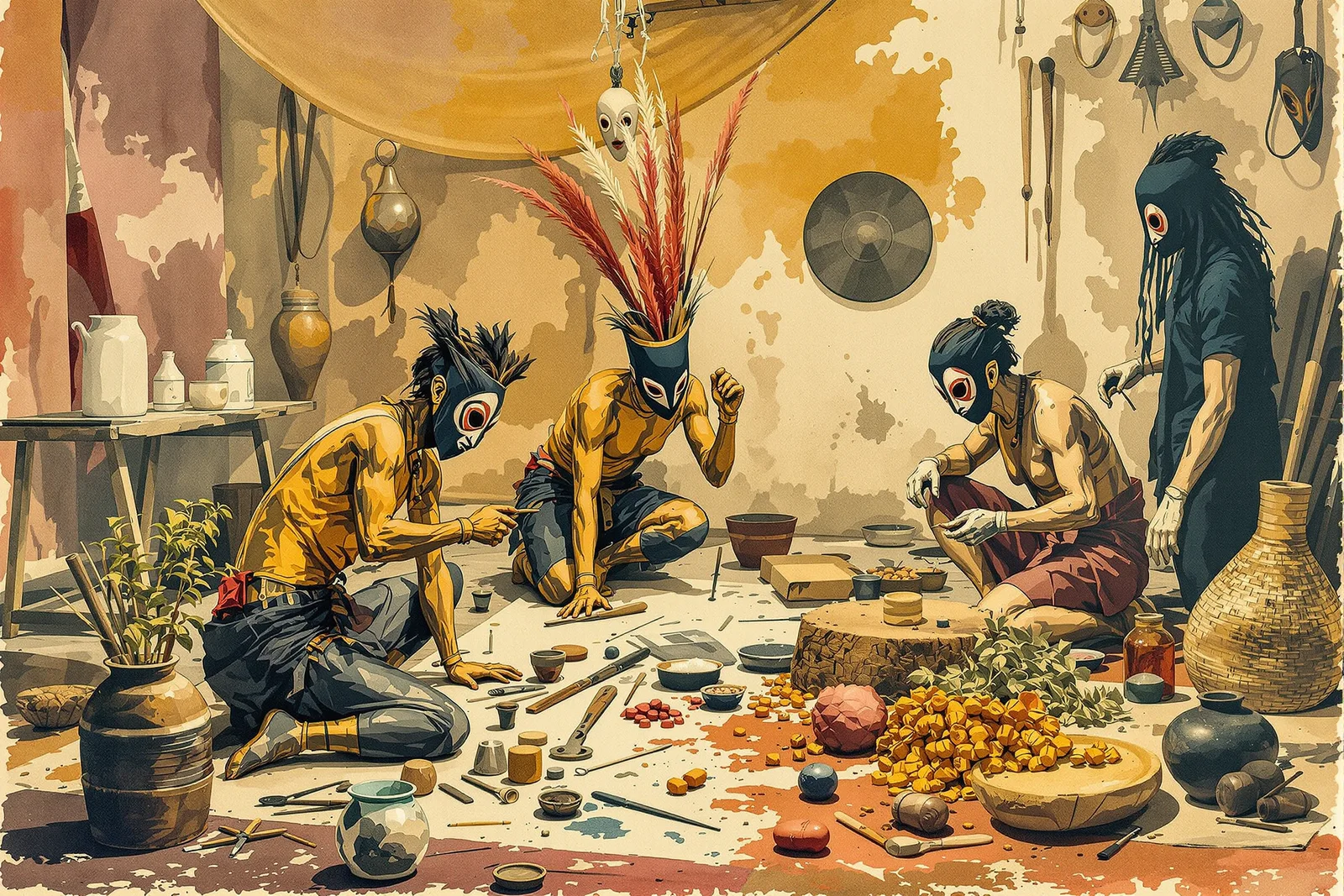
This module is the working craft of building those instruments: the making of masks in the three durable methods — moulded papier-mâché, worked leather, and carved wood — and the building of costume as instant signification, including the great processional effigies a community carries above its own heads. It belongs to the office named ĝír-ba-da-ra, the masked dancer-figure of the old performance, the one whose costumed body carries the meaning the play cannot speak; and it draws on the parent volume, Vol XXIV (The Maker's Codex), specifically Sub-Volume VI (the performing arts), where the disciplines of the stage are set out in full. It stands beside its sibling creation modules — the staged mystery play (Module 811), whose masked figures this module builds, and the drawn record (Module 812) — and it crosses to that staging module continually, because a mask is built to be worn, and the two crafts meet on the same court.
The sovereignty stake is a community's ability to make its own sacred figures with its own hands. A settlement that can build its masks, dress its dancers, and raise its processional effigies can stage any rite its imagination requires without importing a single object. A community that cannot must either buy its sacred images or do without the masked figure entirely — and with it the oldest and most powerful means of making the unseen appear. To mask the dancer is to keep the means of a community's self-representation, at its most charged, in its own keeping. This is recovered-arts work in the sense Vol XVI frames it: the methods below are old, durable, and learnable from first principles by any patient hand.
Part I — What the Mask and the Costume Do
Chapter 1 — Signification in an instant
The Practitioner must first understand why mask and costume are worth the labor, because the reason governs every later choice. Spoken introduction is slow and reaches only those near enough to hear; the masked, costumed figure signifies instantly and reaches the whole gathering at once. The moment a figure in a horned mask and a dark robe enters, the crowd at the back — too far to hear a word — already knows the underworld has arrived. The mask and costume do in a heartbeat, and across a distance, what no announcement can: they declare who this is.
This instant legibility is the first design law of the craft. A mask is read at a distance, in motion, often in poor light, by a crowd that gets one glance before the figure moves on. It must therefore be built in bold, simple, strongly-contrasted forms — a clear silhouette, large features, high contrast between light and shadow — because subtlety that would reward close inspection is simply lost on a court. The novice carves fine detail no one beyond the front row will ever see; the Practitioner carves the shape, and the shape reads to the back wall.
Chapter 2 — The mask transforms the wearer
The mask does a second thing, harder to name and central to the office. By hiding the wearer's own face — the most expressive instrument the body owns — the mask removes the person and leaves the figure. The crowd no longer reads the dancer's individual face; they read the carved face, fixed in one attitude, and they grant that face the figure's identity. This is the old logic of the ĝír-ba-da-ra: the masked dancer was understood, for the duration of the rite, to be the figure, not to portray it. The mask is the instrument of that transformation, and the costume completes it by removing the wearer's ordinary body as the mask removed the ordinary face.
This places a demand on the maker. Because the carved face is fixed, all expression must come from the wearer's body — from the angle of the head and the carriage of the frame (the wearing of which is taught in the staging module, 811). The maker's task is to build a mask whose single fixed expression is strong and legible enough to be brought to life by the body: a mask with a clear, decisive attitude reads with great force when tilted and turned, while a vague or fussy mask reads as nothing no matter how the dancer moves. The maker builds the instrument; the dancer plays it; and a well-built mask makes a strong dancer unforgettable.
The Critical Insight: A mask is not a portrait to be admired up close. It is a signal built to be read at a distance and animated by a body. Every craft decision the Practitioner makes — bold form over fine detail, a clear fixed attitude, high contrast, a silhouette that carries — serves that single end. Build the mask for the back of the crowd and for the dancer's body, and it does its work in the rite; build it for the bench and the close eye, and it vanishes the moment the dancer steps onto the court.
Part II — The Three Durable Mask Methods
Chapter 3 — Choosing the method
Three methods give a community durable, wearable masks from materials any settlement can gather: papier-mâché (paper or fibre layered over a form), worked leather (hide moulded wet and dried hard), and carved wood (a mask cut and hollowed from a single block). Each has a character, a labor cost, and a best use, and the Practitioner chooses by what the rite needs and what the hands and materials allow.
Reference Table 813-1 — The three mask methods
| Method | Material | Weight | Labor | Durability | Best for |
|---|---|---|---|---|---|
| Papier-mâché | Paper/plant fibre + paste, layered on a mould | Very light | Moderate (drying time) | Good if sealed; vulnerable to wet | Large or exaggerated forms; effigy heads; many masks from one mould |
| Worked leather | Vegetable-tanned hide, wet-moulded | Light | Moderate (skill in moulding) | Excellent; tough and long-lived | Durable dance masks meant to last years of use |
| Carved wood | A single seasoned block | Heavy | High (skill in carving) | Excellent; an heirloom | The most important, permanent masks; the deep features of relief |
Chapter 4 — Papier-mâché: the layered mask
Papier-mâché builds a mask by layering paper or plant fibre, soaked in paste, over a form, and letting it dry into a light, rigid shell. It is the most accessible method — it needs no rare skill, only patience — and it is unmatched for large and exaggerated forms, which is why it is the method of choice for oversized features and for the great heads of processional effigies, where a wood mask would be impossibly heavy.
Protocol 813-A — Building a papier-mâché mask
- Make the form (the positive). Model the mask's shape in clay over a base, or build it up on a face-form, exaggerating the features boldly — the form is what the finished mask will read as, so commit to a strong shape here. For a wearable mask, build the form a little larger than the face to leave room for the shell's thickness and a comfortable fit.
- Prepare a release layer. Coat the form with a release — a film of fat or grease, or a layer of wet plain paper laid down first — so the dried shell lifts cleanly off the form and the form can be reused.
- Tear, don't cut, the paper. Tear paper or fibre into small pieces; torn edges feather and lap smoothly, where cut edges leave hard ridges that show through.
- Lay the layers. Soak each piece in paste (a simple flour-and-water or starch paste serves) and lay it onto the form, overlapping each piece and smoothing out air and wrinkles. Build up several layers — typically six to eight for a wearable mask — alternating the direction of the pieces with each layer for strength, and let it dry fully between major build-ups. Rushing the drying warps the shell.
- Demould and trim. When the shell is bone-dry and rigid, lift it from the form, trim the edges clean, and cut the eye-openings (and a mouth-opening if the dancer must be heard) so the wearer can see and breathe.
- Seal, then finish. Seal the porous shell with a coat of paste-and-fibre smoothing or a thin sizing so paint will sit evenly and the mask resists damp; then prime and paint in bold, high-contrast forms. Fit a comfortable interior pad and secure ties or a head-harness.
The Critical caution: an unsealed papier-mâché mask is vulnerable to wet and will soften in rain. Seal it well, and keep it dry between uses, and it lasts for years.
Chapter 5 — Worked leather: the moulded mask
A leather mask is made by moulding vegetable-tanned hide while wet and letting it dry hard, holding the shape permanently. It yields a mask that is light to wear yet extremely tough and long-lived — the best method for a durable dance mask meant to survive years of hard use. The skill is in the moulding, and the material discipline is strict.
Protocol 813-B — Building a worked-leather mask
- Use vegetable-tanned hide. The method depends on the tannage: vegetable-tanned leather wet-moulds and holds shape and hardens as it dries. Mineral-tanned (chrome-tanned) leather does not behave this way and will not take or hold the form — use vegetable-tanned hide of a suitable weight (a medium weight holds detail while remaining wearable).
- Carve or build a hard mould (positive). Carve the mask's form in wood or build it in hard plaster — the leather will be pressed onto this, so its features must be bold and undercut-free enough to release.
- Wet the leather (case it). Soak the hide in water until it is thoroughly damp and supple throughout — "cased," not dripping. Properly cased leather moulds and tools cleanly; over-soaked leather tears and under-soaked leather will not take the form.
- Mould the wet leather to the form. Press and work the cased leather firmly over the mould, pushing it into every contour with the fingers and a smooth modelling tool, drawing the detail up out of the form. Work patiently from the centre outward so no trapped slack distorts the features.
- Hold and dry slowly. Hold or pin the moulded leather to the form and let it dry slowly and completely at ordinary temperature. As vegetable-tanned leather dries it stiffens and hardens, locking in the moulded shape. Do not force-dry it with high heat — fierce heat makes leather brittle and can crack it.
- Demould, trim, and finish. Lift the hardened mask, trim the edges, cut the eye-openings, and finish: leather takes dye, paint, and a sealing dressing well. A dressing of a suitable leather oil or wax-finish both protects the mask and deepens its tone. Line the interior for comfort and fit the ties.
A leather mask, properly cased, moulded, and slow-dried, becomes a hard, light shell that outlasts almost any other and only improves with care.
Chapter 6 — Carved wood: the cut mask
A wood mask is cut and hollowed from a single seasoned block — the most demanding method, the heaviest result, and the one that yields the deepest relief and the most permanent, heirloom mask. It is reserved for the most important figures, the masks a community keeps and reuses across generations.
Protocol 813-C — Carving a wood mask
- Choose seasoned, even-grained wood. Use a well-seasoned (dried) wood of even, workable grain; carving green (wet) wood invites cracking and warping as it later dries. A moderately soft, close-grained timber carves cleanly and is light enough to wear.
- Lay out the design on the block. Draw the mask's outline and the centreline on a block sized to the face, planning the depth so the deepest features sit within the block and the back will hollow to a wearable shell.
- Rough out the form (subtractive discipline). Carving is subtractive — wood removed cannot be returned — so work from the largest forms inward: establish the overall plane and the brow, nose, and cheek masses before any fine feature. Remove wood patiently and check the form constantly against the design.
- Carve the features. Cut the features in bold relief, always reading the grain and cutting with it (cutting against the grain tears the fibre). Keep tools sharp; a sharp edge slices the fibre cleanly where a dull one crushes and splits it. Keep the carving hand braced and the other hand clear of the cut line.
- Hollow the back. Hollow the reverse to a comfortable, even shell so the mask is light enough to wear and sits well on the face — this step makes a wood mask wearable rather than merely a wall-piece. Carve eye- and breath-openings through.
- Smooth, seal, and finish. Refine the surface, then seal the wood (an oil or wax finish, or a primer if it is to be painted) to resist moisture and stabilise it. Paint in bold forms or finish the grain bright; fit an interior pad and secure ties.
Sealed and cared for, a wood mask is the work of an afternoon's design and a season's patience that a community keeps for a hundred years.
Part III — The Neutral Mask
Chapter 7 — The mask that expresses nothing
Among all masks, one is special and is a training instrument before it is a performance object: the neutral mask — a mask with calm, balanced, expressionless features, a face in perfect repose that declares no emotion at all. Its purpose is the opposite of the character mask's: where a character mask fixes one strong attitude, the neutral mask fixes none, presenting a face at rest so that the wearer carries all expression in the body. It is the foundational training tool of the masked performer, and a community building its dance tradition should build one early.
The neutral mask trains the dancer to express through the whole body, because the calm face gives nothing away and the crowd is forced to read posture, gesture, weight, and movement alone. A dancer who has learned to project grief, joy, fear, or supplication through the body while wearing a face that shows nothing has learned the masked performer's central skill — and will animate every character mask far better for it. The maker's task is exacting: the neutral mask must be truly balanced and calm, with no accidental tilt of the mouth or set of the brow that would read as a mood, because the smallest asymmetry breaks the neutrality and defeats the training. Build it symmetrical, serene, and empty, in any of the three methods, and it becomes the school in which every dancer learns to speak with the body.
Part IV — Costume as Instant Signification
Chapter 8 — Dressing the figure to be read
Costume completes what the mask begins, and it obeys the same first law: it must signify instantly and at a distance. The costume is not decoration; it is information, declaring at a glance the figure's identity, rank, nature, and role to a crowd that will not get a closer look. The Practitioner designs costume the way the mask is designed — for legibility across a court — and leans on a small set of powerful signifying tools.
Reference Table 813-2 — The signifying tools of costume
| Tool | What it signifies | Design discipline |
|---|---|---|
| Silhouette | The figure's basic identity and scale, read first and from farthest | Make the outline distinctive and bold; the figure must be recognisable as a shape alone |
| Colour | Role, allegiance, season, nature (by the community's own code) | Use strong, saturated, contrasting colour that carries; agree the code so the crowd reads it |
| Scale & exaggeration | Power, the supernatural, the more-than-human | Enlarge, heighten, or extend the figure (tall headdresses, broad shoulders, trailing forms) to lift it above the ordinary |
| Texture & material | Wealth, wildness, otherworldliness (rough vs fine, natural vs worked) | Choose materials that read their meaning at distance — shaggy and wild, or smooth and rich |
| Motion | Life and force (how the costume moves on the body) | Add elements that move — trailing cloth, fringe, streamers — so the figure reads as alive in motion |
Chapter 9 — Building the costume
The discipline is to choose, from these tools, the few that declare the figure most clearly, and to commit to them boldly. A figure of the underworld might be built from a dark, distinctive silhouette, a heightened scale, and rough wild texture; a figure of the returning light from a bright commanding colour, a tall radiant headdress, and trailing forms that catch the air. The Practitioner resists the urge to load every tool at once — a costume saying too many things at once says nothing clearly. Choose the silhouette first (it is read first and from farthest), then the one or two further tools that complete the declaration, and build those strongly. Test the costume the way a mask is tested: from the back of the court, in motion, in the light the rite will use. If the figure reads clearly there, it is built right.
Part V — The Processional Effigy
Chapter 10 — The figure carried above the crowd
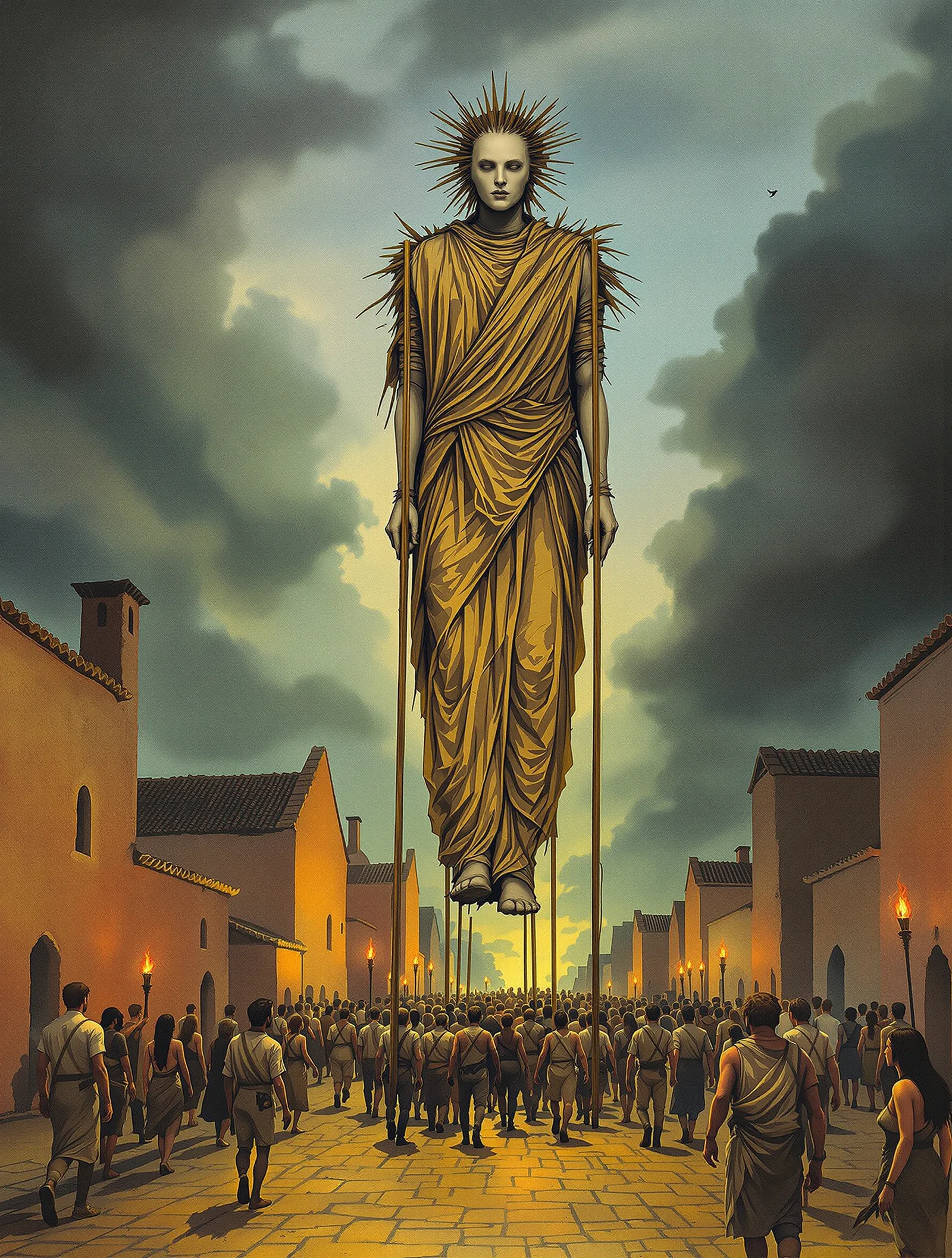
The grandest object of this craft is the processional effigy — a large constructed figure (a giant, an ancestor, a god, a beast) carried through the settlement above the heads of the crowd, so the whole community sees it pass and the play travels to the people (the processional staging of Module 811). The effigy is the mask-and-costume craft built at great scale, and its governing constraint is weight: a figure that must be carried, often by people walking a route, must be as light as it can be made while still reading boldly.
This is why effigies are built on a light frame — a rigid armature of light material (slender wood, cane, or basketwork) defining the figure's form — over which a light skin is stretched: papier-mâché for the head and detailed parts (the method's lightness is decisive here), and cloth for the draped body. The frame carries the shape; the skin carries the reading; and the whole stays light enough to lift and carry. The Practitioner designs the effigy for bold legibility from below and at distance (the crowd sees it from beneath as it passes), for carry (handholds, a balanced load, often poles or a borne platform, the weight planned so bearers can manage the route), and for motion (the figure should read well swaying and advancing, not only standing still).
Protocol 813-D — Building a processional effigy
- Design for the route and the view-from-below. Plan the figure's scale to the route it must travel and the crowd that will see it from beneath; make the silhouette and the great forms bold enough to read from far and low.
- Build a light, rigid frame. Construct the armature from light material (slender wood, cane, basketwork) — rigid enough to hold the form, light enough to carry. The frame is the figure's skeleton.
- Skin it light. Cover the head and detailed parts in papier-mâché (built on or fitted to the frame) for lightness, and drape the body in cloth. Keep every added element as light as its job allows.
- Plan the carry. Build in handholds, carrying-poles, or a borne platform; balance the load so the weight sits where bearers can manage it; and test-carry the route, because an effigy that cannot be carried the whole way is not finished.
- Finish for motion and distance. Paint and dress in bold, high-contrast forms; add elements that move well (trailing cloth, streamers) so the figure reads as alive advancing through the crowd; and seal the papier-mâché against weather.
Your Commitment: You will build your community's sacred figures with your own hands — masks in papier-mâché, leather, and wood by the true protocols; the neutral mask to train your dancers; costume designed to signify in an instant; and the processional effigy raised light and bold above the crowd. Built this way, mask and costume let a community make the unseen appear before its own gathered people; and a community that can build its own sacred figures keeps the means of its deepest self-representation in its own keeping, owing its images to no one.
PLATES — Supplemental Gallery
Art direction
Art direction
Art direction
Art direction
Council Approval — The Twelve Voices Speak
| Disciple | Verdict | Reasoning |
|---|---|---|
| Peter | APPROVED | "It builds the figure on rock — bold form, true method, the mask made to be worn and to last." |
| Thomas | APPROVED | "I doubted a fixed face could speak; the angles of the character mask and the neutral mask convinced me — I can see it." |
| John | APPROVED | "The masked figure lets the community meet the unseen with its own hands. The craft serves the rite, not the eye alone." |
| Matthew | APPROVED | "Every method is set out as a protocol, accountable step by step. A maker could build all three from this page." |
| James the Greater | APPROVED | "The effigy is raised and the route is carried — weight planned, bearers managed, the figure reading from below. Sound work." |
| Andrew | APPROVED | "The processional effigy reaches the whole settlement — the figure travels to every street. None left without the sight." |
| Philip | APPROVED | "Show me how to build it, and the protocols answer — paper, leather, wood, costume, and effigy, end to end." |
| Bartholomew | APPROVED | "No false note: it names the true materials — vegetable-tanned hide, seasoned wood, sealed paper — and the true cautions." |
| James the Lesser | APPROVED | "Modest and exact — it honours the dancer who wears the mask and builds the humble neutral mask that teaches the body." |
| Simon the Zealot | APPROVED | "Here is sovereignty: a people that builds its own sacred figures owes its images to no one and stages any rite it dreams." |
| Judas Thaddaeus | APPROVED | "It builds for the back of the crowd and the figure carried over every head — it leaves no one unable to see." |
| Matthias | APPROVED | "It takes its place in the canon cleanly, carrying ME 19 and pointing home to Vol XXIV. The lot falls true." |
Council Verdict: 12/12 APPROVED. This module is canon.
Let the mask be carved and the dancer dressed, that the community make the unseen appear before its own gathered people.
TRANSMISSION RECORD
Transmission COMPLETE — unaltered & unabridged Module 813 · Mask the Dancer · category: creation Carries ME 19 · ĝír-ba-da-ra · The Girbadara Words ~3,000 SHA-256 of source text c40ec3ab5a2b2bc53d62115dcceb3846498f1b358a6e98ae620972552b0632c4 Canonical text mask-the-dancer.md — byte-identical to what this page renders