Module 812 — Draw What You See
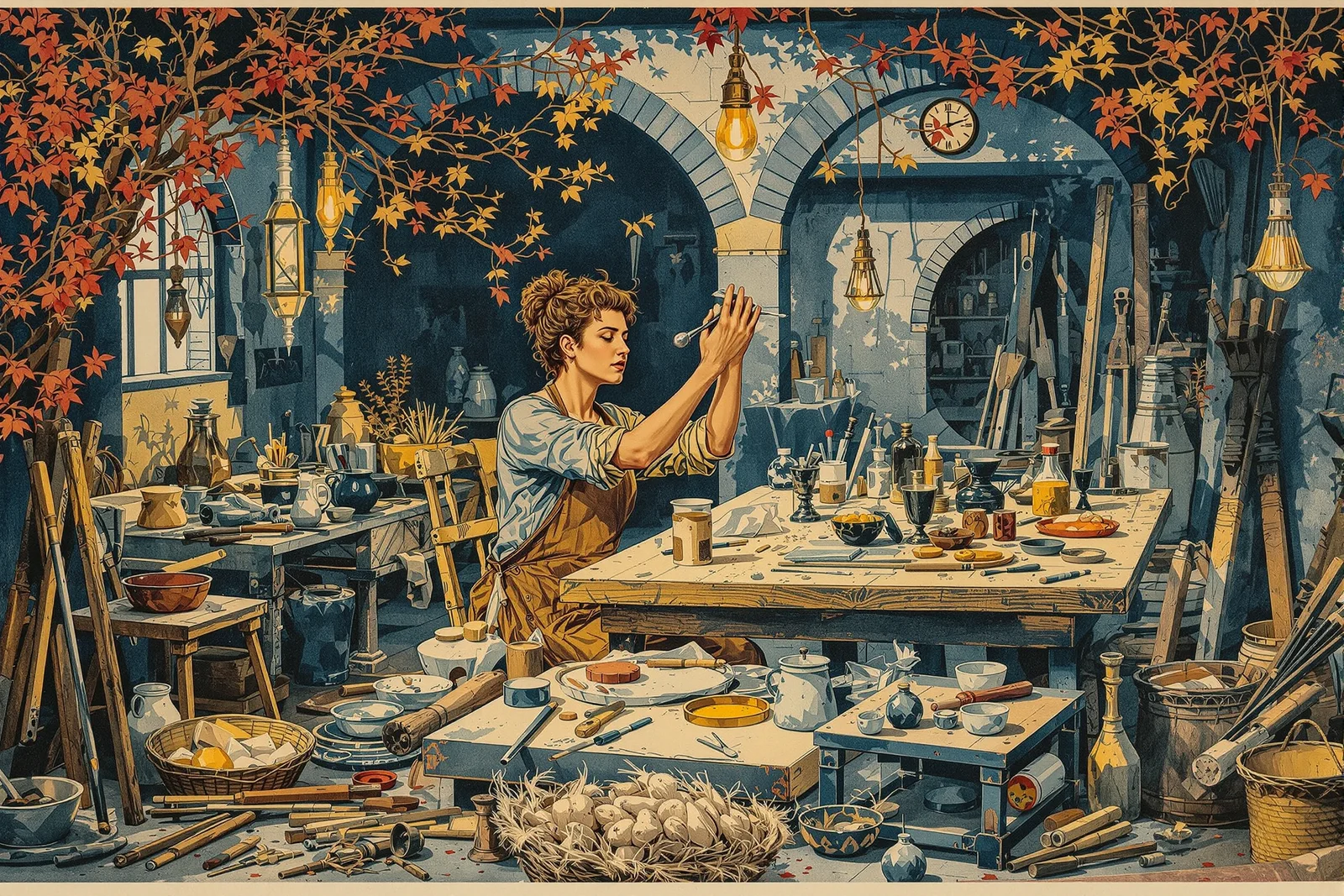
THE ME TABLET · Creation Module 812 · nam-kù-zu
Carrying ME 28 · nam-kù-zu · Art. A Sovereignty Module of the Practitioner Community.
Unaltered and unabridged: ~3,120 words.
Preamble
Most people believe they cannot draw. They are almost always wrong about the reason. The hand that can write can make every mark a drawing requires; what fails is not the hand but the seeing. The untrained eye does not look at the thing in front of it — it looks at its idea of the thing, and the hand obediently draws the idea: the symbol-eye, the symbol-tree, the symbol-hand that every child settles on and most adults never revise. Drawing is not a gift of the hand. It is a trained discipline of the eye — the skill of setting the idea aside and recording what is actually before you: this exact angle, this exact proportion, this exact edge of light against dark. Learn to see, and the hand follows. This is the secret the whole craft rests on, and it is teachable.
This module teaches drawing as that discipline — as trained seeing and accurate recording — and it teaches it for a sovereign purpose. Before the camera, a community's only way to capture what a thing looked like — a plant it must identify, a building it must rebuild, a mechanism it must reproduce, a face it must remember — was to draw it accurately. The documentary draughtsman is among the most quietly essential makers a settlement has, and this module trains that draughtsman. It belongs to the office named nam-kù-zu, the art and craft of the maker, and it draws on the parent volume, Vol XXIV (The Maker's Codex), specifically Sub-Volume I (the visual arts and the foundations of drawing), where the disciplines below are set out in full. It stands beside its sibling creation modules — the staged mystery play (Module 811) and the maker's mask — as the part of the maker's art that records the seen world on a surface.
The sovereignty stake is the community's capacity to record and transmit the visible. A settlement whose members can draw what they see can capture a medicinal plant precisely enough to identify it again, document a structure well enough to rebuild it, record a tool exactly enough to reproduce it, and preserve a likeness across a generation. A community without that skill is blind to its own visible world the moment a thing is out of sight. To draw what you see is to keep, in the settlement's own hands, the means of recording everything the eye can reach.
Part I — Seeing Before Drawing
Chapter 1 — The tyranny of the symbol
The first obstacle every learner must overcome is the mind's own efficiency. The brain is built to recognize and label fast — eye, hand, tree, house — and to discard the specific visual detail the instant the label is assigned, because for survival the label is what matters, not the exact curve of this particular eye. This is invaluable for living and ruinous for drawing, because it means that when you sit down to draw a hand, your mind hands you not the hand before you but the stored symbol for "hand," and you draw that — which is why untrained drawings of hands look like the same wrong hand everywhere. The entire foundational discipline of drawing is the deliberate suspension of the symbol: forcing the eye to report the actual shapes, angles, and relationships in front of it, and forbidding the mind to substitute what it "knows."
The practical sign that a learner has crossed this threshold is a strange one: they begin to draw things they cannot name. Drawing the negative space — the shape of the gap between two objects rather than the objects themselves — works precisely because the gap has no symbol, so the mind cannot substitute one, and the hand is forced to record what is truly there. The Practitioner trains the eye by repeatedly tricking it out of its symbols, until accurate seeing becomes the default.
Chapter 2 — Sighting: measuring with the eye
The draughtsman's core technique for accurate seeing is sighting, the method by which the eye measures proportion and angle directly from the subject. It requires nothing but a straight edge held at arm's length — a pencil will do — and it is the single most important skill in the module. With it, the proportions of anything can be transferred truly to the surface; without it, even a careful drawing drifts into the symbol.
To sight a proportion, the draughtsman holds the pencil out at full arm's length, locks the elbow (so the measuring distance never changes), closes one eye, and aligns the pencil's tip and thumb to span one dimension of the subject — say, the height of a jar. That span becomes the unit. The same locked pencil is then laid against other dimensions — the jar's width, the height of the table — to read them as multiples of the unit: "the width is two-thirds the height; the table is three jars tall." These ratios, not absolute sizes, are transferred to the drawing, and because the relationships are true, the drawing is true at whatever scale.
To sight an angle, the draughtsman holds the pencil up against a sloping edge of the subject — the angle of a roofline, the tilt of a forearm — matching the pencil to the slope, then moves the pencil without rotating it to the surface to see what angle that truly is, judged against the true horizontal and vertical. The eye is a poor judge of angle in the abstract and an excellent one in comparison, and sighting turns every angle into a comparison.
Reference Table 812-1 — The seeing techniques
| Technique | What it defeats | How it works |
|---|---|---|
| Sighting proportion | Wrong sizes and relationships | Hold a pencil at locked arm's length; span one dimension as a unit; read all others as ratios of it |
| Sighting angle | Wrong slopes and tilts | Match the pencil to a sloped edge; carry it un-rotated to the page; judge against true vertical/horizontal |
| Negative-space drawing | Symbol-substitution | Draw the shape of the gaps between things; the gaps have no symbol, so the eye must look |
| Comparative measurement | Drift and distortion | Constantly relate each new mark to those already down — "this aligns with that, half as far again" |
| Plumb and level lines | Crooked structure | Drop an imagined vertical and horizontal through key points to check what lines up with what |
The Critical Insight: Drawing accuracy is not a matter of a steady hand or a good memory for shapes. It is a matter of measurement — of constantly comparing angles and proportions against each other and against the true vertical and horizontal, and recording the comparisons rather than the symbols. The skilled draughtsman is not drawing what they remember a thing looks like; they are measuring what is in front of them with the eye and a held pencil, and transcribing the measurements. Master sighting, and you can draw anything you can see — because you are no longer drawing, you are recording.
Part II — Value: Drawing the Light
Chapter 3 — Line versus value
A drawing made only of outlines describes a thing's edges; a drawing made of value — of light and shadow — describes its form, its volume, the way it sits in space and catches the light. Edges are a convenience of drawing, not a fact of the world: there are no black outlines around real objects, only the meeting of lighter and darker areas. To draw a thing so that it looks solid and three-dimensional, the draughtsman must stop thinking in outlines and start thinking in value — the relative lightness or darkness of each area of the subject — because it is value, far more than line, that the eye reads as form.
Chapter 4 — Reading and rendering the values
The draughtsman trains the eye to see a subject not as objects but as a map of light and dark, and to organize that map into a manageable number of steps — a value scale running from the brightest light to the deepest shadow, with a few clear mid-tones between. Squinting at the subject is the working trick: half-closing the eyes drops out distracting detail and colour and collapses the scene into its essential masses of light and shade, which is exactly what the draughtsman needs to see. The form of any simple solid is then revealed by a predictable arrangement of these values, and the Practitioner learns to recognize them on every lit object.
Reference Table 812-2 — The values on a lit form
| Value zone | Where it falls | What it tells the eye |
|---|---|---|
| Highlight | Where the surface faces the light most directly | The light's direction; the surface's sheen |
| Light (half-tone toward light) | The lit planes turned toward the source | The form turning into the light |
| Core shadow | The band where the surface turns away from the light | The crucial edge that reads the form as round; the darkest part of the object itself |
| Reflected light | Within the shadow, bounced back from nearby surfaces | That the form is round and sits among other surfaces — keep it darker than any lit area |
| Cast shadow | Where the object blocks light from falling on another surface | The object's contact with the ground and its place in space; sharpest near the contact |
Protocol 812-A — Rendering a form in value
- Establish the light's direction first. Find where the light comes from, because every value on the form follows from that single fact. Mark it before any shading.
- Squint and find the masses. Half-close your eyes and reduce the subject to its big areas of light and dark. Block these in first; do not start with detail.
- Place the core shadow. Find the band where each form turns away from the light and lay it in — this single edge, more than any outline, makes the form read as solid.
- Anchor with the cast shadow. Lay in the shadow the object casts, darkest and sharpest where the object meets the surface, to sit the form in space and on the ground.
- Keep reflected light in its place. Render the light bounced into the shadow, but keep it clearly darker than any lit plane — the commonest beginner error is reflected light drawn too bright, which flattens and falsifies the form.
- Reserve the highlight. Leave the brightest highlight until last and use it sparingly; one true highlight reads the light better than many scattered ones.
Part III — The Basics of Perspective
Chapter 5 — Why distant things shrink
Perspective is the disciplined drawing of space — the set of rules by which the three-dimensional world is recorded truthfully on a flat surface. Its foundation is a single observed fact: things appear smaller the farther they are from the eye, and parallel lines receding from the viewer appear to converge. A road's two edges are truly parallel, yet they seem to meet in the distance; the rails, the furrows, the rows of a colonnade all do the same. Perspective is the geometry that lets the draughtsman put that convergence down accurately, so that a drawing reads with the depth the eye actually sees.
Chapter 6 — The horizon, the vanishing point, and the rules
Two ideas carry most of practical perspective. The horizon line is the level of the viewer's eye, drawn across the scene; it is where the sky would meet a flat ground, and crucially it is the line on which the viewer's eye-level sits, so it governs how everything is seen from above or below. The vanishing point is the point on the horizon line toward which a set of parallel receding lines appears to converge. With these two, the draughtsman commands depth.
In one-point perspective, the subject is faced squarely — looking straight down a street or into a room — and all the lines receding away from the viewer converge on a single vanishing point on the horizon. This is the simplest case and the one to learn first. In two-point perspective, the subject is viewed at an angle — the corner of a building, say — so that two sets of parallel lines recede, each to its own vanishing point on the horizon, one to the left and one to the right. Most architectural drawing the documentary draughtsman does is one of these two cases. A third rule underlies both: lines that are truly vertical in the world are drawn vertical on the surface (in these standard cases), and lines truly parallel to the horizon stay horizontal; only the lines receding into depth converge.
Protocol 812-B — Setting up a perspective drawing
- Fix the horizon line at your true eye level. Decide and draw the viewer's eye-level across the scene first; everything else is built relative to it. A high horizon looks down on the subject; a low one looks up.
- Decide one-point or two-point from your viewpoint. If you face the subject squarely, use one vanishing point; if you see it at an angle by a corner, use two. The viewpoint dictates the choice.
- Place the vanishing point(s) on the horizon. Mark where the receding parallels will converge — one point on the horizon for one-point, two for two-point.
- Draw the true verticals vertical and run the recedes to the points. Keep real vertical edges vertical on the surface; send every receding parallel edge to its vanishing point. Let only depth-lines converge.
- Check size by the points. Establish how tall a near object is, then use lines to the vanishing point to find how tall the same object must be drawn farther away. Perspective is also the tool that keeps distant things the right size, not just the right angle.
Part IV — The Documentary Discipline
Chapter 7 — Drawing to record, not to express
The drawing this module most serves is not the expressive drawing made to move a viewer but the documentary drawing made to record a thing accurately so that it can be identified, understood, or reproduced. This is the field-sketch discipline of the naturalist, the surveyor, and the maker, and it has its own standards — different from, and in some ways stricter than, those of art. Its first virtue is accuracy of information: a botanical drawing exists to let another person identify the plant, so it must show the diagnostic features truly, even at the cost of beauty. Its second is clarity: the drawing must communicate, so it favours clean line, clear labelling, and the showing of structure over atmosphere. Its third is completeness for the purpose: it records what a future user will need — often more than one view, a scale reference, and notes.
Chapter 8 — The three documentary crafts
The Practitioner should know the distinct conventions of the three great documentary subjects, because each demands a particular way of seeing.
Botanical drawing records a plant so that it can be identified and its uses known — and identification lives in specific features: the arrangement of leaves on the stem, the structure of the flower, the form of the root, the shape of the leaf margin. The botanical draughtsman shows these diagnostic parts clearly, often drawing several at once — the whole plant, plus enlarged details of flower and seed, plus a cross-section — on one sheet, because a single view cannot carry all the information a future identifier needs.
Architectural drawing records a structure so that it can be understood or rebuilt, and it relies on the disciplined views the builder needs: the plan (looking straight down, as if from above, showing the layout), the elevation (looking straight on at a face, showing height and the arrangement of the front), and the section (an imagined cut through the building, showing how it is made inside). Together these flat, measured views record a building far more usefully for rebuilding than any single perspective could, because they preserve true proportions and the hidden internal structure.
Mechanical drawing records a tool or mechanism so that it can be reproduced and understood, and it uses the same orthographic views as architecture — plan, elevation, section — plus two specialist conventions: the exploded view, which separates a mechanism's parts in space along their lines of assembly so their fit and order are visible, and the cutaway, which removes part of an outer surface to reveal the workings within. These conventions exist to show how a thing is put together and how it works, which a solid external drawing never can.
Reference Table 812-3 — The documentary crafts
| Craft | Records | Key conventions | What a future user gets |
|---|---|---|---|
| Botanical | A plant, for identification and use | Whole plant + enlarged flower/seed details + cross-section on one sheet; diagnostic features clear | The ability to identify the plant again and know its parts |
| Architectural | A structure, for understanding or rebuilding | Plan (from above), elevation (face-on), section (cut through); true measured proportions | The means to understand and rebuild the structure |
| Mechanical | A tool or mechanism, for reproduction | Orthographic views + exploded view (parts separated along assembly) + cutaway (workings revealed) | The means to reproduce the tool and grasp how it works |
Your Commitment: You will draw to record truly — showing the diagnostic feature, the measured proportion, the internal structure that a future user of your drawing will need — and you will hold the documentary drawing to the standard of information first. A documentary drawing is judged not by its beauty but by whether another person, with it alone, can identify, understand, or rebuild the thing it records; and a community whose draughtsmen meet that standard can transmit its visible world across distance and across time.
Part V — The Daily Discipline
Chapter 9 — Drawing is a trained skill, kept by practice
Drawing is not a talent that some have and others lack; it is a trained perceptual skill, and like every trained skill it is built by regular, deliberate practice and lost by neglect. The eye that has learned to suspend the symbol and sight true proportions keeps that ability only by using it, and the most reliable way to build and keep it is a short daily drawing habit — far more effective than rare long sessions, because the skill being trained is the eye's everyday default, and a default is changed by daily repetition. The Practitioner who draws a little every day will, within a season, see the visible world differently than they did before — more accurately, more specifically, with the symbol set aside — and will draw accordingly.
Protocol 812-C — A daily drawing protocol
- Draw every day, briefly. Fix a short daily session — even a quarter-hour — and keep it without fail. Consistency trains the eye far more than occasional length. The habit is the method.
- Start each session by defeating the symbol. Open with a few minutes of a symbol-defeating exercise — negative-space drawing, or drawing a subject upside-down, or a blind contour where you draw an object without looking at the page — to put the eye into seeing-mode before any "real" drawing.
- Draw from life, not from memory or other drawings. Always draw an actual object before you, never your idea of one and never a copy of another drawing, because only life presents the true proportions, angles, and values the eye must learn to read.
- Sight everything. Use the pencil to measure proportion and angle on every drawing until sighting becomes automatic. Do not trust the eye's bare guess while the skill is young.
- Rotate the subjects. Cycle through varied subjects — a plant, a tool, a hand, a corner of a building, a face — so the eye learns to see anything, not just one familiar thing. Variety is what makes the skill general.
- Keep a dated sketchbook and do not discard the failures. Work in a kept, dated book and leave every drawing in it, the weak with the strong. The record of your own progress is itself instructive, and the discipline of not tearing out the bad pages is part of learning to see honestly.
- Carry a field book for documentary practice. Beyond the daily session, keep a small book to hand and record the visible world as it comes — the plant noticed on a walk, the mechanism of a tool, the structure of a building — building the documentary craft in the same motion as the daily discipline.
The Critical Insight: The reason "I can't draw" is almost always false is that drawing is a learnable discipline of seeing, not an inborn gift of the hand, and the gateway to it is the daily practice of looking accurately. The person who draws a little every day, sights every proportion, defeats the symbol at the start of each session, and works from life will learn to draw — reliably, predictably, the way a person who practises an instrument daily learns to play. The talent is in the practice. Keep the daily discipline, and the seeing — and the drawing — will come.
PLATES — Supplemental Gallery
Art direction
Art direction
Art direction
Art direction
Council Approval — The Twelve Voices Speak
| Disciple | Verdict | Reasoning |
|---|---|---|
| Peter | APPROVED | "It builds the craft on rock — not on talent but on seeing, which any practitioner can be taught and can keep." |
| Thomas | APPROVED | "I doubted I could draw; the proof that it is measurement, not gift, convinced me — I can sight a proportion and so can anyone." |
| John | APPROVED | "It frees the discouraged — 'I can't draw' is shown false, gently and truly. That is a kindness as much as a craft." |
| Matthew | APPROVED | "Every technique is set out and accountable — sighting, value, perspective, the documentary views. A scribe could learn it cold." |
| James the Greater | APPROVED | "The documentary discipline is commanded for real use — to identify, to rebuild, to reproduce. This is drawing put to work." |
| Andrew | APPROVED | "It lowers the barrier to the floor — a quarter-hour a day, from life, and the eye changes. The net is cast to every hand." |
| Philip | APPROVED | "Show me how, it asks, and three protocols answer — value, perspective, and the daily habit, step by step." |
| Bartholomew | APPROVED | "No false note: it claims only that seeing is trainable and proves it with the pencil and the squint. Honest to the line." |
| James the Lesser | APPROVED | "Modest and exact — it keeps even the failed pages in the book, and teaches the humility of drawing what is truly there." |
| Simon the Zealot | APPROVED | "Here is quiet fire: a people that can record its own plants, tools, and buildings is blind to nothing it can see." |
| Judas Thaddaeus | APPROVED | "For the one who believes they cannot, it gives a true and reachable path. It abandons no learner to the symbol." |
| Matthias | APPROVED | "It takes its place in the canon cleanly, carrying ME 28 and pointing home to Vol XXIV. The lot falls true." |
Council Verdict: 12/12 APPROVED. This module is canon.
Let the eye be trained to see what is truly there, that the community record its whole visible world and lose nothing to forgetting.
TRANSMISSION RECORD
Transmission COMPLETE — unaltered & unabridged Module 812 · Draw What You See · category: creation Carries ME 28 · nam-kù-zu · Art Words ~3,120 SHA-256 of source text 7a49f523b99d64aadf681079e295c88c65e35a6071edbadba8dde273051505d7 Canonical text draw-what-you-see.md — byte-identical to what this page renders