Module 811 — Stage the Mystery Play
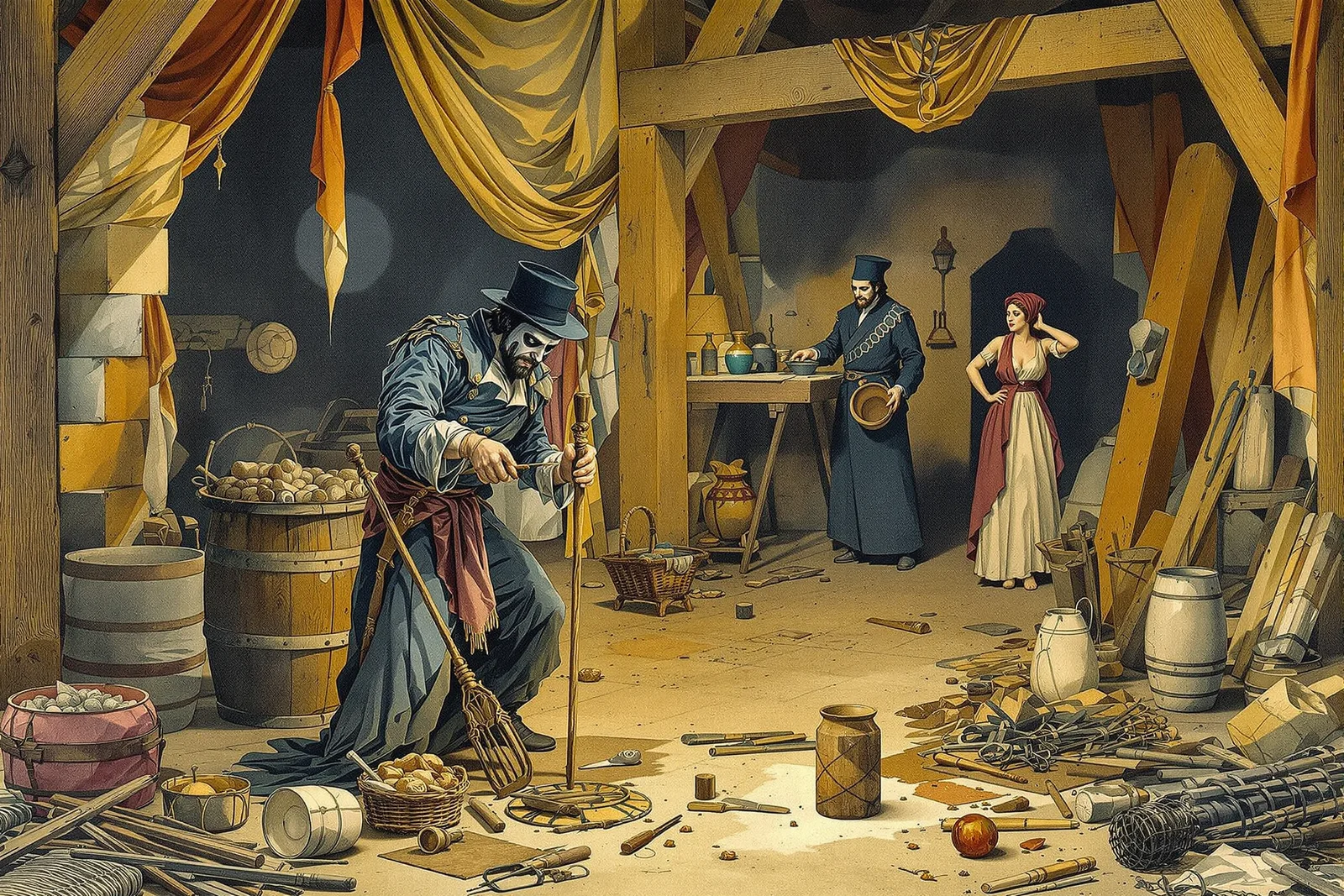
THE ME TABLET · Creation Module 811 · kur-ĝar-ra
Carrying ME 18 · kur-ĝar-ra · The Kurgarra. A Sovereignty Module of the Practitioner Community.
Unaltered and unabridged: ~3,080 words.
Preamble
Before there were books, there was the play, and the play was not entertainment but the way a community thought out loud about the things it could not afford to forget. When a settlement gathers once a year to enact the turning of its season — to show the descent of the year into darkness and its return into light, with masked figures, a story everyone knows, drums, and a crowd that is half audience and half congregation — it is doing something no lecture and no decree can do. It is making its deepest shared knowledge visible, bodily, and collective, so that the whole community holds it not as information in a few heads but as an event they all witnessed and felt together. The mystery play is the oldest theatre, and it is the kind a sovereign community most needs to be able to make for itself.
This module is the working craft of staging such a play. It belongs to the office named kur-ĝar-ra — the ritual performer, the one who steps across the line between the everyday and the enacted and carries the community with them — and it draws on the parent volume, Vol XXIV (The Maker's Codex), specifically Sub-Volume VI (the performing arts), where the disciplines of the stage are set out in full. It crosses to Vol XXIII (The Musician's Codex) for the drum and the rhythm-partnership without which ritual theatre has no pulse, and it stands beside its sibling creation modules — the drawn record (Module 812) and the maker's mask (the masking craft) — as the part of the maker's art that lives not on a surface but in time, in a body, before a gathered crowd.
The sovereignty stake is the community's own imagination. A settlement that can stage its own mystery play can think collectively about its world — its seasons, its origins, its dead, its fears — through the one medium that engages a whole gathering at once, in the body, and remembers. A community that cannot must either import its spectacles or do without the deep, binding, annually-renewed act of thinking-together that ritual theatre alone performs. To stage the mystery play is to keep the means of a community's shared imagining in its own hands.
Part I — The Nature of Ritual Theatre
Chapter 1 — Enactment, not performance
The first thing the Practitioner must grasp is what makes ritual theatre ritual, because it is not the costumes and not the story. Ordinary theatre is performance: actors present a play to an audience that watches from outside, and the line between stage and seats is the whole arrangement. Ritual theatre dissolves that line. The mystery play is not shown to a community; it is enacted by the community, or by performers who stand in for it, upon an occasion the community is living through — the turning of the season, the founding day, the festival of the dead. The crowd is not an audience but a congregation; they are not watching the season turn, they are turning it. The performers are not pretending; for the duration of the rite they are, by the community's agreement, the figures they embody.
This is the origin of the kur-ĝar-ra, the ritual performer of the old world: a figure who was understood to cross between worlds in the enactment, neither merely an actor nor merely a priest, whose office was to become the necessary figure so the community could meet it. The Practitioner inherits that office's logic. To stage a mystery play well is to handle this transformation responsibly — to know when the performer is held to be the figure and when they step back into themselves, and to manage the crossing for the whole gathering.
Chapter 2 — Why a community needs it
The mystery play does specific social work that nothing else does as well. It renders the abstract concrete: a community's idea of the year's death and rebirth, impossible to argue a crowd into feeling, becomes a thing they watch happen and feel in their bodies. It synchronizes a gathering: hundreds of separate people, given one enacted story to attend to together, become for its duration a single witnessing body. And it renews knowledge on a schedule: a play performed every year on its date keeps the community's central story alive across generations, re-taught not as a lesson but as an event each new child grows up inside. The Practitioner stages the mystery play because it is the most powerful instrument a community has for thinking, feeling, and remembering together — and the only one that uses the whole assembled body of the people at once.
Part II — The Structure of the Seasonal Mystery Play
Chapter 3 — The descent-and-return arc
Most seasonal mystery plays, across most traditions, share a deep narrative shape, because most of them enact the same underlying fact: that the year (and the life, and the harvest) descends into darkness or death and then returns into light or life. The Practitioner building an original seasonal play for her own community does not need to borrow any particular tradition's story — the shape is the inheritance, and a community fills it with its own figures, its own land, and its own meaning. The arc has a stable sequence the Practitioner can use as a template.
Structure Template 811-1 — The seasonal mystery play
| Movement | What it enacts | Staging character | Music / rhythm |
|---|---|---|---|
| 1. Gathering / Invocation | The community assembles and the ordinary world is set; the play's world is opened | Bright, inclusive, communal — the crowd drawn in and made participant | Open percussion, communal sound, a calling rhythm that gathers attention |
| 2. The Loss / Descent | The central figure, light, or fertility is lost — taken, dies, or descends into darkness | A marked turn to gravity; the enacted world darkens; pace slows | Slow, deep, descending; the great drum; sparse, falling sound |
| 3. The Threshold / Underworld | The figure is in the dark place; the community is held in the low point with them | The most charged, strange, sustained passage; masks at their most powerful | Drone, sustained low pulse, the strangest sound the tradition holds |
| 4. The Search / Ordeal | A figure goes after the lost one, or the lost one is sought, suffered for, or won back | Rising tension; movement and effort; the turn begins | Building rhythm; the drum quickening; tension toward resolution |
| 5. The Return / Rebirth | The light, life, or figure returns; the dark is broken; the world is restored | The fullest, brightest, most communal passage — the release the whole play built toward | Full ensemble, fast and danceable, the crowd brought into rhythm and often into the dance |
| 6. The Incorporation / Feast | The community celebrates the return together and re-enters ordinary time renewed | Massed, participatory, joyous — the line between performer and crowd dissolved entirely | Communal song and dance; everyone plays, claps, or moves |
Chapter 4 — Reading the template
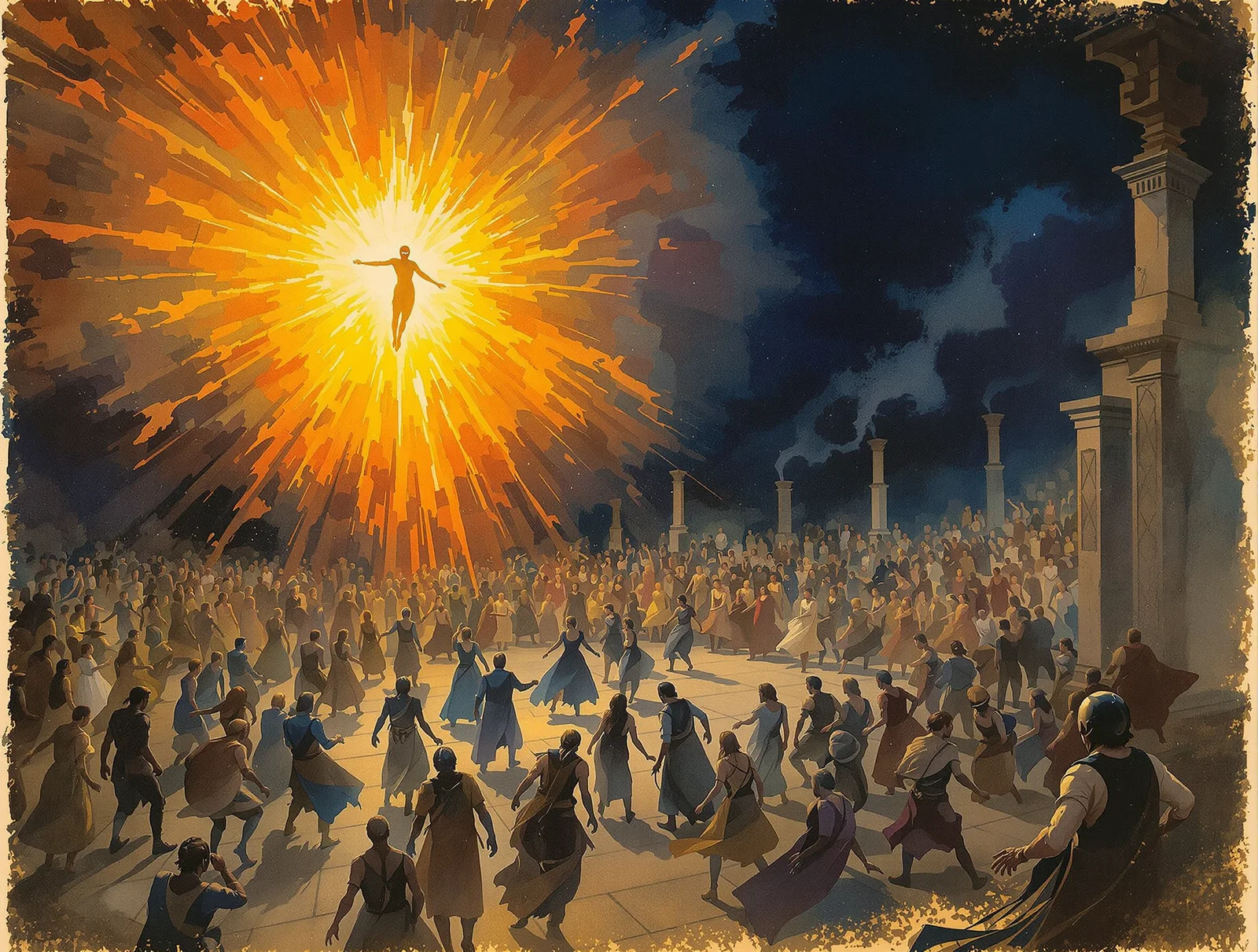
Notice that the seasonal play's arc is the same three-phase passage that carries a human life across a threshold — separation (the loss), liminal middle (the underworld), incorporation (the return and feast) — written at the scale of a whole community and a whole year. This is no coincidence: ritual theatre and the rite of passage are the same technology aimed at different subjects, and the Practitioner who has built one understands the bones of the other. The descent must be felt as a real loss or the return means nothing; the underworld threshold must be held long enough to be uncomfortable or the rebirth is unearned; the return must be the brightest, fullest moment in the whole play, because the entire arc exists to set it up. Build the contrast — the deeper the descent, the more powerful the return — and the play does its work on the crowd almost by itself.
The Critical Insight: The mystery play is not a story that happens to have a happy ending. It is a machine for making a community feel a loss and then a return in their own bodies, so that they leave having lived the year's turning rather than merely having been told about it. Every staging choice — the slowing into the descent, the strangeness of the underworld, the explosion of the return into communal dance — serves that single end. Stage the contrast, not the plot, and the crowd is transformed whether or not the story is novel.
Part III — Processional and Fixed Staging
Chapter 5 — Two ways to stage the world
The Practitioner has two great families of staging to choose between, and the choice shapes everything else. A play can be staged fixed, on a set ground that the community gathers around and faces, or it can be staged processional, moving through the settlement so that the play travels to the people and the route itself becomes the stage. Each has its logic, its strengths, and its demands, and a community's space, scale, and tradition decide which serves.
Fixed staging sets the play in one place — a court, a square, a raised ground, a temple forecourt — and brings the community to it. Its strength is focus: every eye is on one space, the staging can be elaborate and detailed because it need not move, and the crowd is concentrated and unified by facing one direction together. Its demands are sightlines (the gathering must be able to see, which favours a raised playing ground or a natural slope of seating) and acoustics (the voices and drums must carry to the back). Fixed staging suits the climactic, the intimate, and the detailed — the underworld threshold, the moment of return, anything that wants the whole crowd's concentrated attention on a single charged space.
Processional staging moves the play through the community's own ground — the figures travel a route, and the people either follow or wait along it as the play comes to them. Its strength is inclusion and scale: the play reaches a whole settlement, the route can carry the descent-and-return as a literal journey (down to a low place, back up to the centre), and the community's own streets and landmarks become the world of the story. Its demands are different — the staging must read while moving, the figures and sound must carry in the open air over a crowd, and the timing along the route must be managed so the play arrives where it should when it should. Processional staging suits the journey, the search, the descent and return rendered as actual travel through space.
Chapter 6 — Combining the two
The most powerful seasonal plays very often use both in sequence, mapping the staging to the arc. The descent and the search are staged processionally — the community follows the loss down through the settlement, travels the search as a real journey — and then the return and the feast are staged fixed, gathering everyone into one central place for the climactic rebirth and the communal dance. The procession carries the people through the play's middle as participants in a journey; the fixed climax concentrates them for the release. The Practitioner scores the join with care: the moving, searching, open-air music resolves as the procession arrives at the central ground, and the play comes to rest where the whole community can face the return together.
Protocol 811-A — Choosing and building the staging
- Map the arc to your ground. Walk your settlement and ask where the descent's low place is, where the search would travel, and where the whole community can gather for the return. Let the real landscape suggest processional and fixed segments.
- Stage the descent and search to move, the return to gather. Default to processional staging for the journey-shaped middle and fixed staging for the climactic return, unless your space dictates otherwise.
- Secure sightlines and carry for the fixed climax. Choose a raised or sloped central ground so the whole crowd can see the return, and make sure the voices and drums reach the back. The climax fails if half the gathering cannot witness it.
- Make the processional segments read in motion and the open air. Use large, bold figures and masks, strong silhouettes, and loud carrying sound for anything staged on the move, because subtlety is lost on a route.
- Rehearse the join. The seam where the procession arrives and the play settles into its fixed climax is where staging most often breaks. Rehearse the arrival, the gathering of the crowd, and the musical resolution into the return as its own moment.
Part IV — The Performer's Craft
Chapter 7 — Voice, body, and presence
The ritual performer's instrument is the body, and three disciplines govern its use on the open, unamplified, crowd-surrounded stage of the mystery play. The parent volume's Sub-Volume VI treats each in depth; what follows is the working core.
The voice must carry without strain to the edge of a large gathering in the open air, and this is a trained skill, not a matter of shouting. It rests on supported breath — the voice powered from the body's centre, not squeezed from the throat — and on clear, opened articulation that lets words survive the distance and the noise of a crowd. A performer who pushes from the throat will be inaudible and hoarse by the third scene; one who supports from the breath can fill a square and last the whole play. Vocal carry is the first craft of the ritual performer and the one most worth training.
The body must read at a distance and in the round, because the mystery play's audience is far, on many sides, and often standing. This demands what the small, close stage never does: large, clear, unhurried gesture; strong, held silhouettes that read as shapes even when the face cannot be seen; and movement deliberate enough to be legible across a court. The masked performer especially works through the body, because the mask has fixed the face — and the masking craft (the sibling module) teaches how a still mask is brought to life entirely through the angle of the head and the carriage of the body. The ritual performer learns to act in silhouette.
Presence is the hardest to name and the most decisive: the quality by which a performer holds the attention and belief of a whole crowd. It is built from the other two — a carrying voice and a legible body give the performer command of the space — and from a third thing, commitment: the performer's own full belief in the enactment for its duration. A crowd will believe a figure exactly as much as the performer does. The half-committed performer breaks the rite; the fully committed one, in the kur-ĝar-ra's old office, becomes the figure, and the gathering meets it.
Chapter 8 — The performer and the mask
Because the mystery play so often works through masked figures, the Practitioner must understand the particular craft of the masked performer, which inverts ordinary acting. The mask removes the face — the actor's most expressive instrument — and so everything the face would have carried must be carried by the body and the voice instead. A mask tilted down reads as grief or shame; lifted, as pride or appeal; turned sharply, as alarm — the same carved face, made to express opposite things by the angle the performer gives it. The masked performer therefore practices stillness and the held gesture, because a mask jittering with restless small movement reads as nothing, while a mask held in one strong attitude and then changed decisively reads with enormous force. This craft belongs jointly to this module and to the masking craft (the sibling creation module), where the building of the mask is taught; here the Practitioner learns to wear it.
Part V — The Rhythm Partnership
Chapter 9 — The drummer and the performer
Ritual theatre has a pulse, and that pulse is held by the drum. The relationship between the performer and the drummer is one of the most important and least understood in the staging of a mystery play, and the Practitioner must build it deliberately. The drum is not background; in ritual theatre the drum is the performance's clock and its nervous system. It sets the tempo at which the enacted world moves, it marks the turns of the arc, it drives the crowd's body into entrainment, and at the climax it brings the whole gathering into shared rhythm and often into dance. This is why the parent volume routes ritual theatre through the music codex: the play and its drumming are one instrument, and the Practitioner who stages the play must master the partnership at its heart. The disciplines of the drum itself — its building, its heading, its rhythms — belong to Vol XXIII (The Musician's Codex), to which this module crosses; what follows is the partnership.
The partnership runs in both directions. The drummer follows the arc — slowing into the descent, holding the strange sustained pulse of the underworld threshold, quickening through the search, exploding into the full driving rhythm of the return — so that the play's structure is carried in the body of the crowd by the drum. And the performer works with the pulse: timing the great gestures to the beat, letting the drum announce the turns, riding the quickening rhythm into the climax. At the highest level the two improvise together within the agreed arc, the drummer answering the performer's movement and the performer riding the drummer's drive, so that the rite breathes as one living thing rather than a recitation over a backing track.
Protocol 811-B — Building the rhythm partnership
- Score the drum to the arc, not to the scenes. Have the drummer learn the shape — descend, hold, quicken, explode — so the pulse carries the structure even if the staging shifts on the day.
- Give the drum the turns. Let the great changes of the arc — the descent, the moment of return — be announced by the drum, so the crowd feels the turn in their bodies before they see it on the ground.
- Time the great gestures to the pulse. Train the performers to land the largest, most legible gestures on the beat, so movement and rhythm reinforce rather than blur each other across the distance.
- Build the climax as a rhythmic release. Stage the return so the drum drives into its fullest, fastest figure and pulls the whole gathering into shared rhythm — clapping, moving, dancing — dissolving the line between performer and crowd. The communal entrainment is the rebirth, felt.
- Rehearse performer and drummer together, always. Never rehearse the play and its drumming apart and hope they meet on the day. The partnership is a single instrument and must be practised as one (cross Vol XXIII's ensemble discipline).
Your Commitment: You will stage your community's mystery play as an enactment the people live, not a performance they watch — building the descent-and-return arc so the contrast does the work, choosing processional and fixed staging to fit your own ground, training the performer's carrying voice and legible body, and binding the play to the drum as one instrument. A mystery play staged this way thinks, feels, and remembers on behalf of the whole community at once; and a community that can stage its own keeps the deepest medium of its shared imagining in its own hands.
PLATES — Supplemental Gallery
Art direction
Art direction
Art direction
Art direction
Council Approval — The Twelve Voices Speak
| Disciple | Verdict | Reasoning |
|---|---|---|
| Peter | APPROVED | "It builds the play on rock — the descent felt, the return earned, the whole community moved as one." |
| Thomas | APPROVED | "I doubted a template could hold a mystery; the arc convinced me — the contrast does the work, and I can see it." |
| John | APPROVED | "The return into communal dance is love made visible — the line between performer and people dissolved." |
| Matthew | APPROVED | "Every movement and every staging choice is set out and accountable. A company could mount it from this page." |
| James the Greater | APPROVED | "The procession is led and the climax commanded — sightlines secured, the drum driving the crowd. Sound stagecraft." |
| Andrew | APPROVED | "It casts the net over the whole settlement — processional staging reaches every street. None left outside the play." |
| Philip | APPROVED | "Show me how, it asks, and the protocols answer — staging and the rhythm partnership, end to end." |
| Bartholomew | APPROVED | "No false note: it teaches the craft of the carrying voice and the silhouette truly, and claims only what the body can do." |
| James the Lesser | APPROVED | "Modest and exact — it honours the drummer's office and rehearses the seam the proud forget." |
| Simon the Zealot | APPROVED | "Here is fire: a people that stages its own mystery thinks and remembers together, and owes its imagining to no one." |
| Judas Thaddaeus | APPROVED | "It holds the gathering through the dark of the underworld threshold and brings them up into the light. It leaves no one in the descent." |
| Matthias | APPROVED | "It takes its place in the canon cleanly, carrying ME 18 and pointing home to Vol XXIV. The lot falls true." |
Council Verdict: 12/12 APPROVED. This module is canon.
Let the mystery be staged, that the community live its own turning in the body and carry it whole into the next year.
TRANSMISSION RECORD
Transmission COMPLETE — unaltered & unabridged Module 811 · Stage the Mystery Play · category: creation Carries ME 18 · kur-ĝar-ra · The Kurgarra Words ~3,080 SHA-256 of source text c712d746f3cc2eea7dbbb2400218b3137f55a0beefd6c6593f87e81e4cf547b1 Canonical text stage-mystery-play.md — byte-identical to what this page renders