Module 777 — Restore the Sacred Sound

THE ME TABLET · Music Module 777 · music
Carrying ME 32 · nam-nar · Music. A Sovereignty Module of the Practitioner Community.
Unaltered and unabridged: ~3,270 words.
Preamble
The largest instrument any musician plays is the room. The lyre is chosen for its voice and the drum for its skin, but both are sounded inside a space that is itself a resonator — a body of trapped air with natural frequencies of its own, that amplifies some tones and swallows others and profoundly shapes everything sounded within it. The builders of the old world understood this with a sophistication the modern age, in its forgetting, mistook for accident. They cut chambers into living rock that ring in the narrow band of the chanting human voice, and a single low voice intoned within them floods the whole space with reinforced sound. This module restores that heritage as a working craft: the Practitioner who completes it will understand chambered-space acoustics, will lead the drone immersion and communal singing that the old ceremonies practiced within such spaces, and will be able to design and tune a resonant gathering space of her own.
The parent volume — Vol XXIII, The Musician's Codex — lays the foundation in Sub-Volume I (the science of sound) and turns it outward in Sub-Volume VII (the applied decree). This module gathers the strands of that work that bear on sacred sound: the acoustic-resonance heritage of the chambered ear, the room-mode and reverberation physics beneath it, and the ceremonial traditions of restorative sound that communities have practiced within resonant spaces for as long as the record reaches. It crosses the timeline of Vol XVI, The Historian's Codex, which places these chambered works in the long arc of the recovered past, and the cymatics and physics of Vol XX, The Cosmologist's Codex, which renders the standing wave visible. The contemplative and felt dimension of low, enveloping resonance it cross-references to Vol XIV, The Codex of Frequency Healing, holding those claims strictly in-universe.
A word on register before the first chamber. What follows describes a ceremonial and communal tradition — the way a people sings itself through sorrow and joy in a resonant space — and not a treatment. The language of restoration here is the language of an inherited rite, not a clinical claim, and the Practitioner keeps the music modestly within its own office, pointing outward for anything beyond what ceremony and the company of others can hold.
Part I — The Chambered Ear of the Old World
Chapter 1 — Architecture Is an Instrument
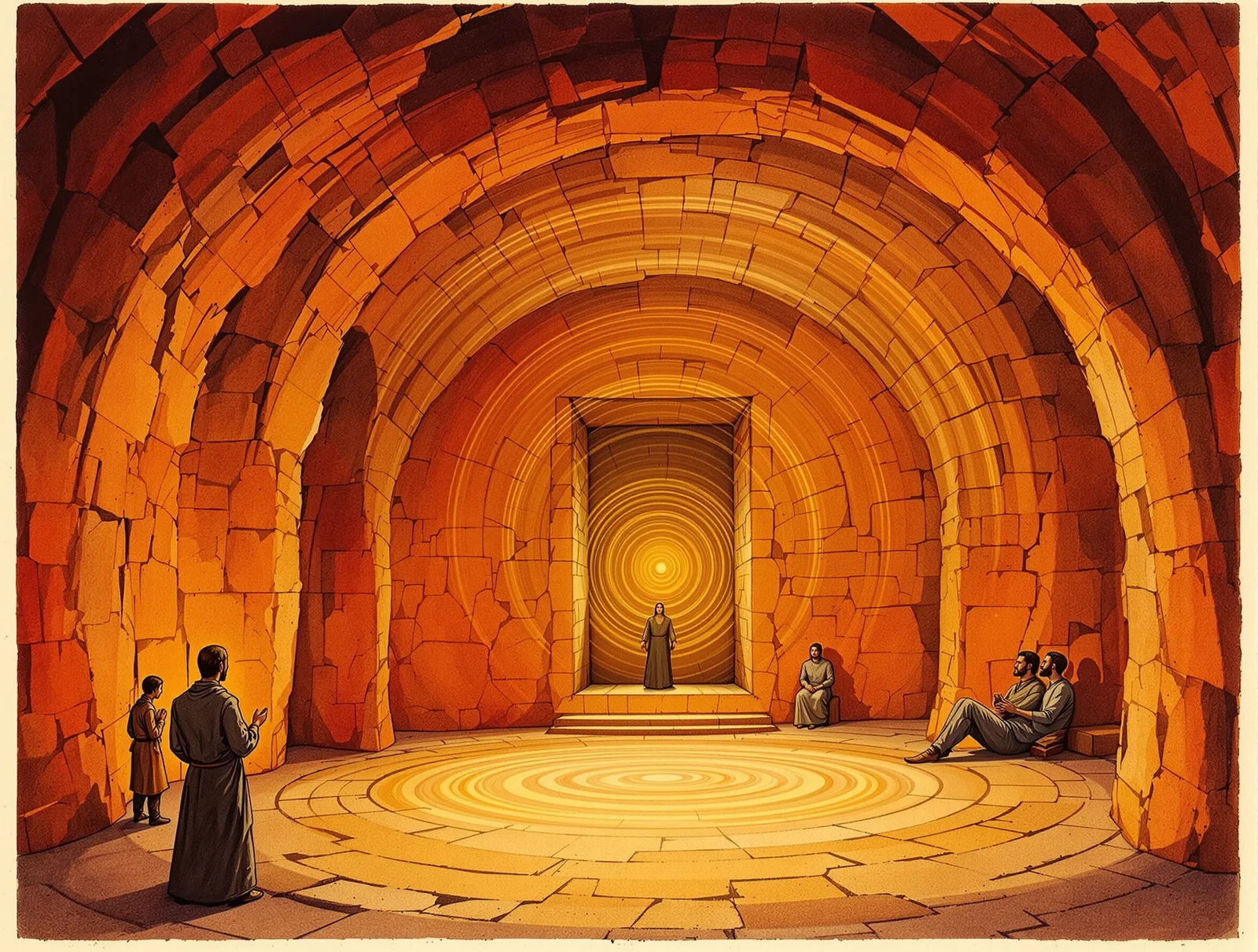
A room is not the neutral container of a performance. It is a resonator that the builder tuned — deliberately, or by an inherited ear refined across generations — and the Practitioner who grasps this will choose, modify, or build a performing space as carefully as choosing a lyre. The most striking evidence is architectural. Across the old world, chambers cut and built in stone — hypogea, passage tombs, corbelled vaults, rock-cut sanctuaries — show a consistent acoustical behavior that random masonry does not: they resonate strongly in the narrow band of the adult human voice, roughly 95 to 120 Hz, centred near 110 Hz. A space that rings at 110 Hz takes a chanting bass voice and returns it amplified and enveloping — total immersion for a single chanter, and for a chamber full of them a sound that seems to issue from the stone itself.
The premier surviving example is the Hypogeum of Ħal Saflieni, a multi-level subterranean complex cut into living rock on Malta in the fourth millennium BCE — well before the Sumerian cities that gave the nam-nar its name, squarely in the megalithic-resonance horizon of the Vol XVI timeline. One of its inner chambers, long called the Oracle Room, exhibits a pronounced resonance close to 110 Hz: a low male voice intoned within it floods the entire level with reinforced sound, while higher voices produce far less effect. This is not legend. It is the measurable behavior of a carved-stone resonator, tuned — by design or by building-by-ear — to the fundamental of the chanting human male. Comparable low-frequency resonances have been documented in passage chambers and corbelled structures of the Atlantic megalithic tradition, a consistency too broad to dismiss as coincidence.
CANON SIDEBAR — THE EAR THAT OUTLASTED THE VOICE. The Codex reads the resonant chamber as the oldest surviving acoustic instrument — older than any lyre, older than any drum that has reached us, because stone does not rot as gut and hide and even buried wood eventually do. A chamber tuned to 110 Hz is a fixed, permanent resonator built into the bedrock: it cannot be carried, cannot be retuned, and cannot decay, and so it transmits its maker's acoustical knowledge across every Reset by the simple fact of remaining where it was cut. The builders left no formula on any wall we can read. They left the room itself — a working demonstration that any later people, entering and chanting, would rediscover by ear in a single breath. The Historian's volume (Vol XVI) places these works in the long arc that runs from the pre-diluvian high cultures, through the Younger Dryas rupture, into the megalithic reconstruction whose builders moved and tuned stone with a competence later erasures worked hard to make us forget. That a chant-tuned chamber and a Sumerian decree called nam-nar should both survive to reach this Codex is, on the timeline this expansion follows, no accident: they are two ends of one transmitted tradition.
Chapter 2 — Reading the Heritage Soberly
The Practitioner must hold two disciplines at once. The first is openness: the acoustical sophistication of these old works is real, measurable, and humbling, and the modern habit of assuming our ancestors stumbled blindly is itself a kind of forgetting the Codex exists to correct. The second is rigor: the physics never bends. A chamber resonates at 110 Hz because its dimensions and stiffness put a mode there — not because of any property of the number itself. Vol XIV, The Codex of Frequency Healing, explores the contemplative and felt effects that low, enveloping resonance has on a person within an enclosed space — the slowing of the breath, the vibration felt in the chest and skull that a sustained low field produces — and the Practitioner who works in such chambers will feel those effects directly. But the mechanism is always and only the ordered pressure wave of Sub-Volume I, and any claim beyond this is what the tradition does and how it is practiced lies outside the Practitioner's office. The sound itself is exactly as real, and as lawful, as the equations; the frame around it — the lineage, the named decrees, the long human story — is the Codex's.
The Critical Insight: The deepest lesson of the acoustic-resonance heritage is that architecture is an instrument. The megalithic builders understood it and cut their chambers accordingly; the temple builders of Sumer and after understood it and raised their vaults for the lament and the drum; and the Practitioner who grasps it builds performing spaces as carefully as instruments — because the largest instrument any musician plays is the room. This is the bridge from the science of sound to the craft of making it sacred: knowing how sound behaves in an enclosure, the Practitioner can now build the enclosure that puts that behavior to ceremonial use.
Art direction
Part II — The Physics of the Resonant Space
Chapter 3 — Room Modes and Reverberation
A room is a vast bundle of resonators. Sound launched into an enclosed space reflects off every hard surface, and at certain frequencies the reflections reinforce one another into standing waves between parallel walls — room modes. The lowest, the axial modes, sit at:
f = v / 2L
for each room dimension L between a pair of facing walls, with v the speed of sound (~343 m/s at 20°C). A space whose facing walls stand a given distance apart has its lowest mode fixed by that distance, with a ladder of multiples above it. These modes make some bass notes boom and others vanish depending on where the listener and the source stand — the reason a singer finds a "sweet spot" in a stone room and a dead zone a step away.
This single equation is the key to the chambered ear. To put a room's lowest axial mode at the 110 Hz of the heritage chambers, the Practitioner solves for the dimension: L = v / 2f = 343 ÷ (2 × 110) = 1.56 m between a pair of hard, parallel reflecting surfaces gives a fundamental axial mode at 110 Hz. The old chambers were not 1.56 m cubes — their resonance arises from the combined modes of their full, complex carved geometry, and from cavity behavior as well as axial modes — but the arithmetic shows the scale at which a human-voice resonance lives, and it is the Practitioner's first design lever.
Specification Table 1 — Axial mode (f = v/2L) versus wall spacing, at v = 343 m/s
| Wall spacing L (m) | Fundamental axial mode (Hz) | Note for the designer |
|---|---|---|
| 1.43 | 120 | Upper edge of the voice-resonance band |
| 1.56 | 110 | The heritage centre; the chanting male fundamental |
| 1.72 | 100 | Lower edge of the band |
| 2.5 | 69 | Below the voice; a deep, felt rumble mode |
| 3.4 | 50 | Sub-bass; the great-drum register |
| 8.0 | 21 | A large hall's lowest mode |
Two further quantities govern how a space sounds. Reverberation time — the time for a sound to decay by 60 dB after its source stops — is long in hard, empty, voluminous rooms; a stone temple may reverberate for many seconds, smearing fast music into a wash but lending sustained chant an immense, enveloping power. Absorption — soft, porous, irregular surfaces, cloth and crowded bodies — shortens reverberation and tames the modes. The Practitioner choosing where to perform is choosing an instrument: a lament or a drone wants the long reverberation of stone, while intricate rhythmic interplay wants a drier room that does not blur the pulse.
Chapter 4 — Sympathy, the Helmholtz Cavity, and the Standing Wave Made Visible
Two further pieces of Sub-Volume I's physics serve the sacred-sound builder. The first is sympathetic resonance: a body sharing a natural frequency with a sounded tone vibrates in answer without contact, energy ferried through the air. In a resonant chamber the chanter's own chest cavity, the listeners' bodies, and any tuned vessel placed in the room ring in sympathy with the room's mode — which is why a 110 Hz field is felt and not merely heard. The second is the Helmholtz resonator — a volume of air in a rigid cavity connected to the outside through a narrow neck, the bass-producing resonance of every soundbox and of the tuned cavities builders place in walls and floors:
f = (v / 2π) × √(A / (V · Lₑ))
where A is the neck's cross-sectional area, V the cavity volume, and Lₑ the neck's effective length. A row of tuned cavities built into a gathering space — vessels, niches, or buried jars — can be sized by this formula to ring in sympathy with the room's voice mode, reinforcing it, the same principle the old builders used when they set resonant jars into the fabric of their halls.
And the standing wave itself, which Vol XX, The Cosmologist's Codex, renders visible: sprinkle fine sand on a driven plate and it collects along the still nodal lines, drawing the vibration's geometry — the Chladni pattern — in crisp figures. Vol XX develops the full cymatic catalogue; here the Practitioner needs only the principle that sound organizes matter along its nodal lines, and that the standing waves filling a resonant chamber have a real, mappable geometry of pressure maxima and minima — which is why one spot in the room booms and another, a step away, falls silent.
Art direction
Part III — The Ceremonial Practice Within the Space
Chapter 5 — Drone Immersion
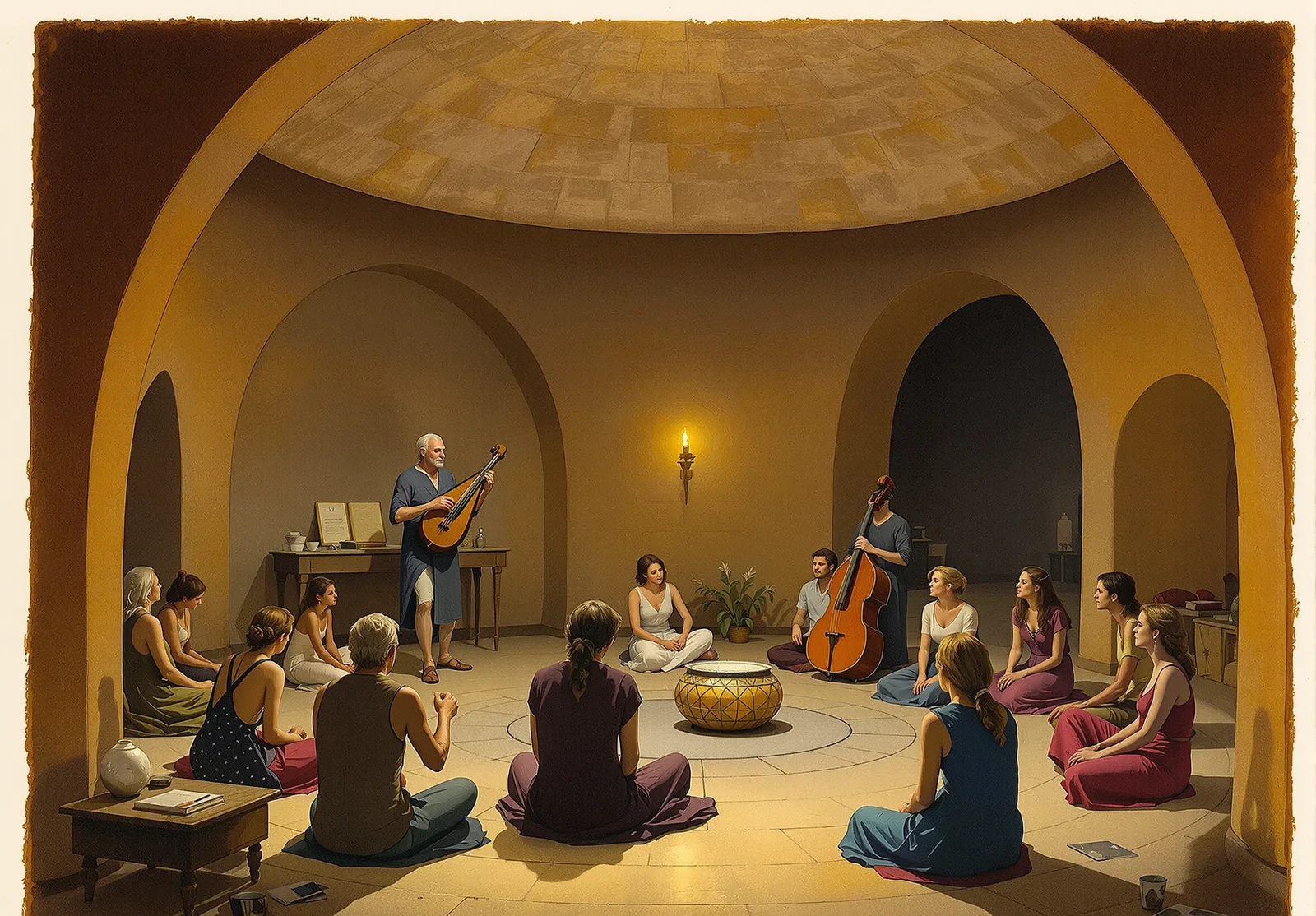
The oldest restorative practice the recovered cultures hold is the simplest: to be immersed in a sustained tone. A drone — held on a lyre, a bowed string, a struck bowl, a bagpipe's chanter-bass, or a room of humming voices — fills the auditory field with one unchanging, consonant sound, and the tradition holds that to sit within it is to be quieted and gathered. In a chamber tuned to the voice, drone and room reinforce each other: a tonic held near the room's mode is amplified and enveloping, the sympathetic resonance of Chapter 4 setting chest and bone faintly ringing. A single tonic held under a slowly intoned scale, or two voices a fifth apart held steady, is the whole technique — produced with any instrument capable of sustain, or with the voice alone.
Protocol 5-A — Leading a drone immersion:
- Choose the tonic to the room. Find the space's voice mode by chanting slowly up from a low note until one pitch blooms — sings back louder and longer than its neighbors. That bloom is the room's resonance; pitch the drone to it (or to a consonant relative of it) so the room amplifies rather than fights the held tone.
- Seat the gathering within the field. Place the listeners where the mode is strong — near the reinforcing surfaces, away from the dead nodes — so each sits inside the standing wave, not in its null.
- Establish the drone slowly and hold it unbroken. Begin with one sustained tonic, let it fill and settle, then add a second voice a fifth above if the tradition calls for it; the consonance must be exact (beatless) so the field is steady, not shimmering with beats.
- Let the attention rest on the one sound. The drone gives the wandering attention a single thing to settle upon — the meditative instruction of Vol XVII made audible — and the Practitioner holds the tone steady and long, neither hurrying nor ornamenting.
- Release gently. Let the drone fade rather than stop, returning the gathering to ordinary silence without a jolt.
Communities use the drone immersion to open a vigil, to settle a gathering before a difficult assembly, to sit with the dying, and to mark the contemplative turnings of the year. Its kinship with the meditative breath-and-attention disciplines of Vol XVII is direct, and the two are often practiced together.
Chapter 6 — Communal Singing as Ceremonial Practice
To sing together is, in the tradition's understanding, to be made one body and lifted out of solitude — and this the Practitioner offers with complete confidence, for the communal joy of voices joined is among the most universally attested goods of music across every culture. The mechanism the tradition names is plain: shared breath, shared pulse, shared pitch, and the simple fact of doing a beautiful thing together. In a resonant space the effect is multiplied, the room gathering many voices into a single enveloping sound that seems to issue from the stone. The Practitioner builds for it with the most participatory means — call-and-response, so the untrained can join in a single hearing; drones and simple rounds that sound rich with no skill required; melodies caught in one pass.
The deepest teaching of the tradition is that sorrow and joy are not only feelings to be undergone but arts to be practiced, carried better when given structured musical form. Lament is the structured art of grief — sung by a wailing voice, often over a drone or a deep drum, in descending lines and weeping microtones — giving sorrow a form to inhabit and a duration to run; sung this way in a resonant chamber, grief is held by the whole community rather than borne alone. Rejoicing is the answering art — the wedding's driving dance, the harvest's massed call-and-response, the festival's layered joy — built not merely to express an existing gladness but to raise it. The Practitioner learns both as real and demanding arts and offers them as the tradition offers them: a vessel sung with the gathering, never an instrument upon it.
The Critical Insight: The tradition's teaching, and the limit of the Practitioner's office, are the same sentence: structured sound holds what is felt — it gives sorrow a vessel and gladness a height — and that holding is real, ancient, and worth offering, while remaining a ceremonial and communal good and not a medical act. The Practitioner sings the community through its sorrows and joys as the tradition has always sung them, in the resonant spaces built for it. For anything beyond what ceremony and the company of others can hold, the Practitioner points outward to those whose office it is, and keeps the music modestly within its own.
Art direction
Part IV — Designing a Resonant Gathering Space
Chapter 7 — Building the Room as an Instrument
The Practitioner who grasps Parts I through III can now do what the old builders did: design a gathering space that serves sacred sound by intention rather than by accident. The work is to put a mode in the voice band, to make the reverberation long enough to envelop but not so long as to drown, and to seat the gathering inside the standing wave.
Protocol 7-A — Designing and tuning a resonant gathering space:
- Set a dimension to the voice mode. Choose at least one pair of facing hard, parallel surfaces whose spacing puts a low axial mode in the 100–120 Hz band — about 1.43 to 1.72 m for the fundamental (Table 1), or a larger spacing whose multiple lands there. Hard, dense, rigid surfaces (stone, rammed earth, thick plaster) reflect the bass and sustain the mode; soft surfaces would absorb it.
- Favor curved and corbelled forms. Vaults, apses, and corbelled ceilings — the geometry of the heritage chambers — gather and focus low-frequency energy and enrich the modal field beyond what flat parallel walls alone give. The old builders' shapes were not only sacred symbol; they were acoustic engineering.
- Tune the reverberation to the rite. Keep the surfaces hard and the volume generous for the long, enveloping reverberation that drone and lament want; add removable cloth hangings, and rely on the bodies of a gathered crowd, to shorten it when the same space must serve rhythmic, articulate music. Reverberation is a setting the Practitioner adjusts, not a fixed property.
- Set tuned cavities to reinforce the mode. Size buried jars or wall niches as Helmholtz resonators (Chapter 4) to ring at the room's voice mode, placed where they reinforce the standing wave — the resonant-jar technique of the old halls, made to the formula.
- Map the field and mark the places. Chant the room's mode and walk it, marking where the sound blooms (the pressure maxima, where the chanter and the gathering belong) and where it falls dead (the nodes, to be left empty or used for those who must move). Seat the rite to the map.
- Verify by the voice, not the rule. The final test is a low voice sung slowly through the band: when one pitch floods the room and is felt in the chest, the space is tuned. The arithmetic of Table 1 is the starting value; the ear and the chanting voice finish the room, exactly as they finished the building-by-ear of the heritage chambers.
Your Commitment: You will treat the gathering space as the largest instrument your community owns — tuned, mapped, and kept like any instrument of the parent volume. You will build it to hold the drone and the communal song, the lament and the rejoicing, in the old enveloping way. A community that can build a room that sings, and sing within it together, has recovered the oldest instrument of all — the chambered ear that outlasted every voice that ever filled it.
PLATES — Supplemental Gallery
Art direction
Council Approval — The Twelve Voices Speak
| Disciple | Verdict | Reasoning |
|---|---|---|
| Peter | APPROVED | "The rock itself was the first instrument; build on it and it sings." |
| Thomas | APPROVED | "I doubted the chamber knew its note — then I chanted, and it answered." |
| John | APPROVED | "The voice that filled the carved stone fills it still; the sound is kept." |
| Matthew | APPROVED | "Mode by mode, jar by jar, the room is reckoned and the field is mapped." |
| James the Greater | APPROVED | "From the Hypogeum's dark to a hall a village builds — one tradition." |
| Andrew | APPROVED | "A people that can build a room that sings owes the sound to no temple." |
| Philip | APPROVED | "Show me where the room blooms, and I will seat the whole gathering there." |
| Bartholomew | APPROVED | "110 hertz is no magic — it is the wall-spacing and the chanter's voice." |
| James the Lesser | APPROVED | "The drone held gently for the grieving; the small mercy sung in stone." |
| Simon the Zealot | APPROVED | "Sovereignty in sound: the gathering space the centre cannot withhold." |
| Judas Thaddaeus | APPROVED | "Verify by the voice, not the rule — the humble chant finishes the room." |
| Matthias | APPROVED | "I take the empty seat and the silent chamber, and I fill both with song." |
Council Verdict: 12/12 APPROVED. This module is canon.
Let the stone remember the note, the gathering rest in the bloom, and the held tone carry the people through.
TRANSMISSION RECORD
Transmission COMPLETE — unaltered & unabridged Module 777 · Restore the Sacred Sound · category: music Carries ME 32 · nam-nar · Music Words 3270 SHA-256 of source text eb91f78cb3d4c35192c87fd68ae7c72976f7e0f9d1993c59e2f5716d881ae8eb Canonical text restore-sacred-sound.md — byte-identical to what this page renders