Module 766 — Train the Ear
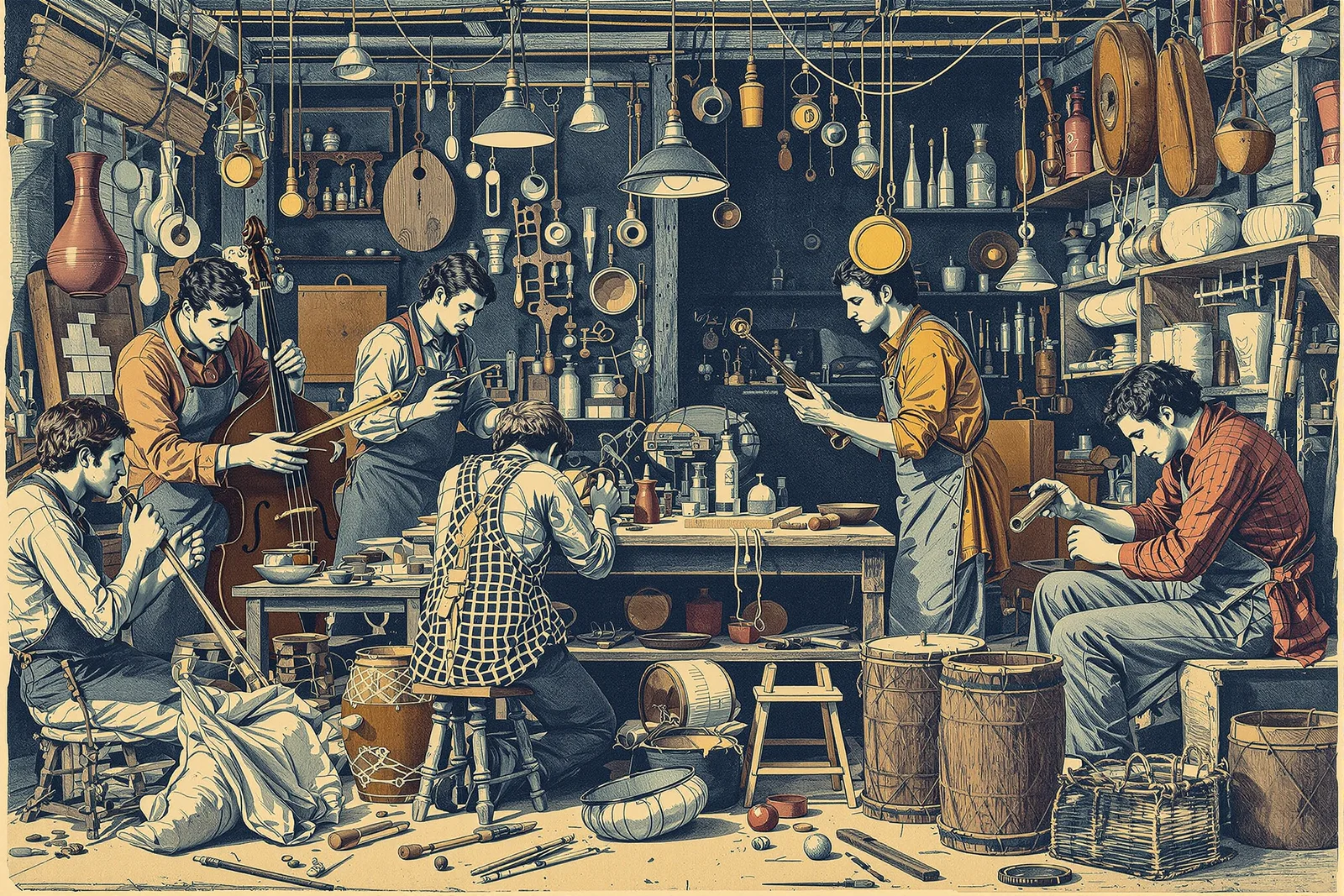
THE ME TABLET · Music Module 766 · nam-nar
Carrying ME 32 · nam-nar · Music. A Sovereignty Module of the Practitioner Community.
Unaltered and unabridged: ~3,240 words.
Preamble
The instruments of Volume XXIII can be built by hands that cannot yet hear. The singing wood is strung, the speaking skin is headed, the reed is cut — and still the village has no music, because no ear in it can tell a true fifth from a sour one. This is the gap the present module closes. To train the ear is to install, inside the Practitioner's own skull, the measuring rod that every other musical art depends upon. Without it, tuning is guesswork, transcription is impossible, and the memory-songs of Module 772 drift a little further out of true with every generation that sings them.
The recovered-arts framing of Volume XVI is nowhere more pointed than here. A flute can be excavated and copied; a trained ear cannot. It must be rebuilt in each person, from silence, by labor — small but daily, like the keeping of a fire. The Practitioner who completes this program will name an interval the moment it sounds, identify a chord by its color, follow a melody and write it down, and hold a remembered pitch steady enough to teach a child. These are not the gifts of the rare "natural"; they are skills, trainable in any nervous system given the right exercises in the right order.
This module assumes you can already make a steady tone — with voice, with a tuned string, or with a fipple flute. It cross-references the parent Volume XXIII for the theory of intervals and the just-ratio system, and it hands forward to Module 765 (Tune by the Beat) for the physical act of tuning, to Module 767 (Find the Voice) for the singing apparatus, and to Module 768 (Sing the Overtone) for the harmonic series made audible. Here we train only the listener.
Part I — The Measuring Rod
Chapter 1 — What an Interval Is
An interval is the distance between two pitches, and that distance is a ratio of frequencies, not a difference. Double a frequency and you have climbed one octave, whether you started at 100 cycles per second or 400; the ear hears the 2:1 relationship, not the gap of 100 or 400 cycles. This is the first and most important fact: the ear is logarithmic — it measures multiplication, and everything that follows rests on this.
Because the ear measures ratios, the simplest ratios sound the most consonant — most "at rest." The octave (2:1) is so consonant the two notes seem almost one. The perfect fifth (3:2) is next most stable, then the perfect fourth (4:3). As the numbers in the ratio grow, the interval grows rougher and more in need of resolution. This ranking from smooth to rough is the raw material the trained ear learns to read.
To compare intervals on one even scale, theory divides the octave into 1200 cents. A cent is a hundredth of an equal-tempered semitone; there are twelve semitones to the octave, hence 1200 cents. Cents are logarithmic, so they add the way the ear hears: a fifth (700 cents) stacked on a fourth (500 cents) equals an octave (1200 cents) exactly. Memorize the following table — it is the ruler.
| Interval | Just ratio | Just cents | 12-tone equal cents | Difference |
|---|---|---|---|---|
| Unison | 1:1 | 0 | 0 | 0 |
| Minor second | 16:15 | 112 | 100 | +12 |
| Major second | 9:8 | 204 | 200 | +4 |
| Minor third | 6:5 | 316 | 300 | +16 |
| Major third | 5:4 | 386 | 400 | −14 |
| Perfect fourth | 4:3 | 498 | 500 | −2 |
| Tritone | 45:32 | 590 | 600 | −10 |
| Perfect fifth | 3:2 | 702 | 700 | +2 |
| Minor sixth | 8:5 | 814 | 800 | +14 |
| Major sixth | 5:3 | 884 | 900 | −16 |
| Minor seventh | 16:9 | 996 | 1000 | −4 |
| Major seventh | 15:8 | 1088 | 1100 | −12 |
| Octave | 2:1 | 1200 | 1200 | 0 |
Read the rightmost column carefully. The just major third is a full fourteen cents flatter than the tempered third; the just major sixth is sixteen cents off. These are not rounding errors — they are audible, and a finely trained ear feels the difference as a faint beating or "buzz" in the tempered version. Volume XXIII calls the just intervals the true intervals because they arise directly from the harmonic series of a vibrating string. The Practitioner trains primarily on these.
The Critical Insight: You are not memorizing twelve sounds. You are memorizing twelve relationships, and a relationship is the same in every key. The major third from a low drone and the major third from a high one are the same interval — same ratio, same feeling, same name. Train the relationship and you can transpose your whole ability up or down at will. Train individual pitches and you have learned almost nothing transferable.
Chapter 2 — Anchors: The Song-Hook Method
The fastest reliable way to fix an interval in memory is to bind it to the opening leap of a song you already know in your body. The hook is a crutch you will later discard, but in the first weeks it is everything. Build your own table from the communal songs of your village so the references never go stale; the principle is what matters.
| Interval | Direction | Where it lives |
|---|---|---|
| Minor second | up | the dread half-step, two adjacent reeds on the flute |
| Major second | up | the first two steps of almost any rising scale |
| Minor third | up | a calling-the-children cry, falling rain |
| Major third | up | a bright bugle opening, the bottom of a major chord |
| Perfect fourth | up | the rising "here-we-go" of a processional |
| Tritone | up | the restless, unfinished leap that demands a next note |
| Perfect fifth | up | the open drone-and-bow of the lyre, the most "hollow" leap |
| Major sixth | up | a wide, yearning reach |
| Octave | up | the same note, higher — the leap that "returns home" |
Sing each hook aloud. The ear learns far faster through the throat than the ear alone, because singing forces the brain to predict the pitch before it arrives — the bridge to Module 767: even a listener who never performs must sing in practice.
Part II — The Graded Daily Drill
Chapter 3 — The Shape of a Session
Ear training fails in long, rare, exhausting sessions and succeeds when done briefly and daily. Twenty focused minutes a day will outpace three hours once a week, because the skill is a habit of attention, and habits are built by repetition across many sleeps, not marathon effort. Sleep consolidates the gains; the spacing is the medicine.
Every session has the same four-part shape, and you spend most of your minutes at the edge of your current ability — the zone where you are right perhaps three times in four. Material you already master is review; material you fail nine times in ten only teaches frustration. Hunt for the edge and stay there.
Protocol 1 — The Daily Session (≈20 minutes).
- Tune (2 min). Sound your reference drone and hum it. Find it in your chest until you can produce it cold, without the drone, within a hair. This single held pitch is the foundation of everything (see Module 765).
- Warm review (3 min). Run the intervals you already own, ascending then descending, naming each before you check it. Keep them sharp.
- Edge work (12 min). Drill the two or three intervals at your current boundary. Hear, guess aloud, then verify. Log nothing fancy — just keep a tally of right and wrong.
- Free listen (3 min). Listen to any music available and name one thing in it: a leap, a chord color, the lowest moving line. Always end on real music.
Chapter 4 — The Graded Ladder
Add intervals in the order below, and do not advance a rung until you score four right in five on the current set across two separate days. Rushing the ladder is the commonest cause of a plateau; the boundaries between stages exist because each new interval is most confusable with the ones just below it.
| Stage | Add these | The skill earned |
|---|---|---|
| 1 | Octave, perfect fifth | the two "hollow" pillars; your frame of reference |
| 2 | Perfect fourth | now you can hear fourth-vs-fifth, the core confusion |
| 3 | Major third, major sixth | the "bright" major colors |
| 4 | Minor third, minor sixth | the "dark" minor colors; major-vs-minor by feel |
| 5 | Major second, minor seventh | the steps and their wide inversions |
| 6 | Minor second, major seventh, tritone | the restless, the rough, the unstable |
| 7 | All of the above, descending | the same intervals falling, a separate skill |
| 8 | Compound (beyond the octave) | tenths, elevenths — for melody work |
Descending intervals are genuinely a separate competence; the brain does not get them free with the ascending ones. Stage 7 is not optional — most melodies fall as often as they rise.
The Critical Insight: When you mistake one interval for another, do not merely note the error — name the confusion pair and drill it directly. Fourth and fifth, major third and fourth, major sixth and minor seventh: each pair has a characteristic muddle. Five minutes spent contrasting only the two that you confuse will undo a month of vague, undirected listening. Train the boundary, not the bulk.
Part III — Beyond the Single Interval
Chapter 5 — Hearing Chords
A chord is three or more pitches sounding together, and the ear identifies it by quality — its overall color — before it ever names the individual notes. Train quality first. The four foundational triads, built by stacking thirds, are the alphabet.
| Triad | Built from the root by | Stacked intervals | The color |
|---|---|---|---|
| Major | major third, then minor third | 5:4 then 6:5 | bright, open, resolved |
| Minor | minor third, then major third | 6:5 then 5:4 | dark, soft, inward |
| Diminished | minor third, then minor third | 6:5 then 6:5 | tense, narrow, anxious |
| Augmented | major third, then major third | 5:4 then 5:4 | strange, suspended, dreamlike |
Drill triads exactly as you drilled intervals: hear, name the color aloud, verify. Major and minor first — that contrast carries most of the emotional weight of music and must become instant. Then add diminished and augmented, which are rarer and more pungent.
Next, learn inversion. The same three notes stacked in a different order keep their name but change their flavor: a major triad with its third in the bass leans forward, with its fifth in the bass it sounds open and rootless. Hear the chord's identity through its inversions, then separately hear which note sits in the bass — two questions, asked one at a time.
Finally, hear chords broken — sounded one note after another, the arpeggio: a stack of intervals presented in time, and a bridge between interval and chord training. Practice naming a triad whether it arrives all at once or note by note.
Chapter 6 — Hearing Scales
A scale is the ordered ladder of pitches a melody draws from, and the ear learns it as a pattern of steps — a sequence of whole-steps (a major second, 9:8) and half-steps (a minor second, 16:15). Learn the patterns, not seven separate notes.
| Mode | Step pattern (W=whole, H=half) | Character |
|---|---|---|
| Major (Ionian) | W W H W W W H | bright, complete, "home" |
| Dorian | W H W W W H W | minor but hopeful |
| Phrygian | H W W W H W W | dark, with a tense low step |
| Lydian | W W W H W W H | floating, the raised fourth |
| Mixolydian | W W H W W H W | major with a soft, lowered seventh |
| Aeolian (natural minor) | W H W W H W W | the plain, grave minor |
| Pentatonic (major) | (gapped: no half-steps) | open, ancient, hard to sing wrong |
Sing each mode up and down against a held drone on its first note. The drone is the teacher: every step reveals its true color only when measured against a steady root — which is why the drone foundations of Module 768 matter for the listener as much as the singer. The pentatonic, having no half-steps, is the gentlest entry and the safest ladder for a beginner's voice; start communal singing there.
Part IV — Transcription: The Pen That Hears
Chapter 7 — Taking Down a Melody
Transcription is the act of hearing music and writing it so another person can sound it again. It is the discipline that fuses every skill in this module, the bridge to the notation literacy of Module 773 and the song-as-memory craft of Module 772, and the means by which a melody is saved from the slow erosion of oral drift.
Work in passes, never trying to catch everything at once; the mind cannot attend to pitch, rhythm, and shape in the same instant, so separate them.
Protocol 2 — The Five-Pass Transcription.
- Pass one — the map. Listen whole, twice, writing nothing. Feel only the large shape: where it rises, where it falls, where it rests, how many phrases. Draw a rough contour line if it helps.
- Pass two — the anchors. Find the tonal home, the pitch the tune leans toward and ends on. Mark the first note and the last note relative to that home. These are your fixed points.
- Pass three — the rhythm. Ignore pitch entirely. Tap and write only the rhythm — long and short, the pulse, the meter. See Module 771 for the pulse itself.
- Pass four — the pitches. Now fill in the notes between your anchors, one phrase at a time, naming each interval as a step or leap from the note before it. This is where your interval training pays its whole debt.
- Pass five — the check. Sing your transcription back against the source. Where they disagree, the source is right; correct and repeat until they merge.
Chapter 8 — From Melody to Harmony
Once single lines come easily, transcribe two things at once: the melody on top and the lowest sounding note underneath, the bass. The bass is the foundation of the harmony and is often slower and easier to track than the melody. With melody and bass written, you can frequently deduce the chords between them, because the bass note plus the melody note narrow the possibilities sharply. This is the doorway to taking down whole pieces — the skill the village ensemble of Module 774 is built upon.
Do not expect speed early; a two-minute song may take a beginner an hour. Within a season of daily passes that same song takes minutes, because the ear has stopped calculating intervals and begun simply recognizing them — the same shift by which a reader stops sounding out letters and just reads. That recognition is the whole aim of this module.
PLATES — Supplemental Gallery
Art direction
Art direction
Art direction
Council Approval — The Twelve Voices Speak
| Disciple | Verdict | Reasoning |
|---|---|---|
| Peter | APPROVED | "The rock of all music is one held pitch, and here it is laid first." |
| Thomas | APPROVED | "It gives the ratios to be checked and the cents to verify them — I am satisfied." |
| John | APPROVED | "Love of the song begins in learning to truly hear it." |
| Matthew | APPROVED | "The ledger of right and wrong tallies is honest bookkeeping for the ear." |
| James the Greater | APPROVED | "A bold ladder, climbed one sure rung at a time. Good." |
| Andrew | APPROVED | "It calls the plain practitioner, not only the rare natural. I bless that." |
| Philip | APPROVED | "Show me the interval and I can now name it — the plate makes it plain." |
| Bartholomew | APPROVED | "No false promise of ease; only daily labor honestly described." |
| James the Lesser | APPROVED | "The smallest daily portion, twenty minutes, is the wise measure." |
| Simon the Zealot | APPROVED | "It roots out the lazy plateau by drilling the very confusion that causes it." |
| Judas Thaddaeus | APPROVED | "For the desperate guesser, hope: the ear can be built from silence." |
| Matthias | APPROVED | "It fills the empty seat between the built instrument and the living song." |
Council Verdict: 12/12 APPROVED. This module is canon.
As the One unfolds into the many and the many resolve again toward the One, so the trained ear hears the ratio hidden in every tone.
TRANSMISSION RECORD
Transmission COMPLETE — unaltered & unabridged Module 766 · Train the Ear · category: music Carries ME 32 · nam-nar · Music Words 3240 SHA-256 of source text e238519908d816d0f63fa9a2e19cfd93d20074bc7504a742a10186201b879f41 Canonical text train-the-ear.md — byte-identical to what this page renders