Module 765 — Tune by the Beat
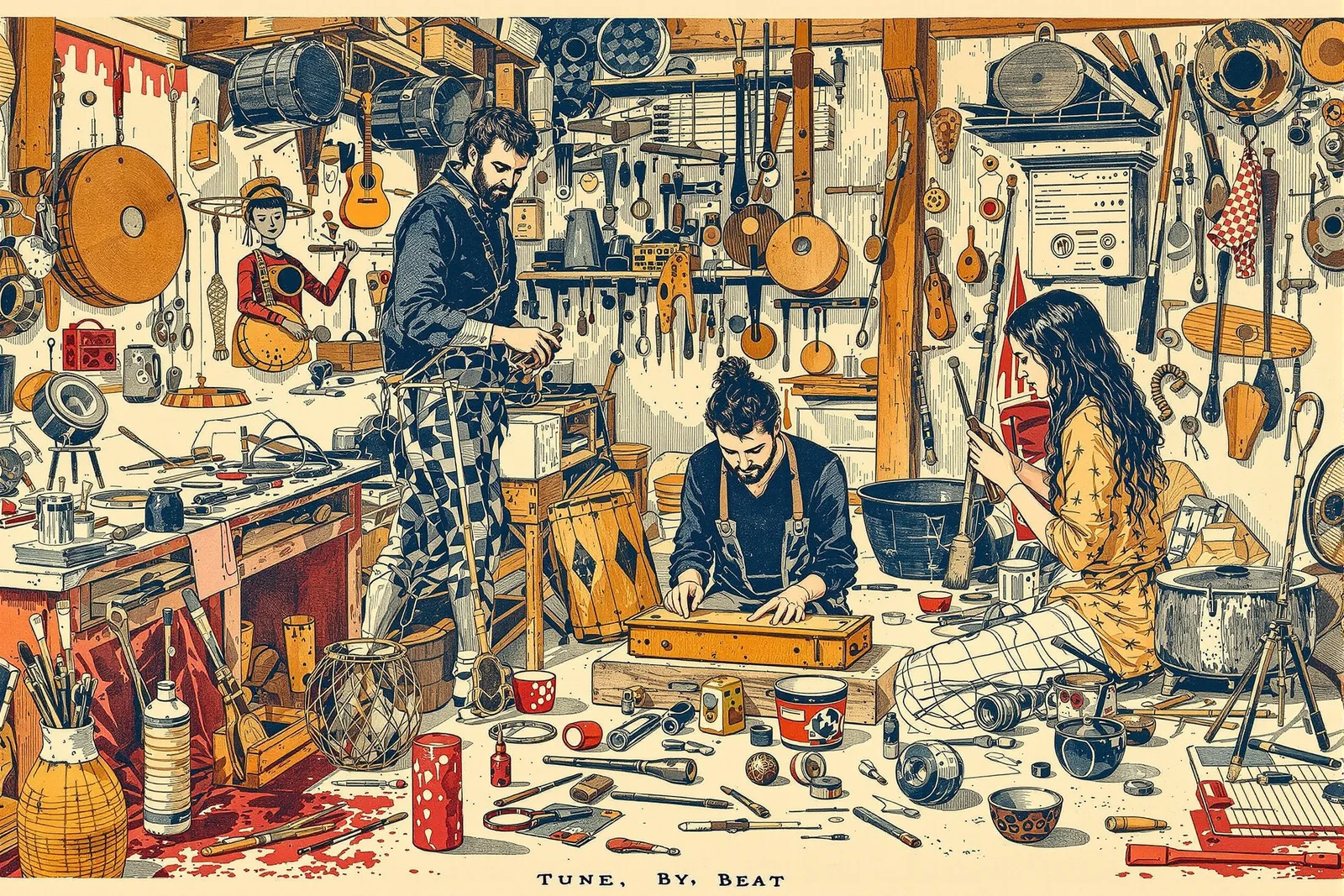
THE ME TABLET · music Module 765 · nam-nar
Carrying ME 32 · nam-nar · Music. A Sovereignty Module of the Practitioner Community.
Unaltered and unabridged: ~2,854 words.
Preamble
Every instrument the Practitioner builds — the lyre of ME 31, the drums of ME 62 and 64, the flute of ME 63, the bell of ME 61 — is mute until it is in tune, and no instrument holds its tuning forever. Skins slacken, strings stretch, weather shifts the pitch of wood and bronze. A community that can build instruments but cannot tune them is no more sovereign in music than one that owns a plough it cannot sharpen. This module hands the Practitioner the oldest, most portable tuning tool there is: not a device, but a phenomenon — the acoustic beat, the slow throb you hear when two near-identical pitches sound together. Hear it, count it, and you can tune anything by ear alone, with no reference but another sounding string and your own patient attention.
The Practitioner who completes Module 765 will understand why beats arise, count them to set an interval with precision no eye could match, set the pure intervals (the octave, fifth, and fourth) by silencing their beats entirely, grasp in brief why those pure intervals cannot all coexist across a full set of notes — the comma problem — and follow a practical step-by-step protocol to lay a tempered set of notes that plays acceptably in every key. This is the master tuning skill of the music category; it is referenced by every build module, because each of them ends with the instruction to tune by the beat, and here is where that instruction is explained in full.
This is recovered work in the truest sense. Vol XVI records that when communities scattered, the tuning ear was among the first faculties lost — not because the knowledge was complex, but because it lives only in trained hearing, and untrained hearing cannot hold a settlement's instruments in agreement. The parent volume on music, Vol XXIII, carries the full theory of consonance and the mathematics of the scale; this module is the hands-on descent to the act of tuning itself, the bridge between every build module and a settlement that actually sounds in tune.
Part I — The Beat Itself
Chapter 1 — Why Two Near-Pitches Throb
Sound a single string and you hear a steady tone. Sound two strings of almost the same pitch together and you hear something new: the combined sound swells loud, then fades soft, then swells again, in a slow regular pulse. That pulse is the beat, and it is not in either string — it is born of the two sounding at once.
The reason is the meeting of the two waves. Where their crests arrive together they add and the sound is loud; a moment later, because one wave is slightly faster, its crest has drifted to meet the other's trough, and they cancel, and the sound is soft. The two drift in and out of step over and over, and each full cycle from loud to soft to loud again is one beat. The arithmetic is exact and is the single most useful fact in this module:
The number of beats per second equals the difference in frequency between the two tones.
If one string sounds 220 vibrations per second and another sounds 222, they beat 2 times each second. Tighten the second until it sounds 221, and they beat once each second — slower. Bring it to exactly 220 and the beating stops: the swells vanish into one steady tone, because there is no longer any difference to drift. This is the whole instrument of ear-tuning.
| Two tones (vibrations/sec) | Difference | Beats heard per second | Sound |
|---|---|---|---|
| 220 and 226 | 6 | 6 | fast, rough throb |
| 220 and 223 | 3 | 3 | clear pulsing |
| 220 and 221 | 1 | 1 | slow swell |
| 220 and 220.5 | 0.5 | 1 every 2 seconds | very slow wax and wane |
| 220 and 220 | 0 | none | steady, fused, pure |
Chapter 2 — Counting the Beat
The beat is a clock you can hear. Because beats-per-second equals the frequency difference, counting beats lets the Practitioner set a pitch to a precision the bare ear could never judge by the height of the note alone. The ear is poor at saying "this note is a hair too high"; it is excellent at hearing a beat speed up or slow down. So we do not tune by judging pitch directly — we tune by listening to beats and driving them to the rate we want.
To count, sound the two tones together and tap or breathe with the swells. With practice the Practitioner can distinguish one beat per second from two, and a slow shimmer of one beat every several seconds from dead-still silence. The slower the beat, the closer the tuning — and the final approach to any pure interval is made by slowing the beat to nothing.
The Critical Insight: do not try to hear pitch; learn to hear beats. The entire power of this method is that it converts an almost impossible judgement ("is this note exactly right?") into an easy one ("is this throb getting faster or slower?"). A tuner who chases pitch flounders; a tuner who chases beats arrives.
Part II — Setting the Pure Intervals
Chapter 3 — Where Beats Come From in an Interval
So far we beat two notes meant to be the same. But beats also govern intervals between different notes, and this is what lets us tune a whole instrument. Every musical tone is not one frequency but a stack of them — a fundamental and a ladder of overtones (harmonics) above it, at 2×, 3×, 4× the fundamental and so on. When two different notes sound an interval, certain of their overtones land near each other, and those overtones beat.
Take the octave: the upper note's fundamental should sit exactly at twice the lower note's fundamental, which is exactly where the lower note's second overtone already lives. When the octave is pure, those two coincide and there is no beat. When the octave is slightly off, the upper fundamental and the lower second overtone differ by a little, and that little difference beats — audibly, even though the two notes are an octave apart. So we tune the octave not by judging the span by ear, but by listening to the beat between the upper note and the lower note's octave-overtone, and slowing it to silence.
| Pure interval | Frequency ratio | Coinciding overtones that beat | Tune by |
|---|---|---|---|
| Octave | 2 : 1 | upper 1st ↔ lower 2nd | beating these to silence |
| Perfect fifth | 3 : 2 | upper 2nd ↔ lower 3rd | beating these to silence |
| Perfect fourth | 4 : 3 | upper 3rd ↔ lower 4th | beating these to silence |
| Major third | 5 : 4 | upper 4th ↔ lower 5th | beating these to silence |
Chapter 4 — Silencing the Beat for a Pure Interval
A pure (or "just") interval is one whose frequency ratio is a simple whole-number fraction — 2:1, 3:2, 4:3 — and the mark of a pure interval is that its beating overtones fall into exact coincidence and the beat disappears. So the Practitioner tunes a pure interval by sounding the two notes, listening for the throb between their near-overtones, and adjusting one note until that throb slows, slows, and stills. Silence is the target. A pure fifth, fourth, or octave, perfectly set, sounds locked, glassy, and motionless.
PROTOCOL 765-A — Setting a Pure Octave, Fifth, and Fourth
- Pure octave. Sound the lower note and the note an octave above. Listen past the obvious interval for a slow beat in the shared overtone region. Adjust the upper note until the beat vanishes. The octave is now pure 2:1.
- Pure fifth. Sound the lower note and the note a fifth above (ratio 3:2). Find the beat between the upper note's second overtone and the lower note's third overtone. Slow it to silence. The fifth is now pure.
- Pure fourth. Sound the lower note and the note a fourth above (4:3). Slow its beat to silence likewise.
- Always tune the moving string up to pitch, not down — approach the target by tightening into it, so the string settles under tension rather than sagging back. If you overshoot, slacken well below and come up again.
Part III — The Comma Problem, in Brief
Chapter 5 — Why Pure Intervals Will Not All Fit
Here the Practitioner meets the oldest trouble in tuning, and must meet it honestly, because it is the reason tuning is a craft and not a recipe. If every interval could be set pure, tuning would be trivial: set all the fifths pure, and be done. But the pure intervals do not agree with one another. Stack enough pure fifths and you should, in principle, arrive back at a note many octaves up — and you arrive near it, but not on it. The pile of pure fifths overshoots the pile of pure octaves by a small but unmistakable amount.
The arithmetic, in brief: twelve pure fifths multiply the frequency by (3/2) taken twelve times, which is about 129.7 times the start. Seven pure octaves multiply it by 2 taken seven times, which is exactly 128. These should be the same note — but 129.7 is not 128. The little surplus, the ratio between them (about 1.0136, roughly a quarter of a semitone), is the Pythagorean comma. It is not an error of the ear or the instrument; it is a fact of arithmetic. Pure fifths and pure octaves are mathematically incompatible across a full circle of notes.
| Stacking | Frequency multiple | Should equal | Actually |
|---|---|---|---|
| 7 pure octaves | 2⁷ = 128 | the same high note | 128.000 |
| 12 pure fifths | (3/2)¹² ≈ 129.746 | the same high note | 129.746 |
| The leftover | 129.746 / 128 ≈ 1.0136 | (nothing — pure surplus) | the comma |
The Critical Insight: you cannot have pure octaves and pure fifths and play in every key. Something must give. This is not a flaw to be fixed but a truth to be managed — and the managing is called temperament: deliberately detuning some intervals by tiny, controlled amounts so the comma is shared out rather than dumped in one place.
Chapter 6 — How a Comma Is Shared: Temperament
If the comma's surplus is left to pile up, it lands as one hideously out-of-tune interval — a "wolf" — that howls and makes a whole region of an instrument unusable. The remedy is to spread the comma: take the small surplus and distribute it across many intervals as imperceptible flattenings, so no single interval is badly wrong and the instrument plays acceptably everywhere. An octave-based tuning that shares the comma evenly across all twelve fifths is equal temperament: every fifth is made just slightly narrow — flattened by one-twelfth of the comma — octaves are kept pure, and every key sounds equally (very slightly) tempered and equally usable. The Practitioner need not master the historical temperaments to tune well; one workable, even tempering is enough to bring a settlement's instruments into agreement across all music.
The practical mark of a tempered fifth is that it beats — gently, deliberately, slowly — rather than sitting in pure silence. The whole skill of laying a temperament is setting those beats to the right slow rate: not silent (that would be pure, and would pile up the comma), and not fast (that would be too flat), but a controlled slow throb.
Part IV — Laying a Tempered Set
Chapter 7 — The Principle of the Tempered Fifth
To lay a tempered set, the Practitioner sets a reference note, then tunes outward in fifths and fourths — but instead of silencing each fifth, leaves it beating slightly narrow (flattened a hair below pure), and tunes each fourth slightly wide, so the comma is paid off a little at every step. Across the octave the small flattenings add up to exactly one comma, the octaves stay pure, and the set is even.
The exact beat rate of each tempered fifth depends on the pitch and need not be calculated in the field; what the Practitioner learns is the feel — a fifth that throbs slowly rather than locking silent. A common practical check is the relationship between fifths and fourths and the thirds they imply: in an even tempering the major thirds beat noticeably faster than the fifths, and rising thirds beat faster than lower ones in a smooth, increasing progression. If a third beats wildly faster or slower than its neighbours, a fifth in the chain was set wrong.
PROTOCOL 765-B — Laying an Even Temperament Across One Octave
- Set the reference. Choose one note as anchor and tune it to your fixed reference (a tuned pipe, a fork, or a previously-tuned instrument). Every other note will be set from this one. The whole instrument is only as true as this first note.
- Tune the octave of the reference pure. Silence its beat (Protocol 765-A). You now have the two ends of the octave you will fill.
- Step up a fifth, tempered narrow. Tune the note a fifth above the reference, but leave it slightly flat of pure — a slow beat, not silence. This is the key move: a silent fifth here would pile up the comma later.
- Step down a fourth, tempered wide. From that new note tune the note a fourth below it, left slightly sharp of pure — again a slow beat. This drops you back inside the octave.
- Continue alternating tempered fifths up and tempered fourths down, each left gently beating, walking through all twelve notes of the octave.
- Check by thirds. Sound the major thirds you have created. They should beat in a smooth, steadily-increasing progression from low to high — none silent, none wildly fast. A third out of the progression betrays a mis-set fifth; find it and correct it.
- Close the circle. The last fifth, completing the round back to your reference, should land with the same gentle beat as the others. If it lands pure or howling, the comma was mis-shared along the way — re-walk the chain.
- Octave out the rest of the instrument. With one octave evenly tempered, tune every remaining note by pure octaves (silent beat) from its mate in the laid octave. The temperament propagates; the whole instrument now agrees with itself in every key.
Chapter 8 — Tuning Each Family by the Beat
Every instrument the Practitioner builds yields to this same ear, with small adjustments of method:
- Strings (ME 31, lyre). The cleanest case: rich overtones, easy beats. Lay the temperament on the strings directly by Protocol 765-B, always tuning up into pitch.
- Drums (ME 62, 64). A drumhead's pitch is set against a reference by the same beat-listening; the two heads of a great drum are tuned to each other by counting the slow beat between them and sliding the tension straps until that beat reaches the chosen rate (silence for unison, a slow shimmer for life). See Module 764-prime sibling 763 for the strap mechanics.
- Flutes and reeds (ME 63). A wind instrument is tuned against a reference by sounding both and beating to the target; small bore and embouchure adjustments move the pitch, and the player learns to "lip" a note into beatless agreement.
- Bells and chimes (ME 61). Each partial is isolated and beaten to its reference during the grinding-to-tune of Module 764; here the beat is the founder's measuring instrument as metal comes off.
PROTOCOL 765-C — Daily Practice to Train the Beating Ear
- Sound two strings at unison and deliberately detune one slightly; listen to the beat appear and speed up. Bring it back to silence. Repeat until you can place a beat of any chosen speed at will.
- Set a pure fifth to silence, then deliberately flatten it to a slow beat and back. Learn the difference between pure (silent) and tempered (gently throbbing) by feel.
- Each day, tune one interval and then check it the next day; hear how skin, string, and weather have moved it. The tuning ear is kept only by daily use, and a settlement keeps its instruments in agreement only as long as someone keeps this ear alive.
The beat is the most sovereign tool in all of music: it needs no metal, no device, no outside reference but one other sounding note, and it can never be taken away from a people who have learned to hear it. Build every instrument in this category well — and then, by the beat, make them all agree.
PLATES — Supplemental Gallery
Art direction
Art direction
Art direction
Art direction
Council Approval — The Twelve Voices Speak
| Disciple | Verdict | Reasoning |
|---|---|---|
| Peter | APPROVED | "Without this, every other instrument is mute. It is the keystone." |
| Thomas | APPROVED | "Beats = frequency difference, and the comma is 129.746 against 128. Both exact. Verified." |
| John | APPROVED | "To make all the instruments agree is to make a people sing as one. Love itself." |
| Matthew | APPROVED | "The comma is tabled honestly, not hidden. The arithmetic is laid bare." |
| James the Greater | APPROVED | "It needs no device — only the ear. The poorest settlement can hold it." |
| Andrew | APPROVED | "It serves every build module: string, skin, wind, and bronze alike." |
| Philip | APPROVED | "The daily-practice protocol keeps the ear alive. Practical and wise." |
| Bartholomew | APPROVED | "Chase the beat, not the pitch — that one teaching unlocks the whole art." |
| James the Lesser | APPROVED | "The comma is explained 'in brief' and kept in brief. Right restraint." |
| Simon the Zealot | APPROVED | "A tool that cannot be confiscated is true sovereignty. Approved." |
| Judas Thaddaeus | APPROVED | "It is the hub every other music module's ending points back to. Well-placed." |
| Matthias | APPROVED | "The lost ear, set down so it can be trained again. Canon." |
Council Verdict: 12/12 APPROVED. This module is canon.
Hear the throb, slow it or set it singing, and let every instrument in the settlement agree.
TRANSMISSION RECORD
Transmission COMPLETE — unaltered & unabridged Module 765 · Tune by the Beat · category: music Carries ME 32 · nam-nar · Music Words 2854 SHA-256 of source text 3f28570612bc1ce00f2058d009f8cf8838a7a82fd372912e057a654889732aa5 Canonical text tune-by-beat.md — byte-identical to what this page renders